


CORE+EP 2025 Annual Report
Investigations of Foodborne Outbreaks and Adverse Events in FDA-Regulated Foods

Report Contents
Introduction
This report includes information on incidents investigated by the United States Food & Drug Administration’s (FDA) Office of Coordinated Outbreak Response, Evaluation, & Emergency Preparedness (CORE+EP) that were linked to FDA-regulated human food in the 2025 calendar year. One of CORE+EP’s missions is to find, stop, and aid in the prevention of foodborne illness outbreaks. These investigations were conducted in partnership with the United States Centers for Disease Control and Prevention (CDC), as well as state and local partners. In addition to handling outbreaks of foodborne illness and, in some cases, series of adverse events, as of October 2024, CORE+EP has increased responsibilities including food defense, traceability, and supply chain management activities. For the purposes of this report, deliverables related to the response of acute outbreak and adverse event incidents will be referred to as “CORE,” while deliverables relating to other duties covered by the Office will be referred to as “CORE+EP.” CORE+EP coordinates with internal partners throughout the Human Foods Program and other FDA offices to perform the work covered by this report.
CORE+EP has a publicly available Investigation Table that is updated weekly with information about foodborne illness outbreaks and certain adverse event investigations that occur across the United States. This tool provides information and transparency around responses to outbreaks, even in their early stages, allowing for early awareness of developing multistate outbreaks of foodborne illnesses. This table is limited to information about incidents managed by CORE+EP and does not include shellfish-related illnesses and outbreaks or incidents related to animal or pet food. The FDA Division of Seafood Safety investigates, tracks, and monitors bivalve molluscan shellfish-related illnesses, fish-related intoxications, and their respective outbreaks. Illnesses or adverse events related to animal/pet food and feed are monitored and investigated by FDA’s Center for Veterinary Medicine (CVM).
Information on outbreaks linked to products regulated by the United States Department of Agriculture Food Safety and Inspection Service (USDA FSIS) can be found on their Foodborne Illness and Disease page. CDC also publishes annual summaries, which include information on both FDA- and USDA-regulated products linked to outbreaks.
Note from the CORE+EP Director
Through organizational changes to the FDA in 2025, CORE+EP teams have continued to safeguard public health by working diligently to continue our efforts to find, stop, and learn from foodborne illness outbreaks.
Throughout 2025, we managed several high-profile investigations, including a historical outbreak of Salmonella infections linked to cucumbers, an outbreak of Listeria monocytogenes infections linked to prepared meals that challenged investigators, and a novel outbreak of infant botulism linked to a specific powdered infant formula brand. In addition to our normal outbreak work, CORE+EP increased transparency around outbreak investigations, by launching Executive Incident Summary (EIS) Abstracts. These post-response deliverables provide a high-level summary of steps taken during each investigation handled by a Response Team and are redacted in a way that complies with disclosure laws. The abstracts highlight the work of federal, state, and local partners, and also complement FDA’s existing tools to share as much information as possible about foodborne illness investigations as soon as we can.
In 2025, CORE+EP also launched two Foodborne Outbreak Overview of Data (FOOD) Reports, which provide information on food-pathogen pairs that have been linked to repeated outbreaks of foodborne illness. FOOD Reports are an ongoing series of reports that include historical epidemiologic data, laboratory analysis, traceback and investigational findings, and post-response prevention activities taken by FDA. These reports provide critical information that may be useful in preventing future foodborne illnesses.
Beyond responding to outbreaks and certain adverse events, the information included in this report highlights just a few of the activities CORE+EP engages in outside of outbreak and adverse event investigations. I’m pleased to share with you some of our many achievements in this 2025 annual report.
Dr. Stic Harris, CORE+EP Director
2025 At A Glance
69 Incidents Evaluated:
Incidents evaluated included potential outbreaks, confirmed outbreaks, and certain adverse events that were analyzed by the CORE Signals and Surveillance (Signals) Team. Not all incidents evaluated by Signals are transferred to one of four CORE Response Teams for follow up.
26 Responses Initiated:
When an outbreak appears to be caused by an FDA-regulated food, information related to the incident is transferred to a Response Team to coordinate FDA’s response efforts.
11 Advisories Issued:
Public health advisories provide consumers with actionable advice to stay safe when an FDA-regulated food is linked to an outbreak.
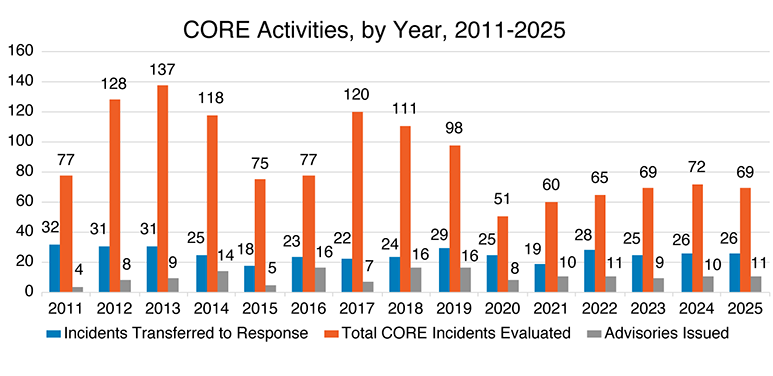
Note: These categories above represent the number of activities that occurred during 2025. The lifespan of a single incident may include activities spanning multiple years.
The Signals Team evaluates emerging outbreaks and disease surveillance trends in collaboration with CDC, USDA FSIS, other FDA offices, and state agencies. The team reviews data from food firms, including past inspections, sampling results, product distribution, and sourcing information. It also considers previous incidents involving similar pathogen and food pairs. This information can provide clues to understand emerging outbreaks. When an outbreak appears to be caused by an FDA-regulated human food, information related to the incident is transferred to a Response Team to coordinate FDA’s response efforts. The coordinated efforts often lead a Response Team to identify a specific ingredient or products that can be linked to illnesses and support preventative public health actions.
Not all evaluations conducted by Signals result in a transfer. For example, outbreaks that are linked to non-FDA regulated products, such as those regulated by USDA, are not transferred to a Response Team but are assigned to the proper regulatory agency for further coordination. Additionally, not all incidents transferred to a Response Team result in an advisory being issued. In most cases, this is because a vehicle is not identified while the outbreak is ongoing or at the end of an outbreak investigation and there is no specific advice for the public.
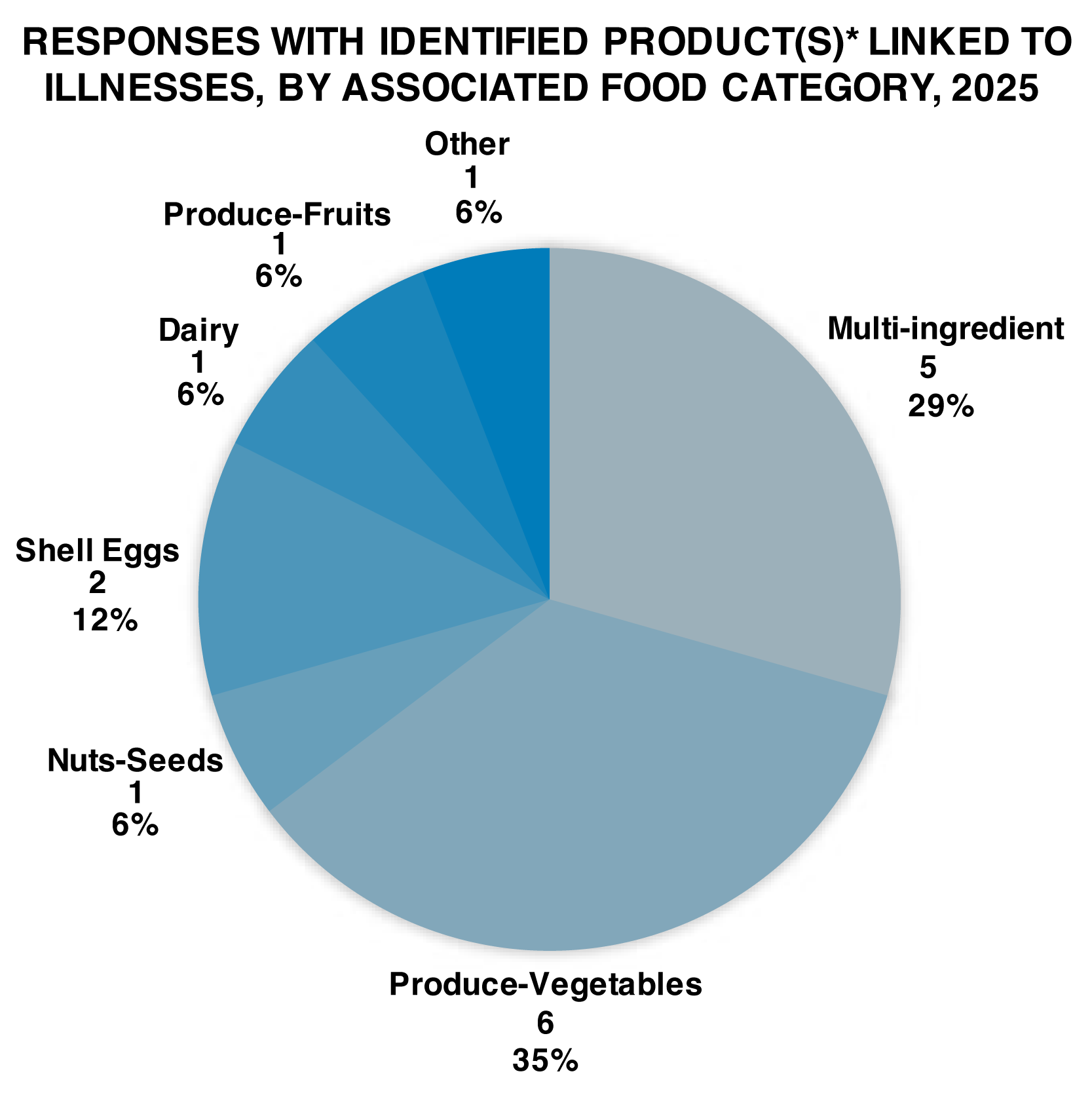
Multi-ingredient: Frozen Shakes (included in 2024 and 2025 Annual Report), Prepared Pasta Meals, Pistachio Cream, Ready-to-Eat Foods, Mini Pastries
Shell Eggs: Eggs (two distinct outbreaks linked to eggs in 2025)
Dairy- Solid/Semi-Solid Dairy Products: Powdered Infant Formula
Produce- Fruits: Mangoes**
Produce- Vegetables: Cucumbers, Frozen Sprouted Beans, Cilantro**, Parsley**, Spring Mix**, Sprouts**,
Other: Moringa Leaf
*Products were categorized using Interagency Food Safety Analytics Collaboration (IFSAC) criteria.
**Responses where a product(s) was linked to illnesses, but no Advisory was issued – this is typically due to a lack of sufficient information about what is causing illnesses during the time of ongoing public health risk. Although an Advisory is not issued in these instances, confirmed vehicles are reported on the CORE Investigation Table.
Public Health Actions
The work conducted by CORE during and following investigations of foodborne illness outbreaks and certain adverse events culminate in actions that can drive the prevention of additional illnesses and future outbreaks. When investigators find the food source of a multistate foodborne illness outbreak, FDA can take public health actions, such as issuing a public health advisory or recommending that companies voluntarily recall products confirmed to be associated with an outbreak, which are powerful steps to protect public health. In some cases, FDA’s Office of Compliance & Enforcement can pursue additional compliance actions to further protect consumers from unsafe food, such as issuance of warning letters, seizure, injunction, and addition of firms to import alerts.
In 2025, FDA issued 11 public health advisories related to multistate outbreaks of foodborne illnesses.
Investigations coordinated by CORE also inform follow-up activities carried out by other offices and divisions of FDA. These include but are not limited to follow-up inspections, continued risk assessments, and the development of prevention strategies.
FDA Actions Related to Outbreaks in 2025*
| Pathogen or Cause of Illness | Product(s) Linked to Illnesses | FDA Advisories | Recalls | Legal and Other Action |
|---|---|---|---|---|
Salmonella Enteritidis | Mini Pastries | Outbreak Advisory | Recall Announcement | Import Alert #99-19 |
| Listeria monocytogenes | Frozen Shakes | Outbreak Advisory | Recall Announcement | |
| Listeria monocytogenes | Ready-to-Eat Foods | Outbreak Advisory | Recall Announcement | Warning Letter |
Salmonella Montevideo | Cucumbers | Outbreak Advisory | Recall Announcement | Warning Letter |
Salmonella Enteritidis | Eggs | Outbreak Advisory | Recall Announcement | |
Salmonella Oranienburg | Pistachio Cream | Outbreak Advisory | Recall Announcement | Import Alert 99-43 |
| Listeria monocytogenes | Prepared Pasta Meals | Outbreak Advisory | Recall Announcement | |
Salmonella Anatum | Deep-brand Frozen Products (Sprouted Beans) | Outbreak Advisory | Import Alert 99-43 | |
Salmonella Enteritidis | Eggs | Outbreak Advisory | Recall Announcement | |
Salmonella Richmond | Moringa Powder | Outbreak Advisory | Recall ( Announcement in Advisory ) | |
| Infant Botulism | Powdered Infant Formula | Outbreak Advisory | Target Corporation Warning Letter The Albertsons Companies Incorporated Warning Letter |
*Note: Some investigations listed in this table may have been initiated in 2024, but an advisory was not issued until 2025. This is not an exhaustive list of all FDA activities related to these incidents and additional activities may be ongoing.
New Trends in 2025
Intentional Adulteration Rule
CORE+EP also plays a central role in policy-related activities and the implementation of the “Final Rule for Mitigation Strategies to Protect Food Against Intentional Adulteration” (IA Rule) which is part of the Food Safety Modernization Act. CORE+EP’s Food Defense Team:
- Provided subject matter expert input on 66 domestic and one foreign comprehensive food defense inspections, and
- Deployed enhancements for a system used by FDA Food Defense Branch investigators so they can more fully leverage this technology during their inspections.
CORE+EP staff across the office helped respond to over 300 Food Traceability Rule Technical Assistance Network inquiries and dozens of IA Rule inquiries.
Both of these policies are heavily contributed to by the expertise and knowledge from CORE+EP staff and are designed to promote safety in the US food supply.
Noteworthy Outbreaks

In April 2025, FDA investigators collected an environmental sample from Bedner Growers, Inc., of Boynton Beach, Florida, as part of a routine follow-up inspection after the FDA and CDC, in collaboration with state and local partners, investigated an outbreak of Salmonella Africana and Salmonella Braenderup in 2024. Analysis of the 2025 environmental sample was positive for Salmonella Montevideo and matched recent clinical samples from ill people, by whole genome sequencing (WGS) analysis. This prompted FDA, along with CDC and state and local partners, to initiate an outbreak investigation and allowed the Agency to get a head start on a response to an outbreak based on compelling laboratory data.
As part of the 2025 outbreak investigation, FDA collected a product sample of Bedner Growers, Inc. cucumbers from a distribution center in Pennsylvania. Salmonella Montevideo was detected in the cucumber sample and based on WGS analysis, it was determined to match the strain of Salmonella causing illnesses in this outbreak as well as the Salmonella found in the environmental sample during the 2025 follow-up farm inspection. Additional analysis of this product sample also found a Salmonella Braenderup strain that matched some illnesses in the 2024 outbreak of Salmonella Africana and Salmonella Braenderup linked to cucumbers grown by Bedner Grower’s, Inc. The 2024 outbreak ultimately ended with 551 illnesses in 34 states and the District of Columbia.
Moreover, laboratory, epidemiological, and traceback data collected during the 2024 investigation determined that cucumbers from Bedner Growers, Inc., and Thomas Produce Company, of Boca Raton, Florida, were the likely sources of illnesses in this 2025 outbreak; however, these growers did not account for all the illnesses in this outbreak. Multiple other strains of Salmonella, unrelated to this outbreak investigation, were found at Bedner Growers, Inc. and Thomas Produce Company during on-farm inspections and these strains matched clinical isolates from illnesses that occurred in 2024 and previous years. In response to the investigation, Fresh Start Produce initiated a recall and Bedner Growers, Inc. received a warning letter based on observations noted during the FDA inspection.
Similar to the 2024 outbreak investigation, FDA also conducted a traceback investigation and identified Bedner Growers, Inc. as the common grower of cucumbers eaten by ill people in this 2025 outbreak. Bedner Growers, Inc. and several downstream companies issued recalls for cucumbers and products containing recalled cucumbers.
This investigation highlights the value of continued sampling and surveillance efforts in the food supply. FDA’s routine follow-up inspection and sample collection at this firm following a previous outbreak enabled critical laboratory evidence to be detected and characterized, leading to an outbreak investigation and a rapid agency response. Ultimately, the 2025 outbreak was significantly smaller than the 2024 outbreak (69 cases in 2025 versus 551 cases in 2024), which could be due, in part, to the early sampling and outbreak response.

In November 2024, CDC notified FDA of a historical outbreak of Listeria monocytogenes that started in 2018 (with 20 cases from 2024 and 2025) being investigated by CDC in collaboration with state and local partners. Most ill people resided in institutional settings such as in long-term care facilities (LTCF) prior to illness onset and several people reported being on a mechanical soft diet. This information, as well as FDA expertise, allowed the agencies to focus on products served at LTCFs that are eaten by people on this type of diet, including foods such as supplemental shakes. Invoice information provided by associated LTCFs, documents and photos obtained during state sampling, and traceback investigation showed that each facility received a frozen supplemental shake of either Lyons ReadyCare or Sysco Imperial brand, both manufactured at Prairie Farms Dairy, Inc. in Fort Wayne, IN.
As part of this investigation, FDA conducted an onsite inspection at the common manufacturer and collected environmental and product samples. Three of the environmental swabs collected from the processing area tested positive for Listeria monocytogenes. Whole genome sequencing analysis determined that the Listeria detected in these samples was closely related to the strain of Listeria that was causing illnesses in this outbreak. In response to this investigation, Lyons Magnus LLC recalled Lyons ReadyCare and Sysco Imperial Frozen Supplemental Shakes.
CDC investigated this outbreak in 2018, 2021, and 2023 before it was ultimately solved in 2025. The outbreak resulted in 42 sick people from 21 states, 41 hospitalizations, and 14 deaths. Epidemiologic data in previous investigations identified that sick people were residents in long-term care facilities and nursing homes and the likely source was a food item served in those types of institutions, but there was not enough information to identify the specific food. New traceback information collected from illnesses occurring in 2024, along with historical illness information, updated epidemiological data, and the laboratory data collected during FDA’s inspection allowed the agencies to solve this outbreak.

On November 7, 2025, FDA and CDC were notified by the Infant Botulism Treatment and Prevention Program (IBTPP) at the California Department of Public Health (CDPH) of a cluster of infant botulism among infants who reportedly consumed the same ByHeart Whole Nutrition Infant Formula product. Among cases with confirmatory testing, eight illnesses were confirmed to be caused by botulinum toxin type A. On November 8, 2025, FDA worked with the firm to initiate a recall and FDA and CDC issued advisories warning consumers not to use certain recalled ByHeart Whole Nutrition Infant Formula products. In response to investigational updates, ByHeart expanded its recall on November 11, 2025, to include all ByHeart infant formula nationwide, including cans and single-serve packets. On December 12, 2025, FDA sent Warning Letters to major retailers including Walmart, Target, Kroger, and Albertsons for continuing to sell recalled infant formula weeks after the nationwide recall had been announced.
With product actions and public communications already underway, FDA and CDC, in collaboration with CDPH IBTPP, and other state and local partners, continued their investigation to understand the cause of the outbreak.
As part of this investigation, FDA inspected ByHeart’s manufacturing facilities and collected samples of finished powdered infant formula and ingredients. These inspections led to the identification of Clostridium botulinum in a powdered milk ingredient as well as finished product. The inspections at the ByHeart facilities did not identify any additional factors that could explain the cause of this outbreak. State partners also collected closed and open product samples from parents of infants included in the outbreak.
FDA also conducted an inspection at Dairy Farmers of America (the processor for Organic West Milk, which was a supplier to ByHeart). FDA and ByHeart sampled dairy ingredients from Dairy Farmers of America. Two samples from one lot of organic whole milk powder were shown by whole genome sequencing (WGS) analysis to match a clinical sample and a closed powdered infant formula sample.
On February 26, 2026, CDC declared the outbreak over and FDA transitioned from its initial response activities and provided WGS results. WGS analysis identified 17 different strains of Clostridium botulinum in samples from patients, finished formula, and ingredients. While these sample results added to the available evidence needed to investigate the root cause of this outbreak, due to the complexities of Clostridium botulinum and limited scientific evidence currently available, FDA has not yet determined the root cause(s). This is the first known infant botulism outbreak in the U.S. tied to infant formula. As a result, FDA has engaged with international experts and standard-setting bodies in support of conducting a risk assessment on Clostridium botulinum in infant formula, which will consider all available data and help determine next steps.
FDA has transitioned to post-incident response activities, which may include additional surveillance, as well as prevention and compliance activities. Additionally, FDA’s investigation into the root cause is ongoing with the focus on ingredients and future updates will be reported on FDA’s Post-Outbreak Response Activities: Clostridium botulinum Illnesses Associated with Consumption of Powdered Infant Formula.
GRAPHIC HERE

During routine sample collection in March 2025, USDA-FSIS identified Listeria monocytogenes in a sample of chicken fettuccine alfredo meals. During the same time, CDC identified a cluster of listeriosis illnesses that matched the strain from the FSIS sample by whole genome sequencing analysis. Interview information from sick people identified prepared meals purchased at grocery stores as the leading item of interest. This raised concerns because the product lot codes associated with the positive sample had not been distributed and did not enter the food supply. So how were people continuing to become ill?
Since the chicken fettuccine alfredo meal included both FSIS- and FDA-regulated ingredients, it became a dual jurisdiction investigation where both FDA and FSIS collaborated with CDC to solve the outbreak.
FDA used specific meal information reported by ill people and firm records to trace FDA-regulated ingredients through the supply chain to the establishments where those were produced. FDA also conducted multiple inspections and collected multiple samples throughout the supply chain. Ultimately, FDA’s investigation narrowed in on pasta made and distributed directly to food service customers by Nate’s Fine Food, LLC.
In response to this investigation, several recalls were initiated by multiple companies. This action removed potentially dangerous products from the market.
This outbreak investigation, while uncommonly lengthy, showcases the complex effort it often takes to gather all the necessary information while collaborating with multiple federal agencies, state and local partners, and industry to keep the public safe and prevent additional illnesses.
CORE+EP Publications
One way CORE+EP guides and supports outbreak prevention efforts is through sharing CORE+EP’s outbreak investigations and analytic summaries with internal and external stakeholders through publications and presentations. CORE+EP publishes articles on FDA.gov, in peer-reviewed scientific journals, and in other food safety and public health related periodicals. CORE+EP staff also present at conferences and scientific meetings. In 2019, the Outbreak Analytics Team was created to support this mission and has since successfully published an increased number of articles since inception, compared to previous years.
For details on publications, see CORE+EP Publications.
CORE+EP Resources
The CORE Investigation Table is updated weekly with information about foodborne illness outbreak and certain adverse event investigations that occur across the United States. This tool provides information and transparency around outbreak investigations, even in their early stages, which allows for early awareness of developing multistate outbreaks of foodborne illnesses. This table is limited to incidents managed by FDA’s CORE and does not include shellfish-related illnesses and outbreaks or incidents related to animal or pet food. The FDA Division of Seafood Safety investigates, tracks, and monitors bivalve molluscan shellfish-related illnesses, fish-related intoxications, and their respective outbreaks. Illnesses or adverse events related to animal/pet food and feed are monitored and investigated by FDA’s Center for Veterinary Medicine (CVM). Information on outbreaks linked to products regulated by USDA FSIS can be found on their Foodborne Illness and Disease page. CDC also publishes annual summaries, which include information on both FDA- and USDA-regulated products linked to outbreaks.
Investigations of Foodborne Illness Outbreaks
Public Health Advisories from Investigations of Foodborne Illness Outbreaks
Acknowledgments
CORE+EP’s work to find, stop, and aid in the prevention of foodborne illness outbreaks would not be possible without all our partners across the U.S. and internationally. Our Office would like to extend our greatest appreciation for the continued collaborations with local, state, tribal, and territorial health and agriculture departments; the Centers for Disease Control and Prevention; the U.S. Department of Agriculture; and internal partners at FDA.