


Holiday Wishlist or Watchlist? Know What is Naughty or Nice with FDA Import Operations
By Christian B. Martinez, Communications Advisor, Office of External Affairs
Consider the following scenario.
A woman wishes to surprise her teenage daughter with something special for the holidays—a luxury skincare and makeup kit she'd seen beauty influencers raving about on social media. This hypothetical Korean beauty brand promised to deliver a smooth, radiant complexion and costs half the price of similar products sold in U.S. stores when ordered directly from the overseas manufacturer. She placed the order in early December, anticipating its arrival just in time for Christmas.
Fortunately, the package never made it to her doorstep. Instead, it was detained at a port facility after FDA import Investigators discovered the "luxury" skincare products contained hydroquinone, a regulated skincare ingredient that requires a prescription in the United States, along with unlisted mercury compounds in the foundation. What appeared to be a coveted beauty regimen was in fact a collection of products with the potential to cause skin discoloration, kidney damage, and neurological problems with continued use.
Several states away, a man named James thought he'd found the perfect gift for his fitness-enthusiast brother—an expensive "performance enhancement" supplement stack from a European company advertising "pharmaceutical-grade" ingredients. The $200 package promised dramatic muscle gains and energy boosts, with testimonials that seemed too good to be true.
And they were. FDA import Investigators flagged the shipment when they discovered the supplements contained undeclared anabolic steroids and stimulants banned in the United States. What James intended as a thoughtful fitness gift was actually a collection of adulterated products that could cause serious cardiovascular and liver complications.
As illustrated in these scenarios, the Office of Import Operations (OIO) works tirelessly to ensure the safety and protection of U.S. consumers, and this edict holds especially true during the holiday season. Whether it is for Christmas, Black Friday, or any number of end-of-year sales and denominational holidays occurring around the world, OIO works behind the scenes to screen the inevitable shipping and shopping surge.
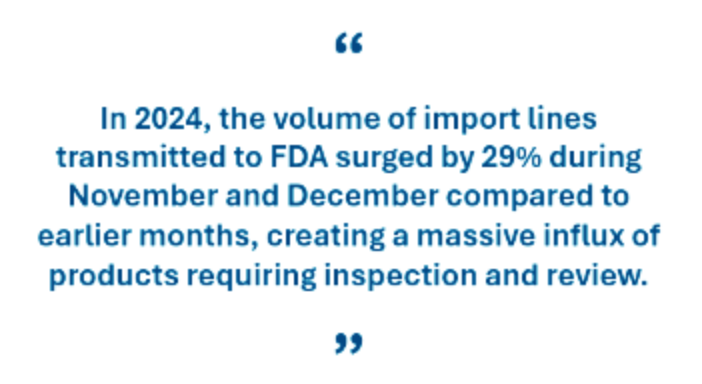
To illustrate the scope of the potential surge, consider the following facts. In 2024, the volume of import lines transmitted to FDA surged by 29% during November and December compared to earlier months, creating a massive influx of products requiring inspection and review. Food imports alone generated an additional 625,000 lines each month during the peak holiday period, while cosmetics added another 550,000 lines monthly. Nearly three-quarters of these food and cosmetic imports originated from just four countries—China, Japan, Mexico, and Canada—creating concentrated streams of products that FDA's Import Operations staff must efficiently process while maintaining rigorous safety standards. This dramatic seasonal spike transforms routine import oversight into an intensive, high-volume operation where Investigators must quickly identify potentially dangerous products hidden among millions of legitimate holiday purchases.
The range of pertinent products is staggeringly diverse as well. On any given day, import Investigators might encounter unapproved pharmaceuticals, misbranded drugs lacking proper firm registration or English labeling, medical devices missing critical premarket approvals, or tobacco products without required authorization. Food and dietary supplements present their own challenges—products may lack mandatory nutrition labeling, contain unsafe additives, or fail to meet English labeling requirements. Even routine consumer items demand vigilance: cosmetics like lipstick and eyelash extensions can harbor dangerous chemicals, while common food imports including bakery products, snacks, candy, fresh fruit, coffee, and chocolate may contain contaminants or undeclared allergens that pose serious health risks.
For Nazmul Hassan, U.S. Public Health Service Captain and Deputy Office Director for Import Operations and Enforcement, it is all too easy for the public to underestimate the level of scrutiny required for these overseas products and the underlying risks they might pose.
“Let’s say you have a batch of seasonal cookies, whether they are reindeer-shaped, or gingerbread or any festive design,” says Hassan. “If it has a red gumdrop nose or maybe some red buttons, that ‘red’ food coloring might not be an approved ‘red’ here in the United States. Some dyes that are common use in other countries can be associated with health risks and contaminants, so we do have a very high standard when it comes to FDA-regulated products.”
One thing Hassan finds both amusing and alarming when it comes to foods is some of the tactics used by vendors to avoid scrutiny. A label might say “no color additives” on a pastry that might be the most colorfully and festively designed product you have ever seen.
“So, investigators of course will immediately collect that sample and send it to our laboratory for analysis,” said Hassan. “There is a very high probability it will contain a color additive that is not approved.” After all, if someone claims their colorful food product has no color additives, the next natural question that comes to mind is: how did they get the color then?
In addition to food and cosmetics, the public may be surprised to learn that the FDA also regulates toys that match certain regulated criteria. A laser pointer, or perhaps an action figure that uses lasers, for example, has FDA requirements for what strength the laser should be. So, if a consumer were to buy a toy from an overseas manufacturer, they could inadvertently be introducing something much more powerful and dangerous to their children and pets, leading to potential accidents and blindness.
So how do these products proliferate from Americans’ online shopping carts onto U.S. shores? The symbiotic relationship between social media and online marketplaces seems to play a significant role. Social media sites such as TikTok and Instagram may feature influencers advertising cosmetics, supplements, and consumables for which they may earn a commission. Those links can lead to foreign online marketplaces that may not be familiar with U.S. FDA regulatory requirements, unlike established domestic importers and retailers that typically maintain ongoing compliance relationships with our agency. For example, when you order products online, especially from international sellers, those packages often arrive with missing, inaccurate, or incomplete documentation, which requires FDA staff to request additional information and/or conduct physical examinations before the products can be cleared, which can delay delivery.
“Traditional commercial importers typically possess comprehensive understanding of FDA requirements and regulatory procedures,” said Kimberly Salley, a management program analyst with Import Operations and Enforcement, “whereas individual consignees receiving online purchases often don’t realize that their products are FDA-regulated or that specific regulatory requirements apply to their shipment.”
The best advice for keeping yourself and your family safe during this holiday season?
Make sure to do your research:
- Purchase from established retailers with clear contact information, physical addresses, and customer service capabilities.
- Consider ordering directly from manufacturers when available, as this may provide better access to warranties or product guarantees despite the potentially higher costs.
- Be cautious of sellers offering products at significantly below-market prices, as this can indicate counterfeit or fraudulent products.
- While many legitimate international companies sell safely in this country, be cautious of sellers who don't provide clear information about their compliance with U.S. FDA regulations. Check for proper labeling, ingredient lists, and manufacturer information.
- Take time to research unfamiliar brands or sellers, especially for health-related products like dietary supplements, skincare items, or medical devices. Increased package volumes during the holidays can slow FDA review processes, so order early if you need products by specific dates.
- Be skeptical of products promising miraculous results, instant cures, or claims that seem too good to be true, and be wary of products with only brief, generic, and positive reviews.

Finally, to truly ensure that you, your family, and your friends have a safe and festive holiday season this year, be sure to take advantage of FDA’s official tools and resources. You can Search the FDA’s Import Alert database to see if specific firms or products are currently listed on Import Alert. Import Alerts are used to protect consumers against products with a history of known violations. You can also visit Import Program | FDA for comprehensive guidance on the import process, tips for importing FDA-regulated products, FDA import actions and enforcements, and contact information for additional assistance.