


Ventilator Correction: Philips Issues Correction for Trilogy Evo Platform Ventilators
The recommendations provided below have changed and the reasons for recall below have been clarified. This recall involves correcting devices and does not involve removing them from where they are used or sold. The FDA has identified this recall as the most serious type. This device may cause serious injury or death if you continue to use it without correction.
Affected Product
The FDA is aware that Philips has issued a letter to affected customers recommending all Trilogy ventilators be corrected prior to continued use. Affected devices:
| Device Name | Model Number | UDI-DI |
|---|---|---|
| Trilogy Evo | DS2110X11B | 00606959051942 |
| Trilogy EV300 | DS2200X11B | 00606959052017 |
| Trilogy Evo O2 | DS2100X11B | 00606959051997 |
| Trilogy Evo Universal | DS2000X11B | 00606959052000 |
What to Do
Update all Trilogy Evo Platform ventilators with software version 1.05.15.00. Review the latest User Manual Addendum.
Philips issued a letter on March 2 to provide recommendations for affected customers. On April 24, Philips issued a follow-up letter to provided updated guidance regarding nebulizer use. Philips recommends affected users take the following actions:
- Update all Trilogy Evo Platform ventilators with software version 1.05.15.00. The software is available as free download through the My Philips for Professionals (MyP4P) and InCenter websites.
- Review the latest version of the User Manual Addendum. Ensure a copy of all product literature, including the User Manual Addendum, is included with every Trilogy Evo Platform ventilator in your fleet.
- Non-pneumatic nebulizers can be used as long as they are placed in accordance with the guidance and instructions on the proper location for a nebulizer on the various types of patient circuits.
- WARNING: Ventilator accuracy can be adversely affected by changes to the inspired gas caused by the use of both pneumatic and non-pneumatic nebulizers.
- For customers who have updated 1.05.15.00 release, the User Interface only refers to pneumatic nebulizers – these instructions also apply to non-pneumatic nebulizers.
- Communicate this notice to anyone in your organization who interacts with a Trilogy Evo Platform ventilator, including clinicians, therapists, nurses, caregivers, and patients. Ensure they are aware of the changes regarding the use of nebulizers with these ventilators and that non-pneumatic nebulizers may be used.
- If a Trilogy Evo Platform ventilator previously in your possession has been transferred, ensure this information is communicated to them, including the User Manual Addendum.
Reason for Recall
Philips has identified three issues affecting Trilogy Evo Platform ventilators:
Hazards and harms associated with nebulizer use (pneumatic or non-pneumatic)
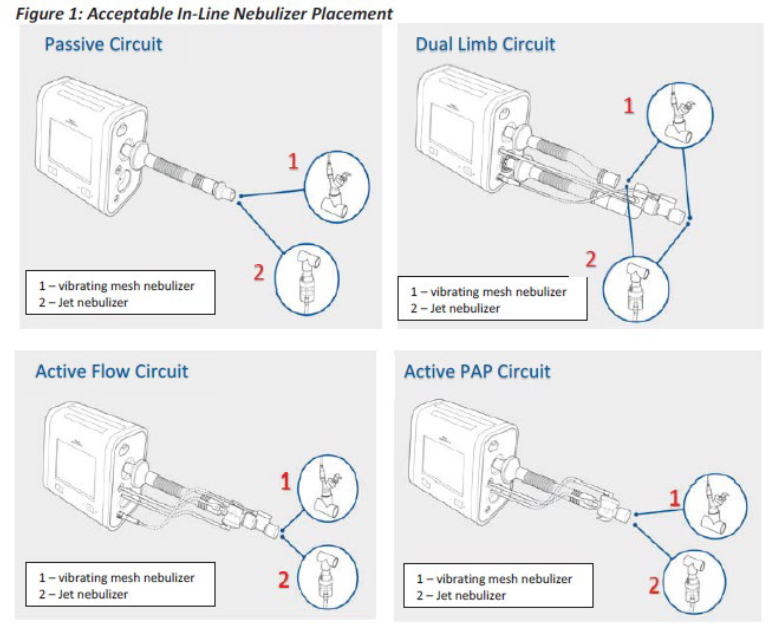
Exercise caution when using a nebulizer (pneumatic or non-pneumatic) with the Trilogy Evo, Trilogy Evo O2, Trilogy Evo Universal and Trilogy EV300. Nebulizers may impact ventilator performance depending on the type of nebulizer, circuit configuration and therapy mode.
When a nebulizer (pneumatic or non-pneumatic) is used inline with a passive circuit during AC-VC, SIMV or AVAPS modes, clinicians should be aware of possible discrepancies in tidal volume delivery and monitoring. In adult active PAP and adult dual limb circuits, non-pneumatic nebulizers have not demonstrated impact on ventilator performance or displayed parameters based on available testing. In contrast, pneumatic nebulizers may affect ventilator performance across all circuit types.
During nebulization, volume delivery accuracy in AC-VC, SIMV, or AVAPS modes may be impacted by gas added by pneumatic nebulizers and, in certain configurations, changes in gas properties associated with non-pneumatic nebulizers. As a result, patient volume and flow monitoring displayed on the device may not reflect actual patient values and triggering sensitivity may be affected. In addition, aerosolized particles may impact circuit components including external flow sensor (EFS) (active flow and dual limb circuits) and passive exhalation valve (single limb circuits), mask or mask elbow. These discrepancies in delivery and monitoring can lead to potential harms such as hypoventilation, patient discomfort, and delayed clinical response. Any reduction in ventilator accuracy is expected to resolve once treatment is complete.
Nebulizer Use and Flow Sensor Impact
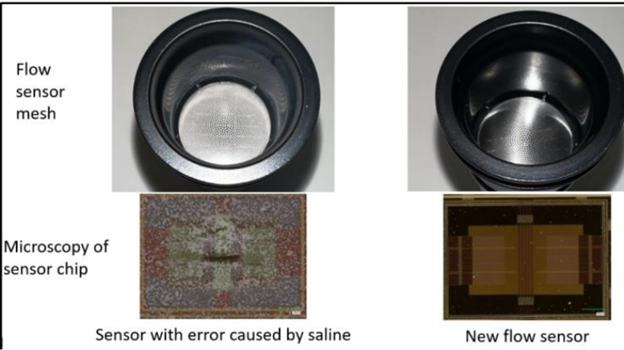
Depending on where a nebulizer is placed on the patient circuit, aerosol can enter the ventilator and accumulate on the internal flow sensor. Over time, this buildup may interfere with the sensor’s ability to accurately measure airflow, leading to incorrect flow calculations and potentially impacting the therapy delivered to the patient. In these cases, the internal flow sensors should be replaced.
Aerosol deposits that accumulate on the flow sensor may cause over-delivery of tidal volume, under-delivery of FiO2, and in some cases a Ventilatory Inoperative condition. Potential harms in this situation may include over inflation of the lung, low oxygen saturation, hypoventilation, delay/absence of therapy, and respiratory discomfort.
Obstruction Alarm Timing
In some situations, the Obstruction Alarm does not trigger within the timeframe dictated by the relevant standards – two breath cycles or five seconds. In certain ventilation modes, with or without backup rates, the alarm could be delayed by up to four breaths.
As of March 6, Philips has reported three serious injuries and no deaths associated with these issues.
Device Use
Philips Respironics Trilogy Evo, Evo O2, EV300, and Evo Universal ventilators provide continuous positive airway pressure (CPAP) and intermittent positive airway pressure breathing support for people who need mechanical ventilation. They are intended for pediatric through adult patients weighing at least 2.5 kg and are used in hospitals and health care settings and for patient nonemergency transport. The Trilogy EV300 and Trilogy Evo may also be used by people requiring mechanical ventilation in their homes.
Contact Information
DME and Homecare Customers in the U.S. with adverse reactions, quality problems, or questions about this recall should contact Philips at 1-800-345-6443, press option 2 for repair and then option 1. Hospital customers in the U.S. with adverse reactions, quality problems, or questions about this recall should contact Philips at 1 (800) 722-9377, press option 2.
Additional FDA Resources
- FDA Enforcement Report - Event 98537
- CDRH Medical Device Recall Database - Event 98537
- FDA Enforcement Report - Event 98540
- CDRH Medical Device Recall Database - Event 98540
Unique Device Identifier (UDI)
The unique device identifier (UDI) helps identify individual medical devices sold in the United States from distribution to use. The UDI allows for more accurate reporting, reviewing, and analyzing of adverse event reports so that devices can be identified more quickly, and as a result, problems potentially resolved more quickly.
- How do I recognize a UDI on a label?
- AccessGUDID database - Identify Your Medical Device
- Benefits of a UDI System
How do I report a problem?
Health care professionals and consumers may report adverse reactions or quality problems they experienced using these devices to MedWatch: The FDA Safety Information and Adverse Event Reporting Program.
Timeline of Communication Updates
| Date | Action |
|---|---|
| 05/28/2026 | The FDA updated this communication to inform the public of updated recommendations from the firm. |
| 04/15/2026 | The FDA issued a Recall Summary to notify the public of this high-risk device issue. |