


Vet-LIRN Cooperative Agreements
Currently Funded Opportunities
Vet-LIRN Network Infrastructure Grant Program (U18)
Infrastructure funding is key to making sure that the network can function and that laboratories can work to support Vet-LIRN’s mission. These awards facilitate participation in Vet-LIRN activities such as consumer complaint response, emergency exercises, proficiency exercises, and laboratory accreditation. The agreements also increase the agency’s capability to analyze an increased number of samples in the event of animal food- or drug-related illnesses or other large-scale emergency events that require increased testing of implicated diagnostic or animal food samples. Cooperative agreements allow network laboratories to request additional funds if they are participating in a specific Vet-LIRN project, such as Antimicrobial Resistance (AMR) monitoring efforts or if they are conducting whole-genome sequencing (WGS) work, or if their caseload is particularly heavy.
Vet-LIRN Network Capacity-Building Projects (U18)
The cooperative agreement is intended to support projects or equipment grants to help investigate potential issues with animal foods, as well as support work related to antimicrobial resistance and antimicrobial stewardship. Vet-LIRN laboratories may apply for funding for research related to emerging public food safety issues identified by Vet-LIRN and for equipment and personnel necessary to expand laboratory capability and capacity. This work may include the development and validation of new methods or work to support efforts related to antimicrobial resistance or antimicrobial stewardship. Laboratories that are working to develop and validate new methods may include blinded method tests (BMTs).
Blinded Method Tests
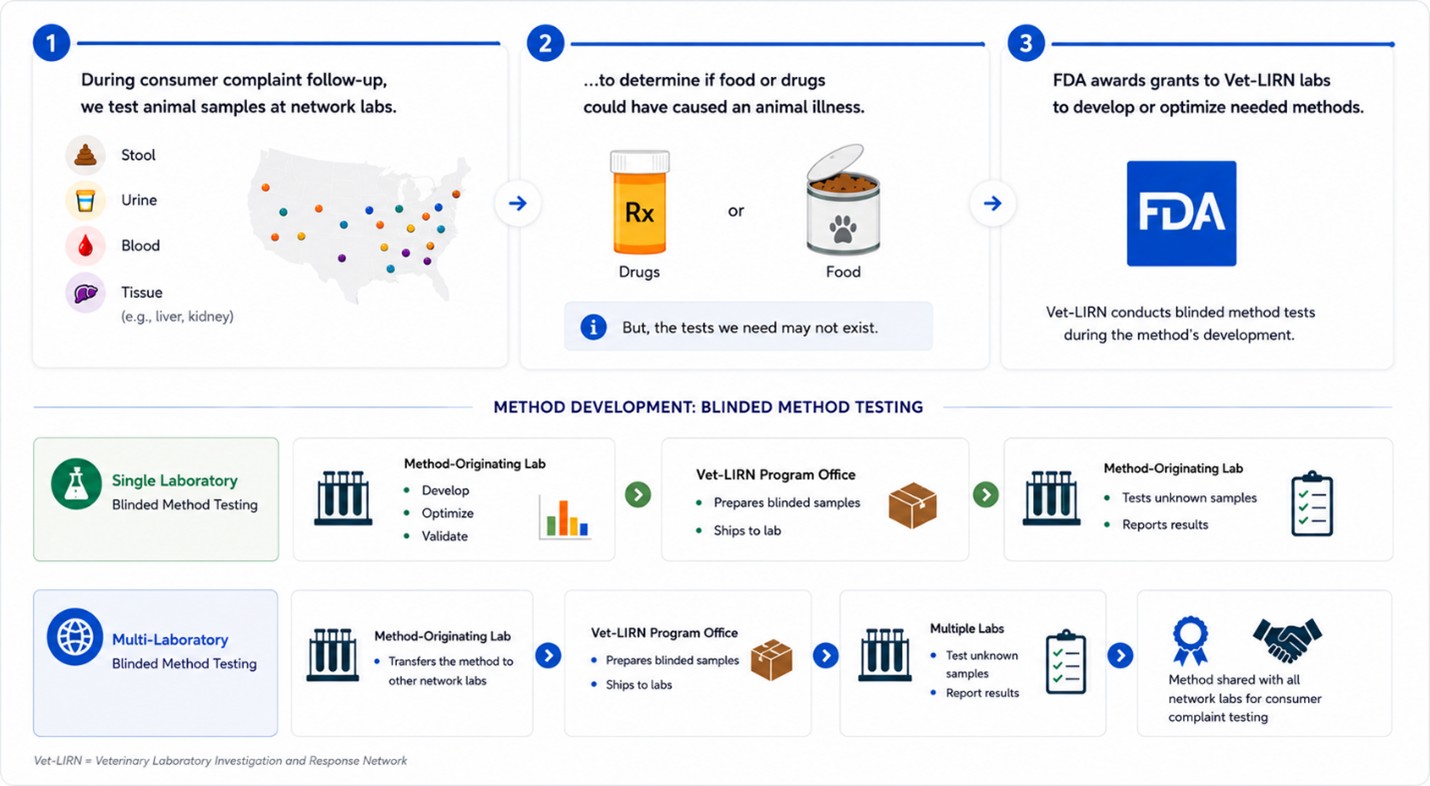
Testing animal diagnostic specimens enables Vet-LIRN to fully address consumer complaints about animal food or drugs. The Capacity Building grants and associated Blinded Method Tests ensure that the testing methods used in network laboratories are well evaluated and provide reliable data. Although Vet-LIRN methods are not regulatory methods, the FDA Method Validation Guidelines are generally followed during the method development and evaluation. Most of the projects have the following phases (see Figure 1):
- Grant recipient laboratory develops a new method and validates it through in-house experiments using non-blinded samples.
- Vet-LIRN evaluates the method performance in the method originating (MO) laboratory through exercises called Blinded Method Tests (BMTs). Vet-LIRN prepares and ships test samples (both with and without the analyte) to the MO laboratory for blinded (i.e., unbiased) analysis. The MO laboratory analyzes blinded samples and submits results to organizers for evaluation of performance.
- MO laboratory shares the newly developed method with other laboratories and assists them in setting it up.
- Vet-LIRN evaluates the method performance in multiple collaborating laboratories by conducting a multi- laboratory Blinded Method Test.
The methods developed by our Vet-LIRN laboratories are extensively evaluated and may be:
- shared with others via the data depository portal (www.protocols.io), published in a scientific journal, and
- adopted and used by Vet-LIRN laboratories for their routine animal diagnostic purposes and CVM consumer complaints.
Some newly developed methods are further evaluated through proficiency tests by comparing their performance to performance of other similar methods.
Figure 1. What are the steps during a Blinded Method Test?
Highlighted methods with BMTs 2024-2026 include:
- Kansas State University – Quantification of 23 cannabinoids in bovine milk using UPLC-MS/MS. Cannabinoids are deposited to and secreted through milk. Quantification of cannabinoids in bovine milk is important for: (i) human and animal food safety, and (ii) animal diagnostics – to rule in/out the exposure to hemp. Two single-laboratory BMTs were conducted using incurred milk (Round-1) and fortified milk (Round-2) confirming reliability of the method.
- Michigan State University – Quantification of vitamins A, D, and E in bovine liver. Vitamin deficiency and toxicity (e.g. vitamins A and D) in cattle is common and the liver is a suitable diagnostic tissue to assess this. The newly developed method targeting both deficiency and toxicity levels of vitamins was evaluated in a single-laboratory BMT.
- University of Missouri – Quantification of 11 cannabinoids in dry industrial hemp using UPLC-DAD. This matrix is relevant as a potential animal food.