2023 FDA Science Forum
Validation of a Mathematical Model of Heart Rate Response to Fluid Perturbation
- Authors:
- Center:
-
Contributing OfficeCenter for Devices and Radiological Health
Abstract
Background:
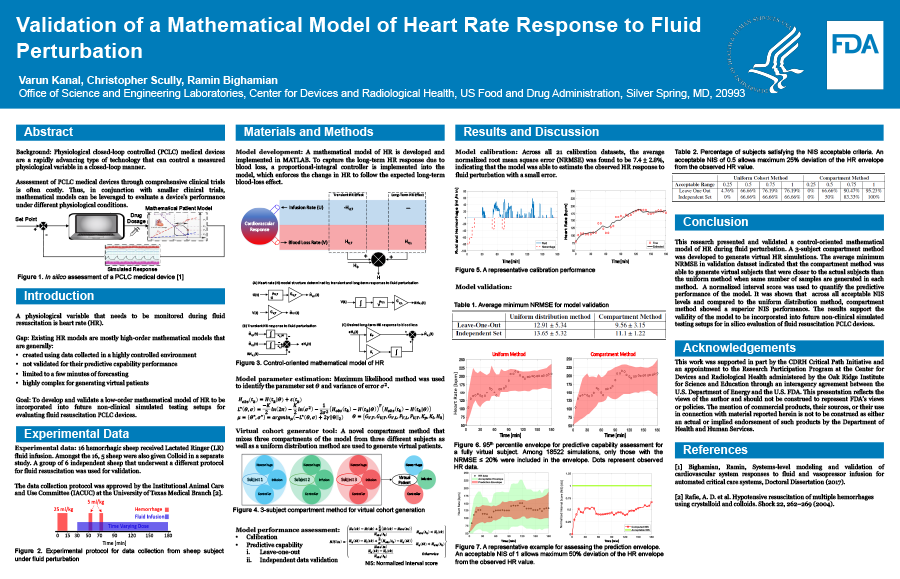
Physiological closed-loop controlled (PCLC) medical devices are a rapidly advancing type of technology that can control the state of patients by using physiological feedback in a closed-loop manner. PCLC devices do not involve constant human adjustment of parameters, and thus, assessing the performance of this type of device is essential. Validated mathematical models can create virtual patient cohorts to study the performance of PCLC devices for fluid resuscitation under different simulated physiological conditions. This research validates our previously developed mathematical model of heart rate (HR) response to fluid perturbation by evaluating its predictive capability performance.
Methods:
The model was evaluated in terms of model predictive capability performance via a leave-one-out procedure (21 sheep subjects) and an independent dataset (6 sheep subjects). The data collection protocols were approved by the Institutional Animal Care and Use Committee (IACUC) at the University of Texas Medical Branch. A novel compartment-based virtual cohort generation tool was used in each analysis.
Result:
Analysis performed using the leave-one-out approach showed that, out of 16000 simulated subjects, the model was able to generate at least one simulated subject that was close to the real subject within an error margin of 9.6+/-3.2% normalized root mean square error (NRMSE). Furthermore, analysis on the independent data collected using a different experimental protocol revealed that, out of 18522 simulated subjects, the model was able to generate at least one simulated subject within an error margin of 11.1+/-1.2% NRMSE for each real subject. The generated envelope of simulated subjects showed that 95% of the testing datasets presented simulated HR patterns that were close to the real data and within a deviation of 50% from the observed data.
Conclusion:
We evaluated our previously developed mathematical model of HR in terms of its predictive capability performance. It was shown that the model is able to replicate the normal- and worst-case conditions within the testing dataset. The results show that the model can be incorporated into our existing hemodynamic models to create a virtual cohort of patients for testing PCLC devices for hemorrhagic applications.