2023 FDA Science Forum
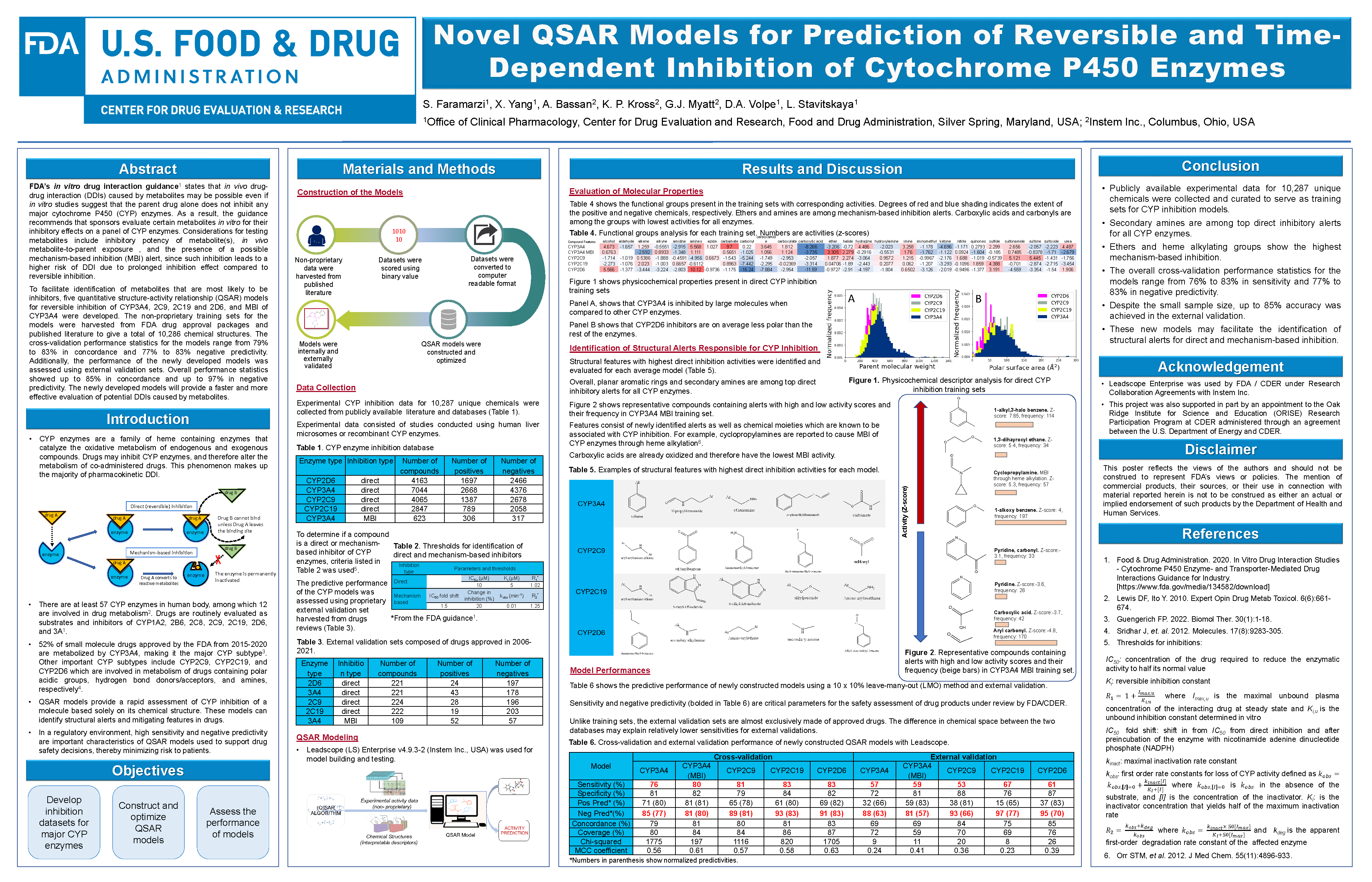
Novel QSAR models for prediction of reversible and time-dependent inhibition of cytochrome P450 enzymes
- Authors:
- Center:
-
Contributing OfficeCenter for Drug Evaluation and Research
Abstract
The FDA’s in vitro drug-drug interaction (DDI) guidance [https://www.fda.gov/media/134582/download] states that in vivo DDIs caused by metabolites may be possible even if in vitro studies suggest that the parent drug alone will not inhibit any major cytochrome P450 enzymes (CYPs). Furthermore, the guidance recommends that sponsors evaluate metabolites in vitro for their inhibitory effects on a panel of CYPs. Specifically, an in vitro CYPs inhibition study is recommended if the metabolite is less polar than the parent drug and the area under the plasma concentration-time curve (AUC) of a metabolite is ≥ 25% of AUC of the parent, or if the metabolite is more polar than the parent drug and the AUC of metabolite is ≥ AUC of the parent drug. In addition, a lower cut-off value for the metabolite-to-parent AUC ratio may also be considered if a metabolite contains a structural alert for potential mechanism-based inhibition (MBI) of CYPs, since such inhibition carries a higher risk of causing DDI due to their prolonged inhibition effect. To facilitate identification of structural alerts, an extensive literature search was performed, in a recent study, and alerts for MBI of CYPs were collected. Furthermore, in the present study, five quantitative structure-activity relationship (QSAR) models were developed to predict not only time-dependent inhibition of CYP 3A4, an enzyme that metabolizes approximately 50% of all marketed drugs, but also reversible inhibition of 3A4, 2C9, 2C19 and 2D6. The non-proprietary training database for the QSAR models was harvested from FDA drug approval packages and published literature from sources such as Binding Database, Google Scholar, PubMed, and the US Patent database, to give a total of 10,286 chemical structures. The cross-validation performance statistics for the new CYP models range from 76.2% to 83.5% in sensitivity and 80.8% to 92.8% negative predictivity. Additionally, the performance of the newly developed models was assessed using external validation sets. Overall performance statistics showed up to 97.3% in sensitivity and up to 67% in negative predictivity. The newly developed models will provide a faster and more effective evaluation of potential drug-drug interaction caused by metabolites.