2021 FDA Science Forum
Method Optimization for the Analysis of Food, Dietary Supplements and Cosmetics by LA-ICP-MS
- Authors:
- Center:
-
Contributing OfficeCenter for Food Safety and Applied Nutrition
Abstract
Monitoring nutritional and toxic elements present in food and cosmetics is part of the Food and Drug Administration’s mission to protect and promote public health. The analysis of food, cosmetics, and dietary supplement products typically involves acid decomposition followed by Inductively Coupled Plasma – Mass Spectrometry analysis.
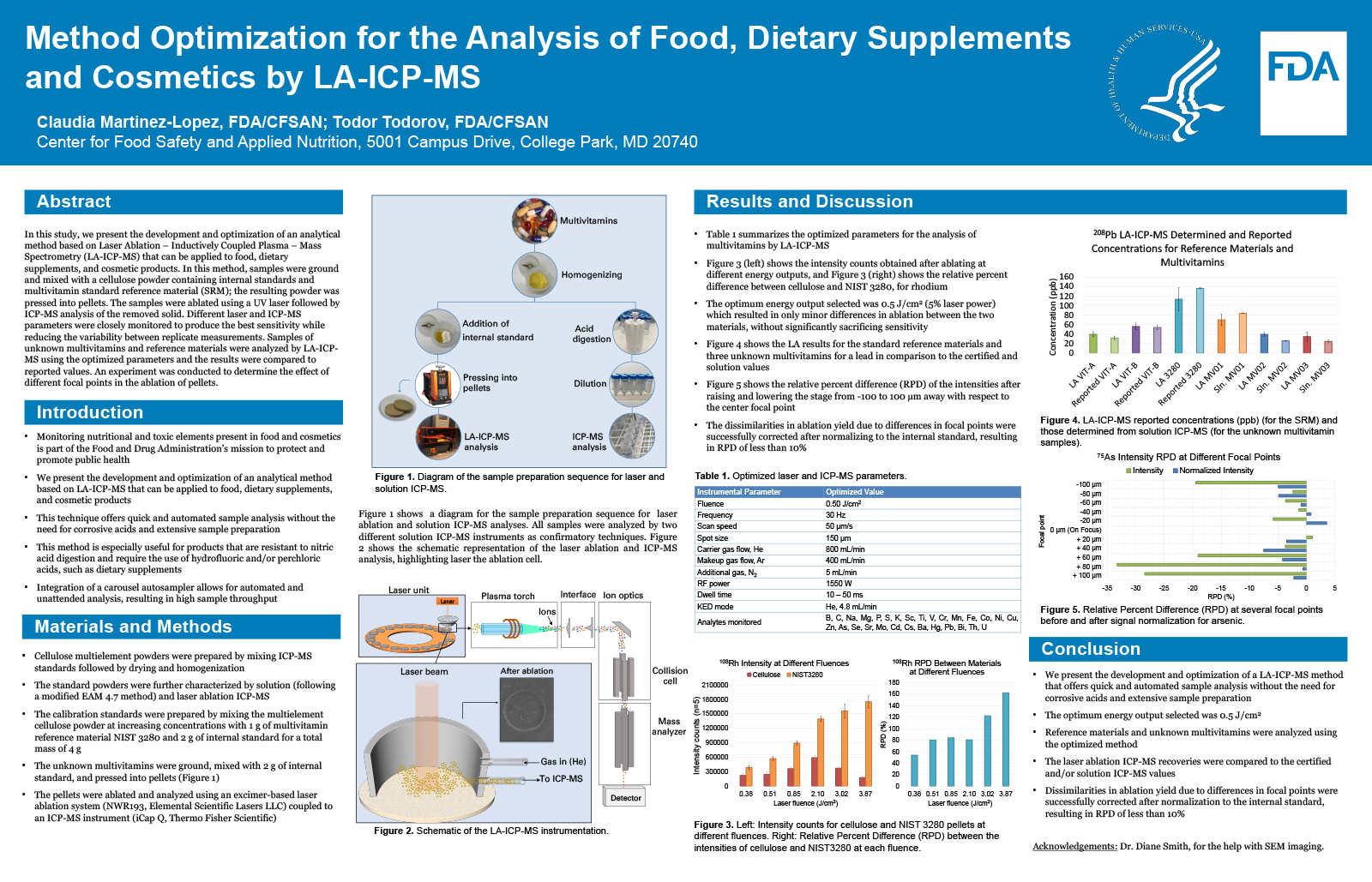
In this study, we present the development and optimization of an analytical method based on Laser Ablation – Inductively Coupled Plasma – Mass Spectrometry (LA-ICP-MS) that can be applied to food, dietary supplements, and cosmetic products. This technique offers quick and automated sample analysis without the need for corrosive acids and extensive sample preparation. This method is especially useful for products that are resistant to nitric acid digestion and require the use of hydrofluoric and/or perchloric acids.
In this method, samples were ground and mixed with a cellulose powder containing internal standard elements; the resulting powder was pressed into 13 mm by 1 mm pellets. The samples were ablated using a UV laser followed by ICP-MS analysis of the removed solid. Integration of a carousel autosampler allows for automated and unattended analysis, resulting in high sample throughput. Several calibration strategies were compared (i.e., external calibration, standard addition calibration and matrix matched calibration) using increasing concentrations of cellulose powder fortified with multiple elements of interest. Different laser and ICP-MS parameters were closely monitored to produce the best signal while reducing the variability between replicate measurements (%RSD). The optimized parameters consisted of 30% energy (2.30 J/cm2), a scan speed of 50 um/s, a repetition rate of 30 Hz, a 150 um spot size, 800 mL/min of carrier gas (He), 450 mL/min of makeup Ar gas and 5 ml/min of N2 gas. In addition to the instrumental parameters, different preparation procedures were evaluated to optimize sample homogenization. An experiment was also conducted to determine the effect of the differences in focal points between pellets of different thickness.