2023 FDA Science Forum
High-Resolution Ion Mobility Mass Spectrometry for Oligonucleotide Impurity Analysis
- Authors:
- Center:
-
Contributing OfficeCenter for Drug Evaluation and Research
Abstract
Background:
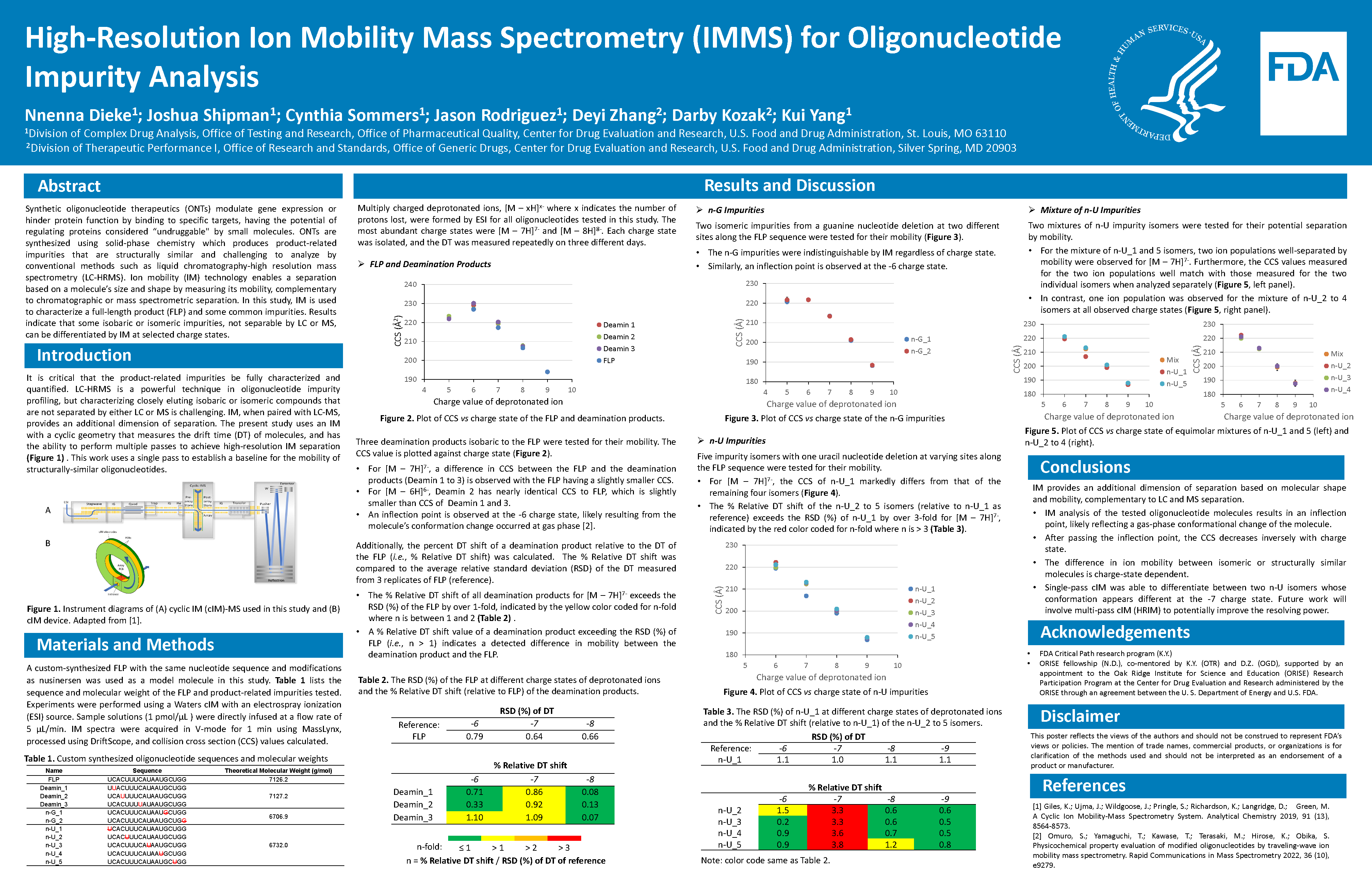
Synthetic oligonucleotide therapeutics (ONTs) modulate gene expression or hinder protein function by binding to specific targets, having the potential of regulating proteins considered “undruggable" by small molecules. ONTs are synthesized using solid-phase chemistry which produces product-related impurities that are structurally similar and challenging to analyze by conventional methods such as liquid-chromatography mass spectrometry (LC-MS). Ion mobility (IM), when paired with MS, provides an additional dimension based on a molecule’s size and shape by measuring its mobility and calculating the collision cross section (CCS).
Purpose:
This study aims to investigate the IM spectrometry (IMS) coupled with collision-induced dissociation (CID) before and after IM, to differentiate challenging impurities, particularly LC or MS-inseparable isomeric or isobaric molecules.
Methodology:
Experiments were performed using a Waters Cyclic IMS. Sample solutions were directly infused into the mass spectrometer. IM spectra were acquired in V-mode for 1 min.
Results:
Preliminary data was obtained using single-pass IM for the full-length product (FLP) and three impurities:
two deletion impurities (n-U and n-G) and one deamination impurity. The deprotonated ion at charge state -8, [M – 8H]-8, was predominate. Different drift times were observed for the FLP and deamination impurity (18.8 ms) vs deletion impurities (18.0 and 17.8 ms). Different drift times were also obtained from different charges states ([M – xH]-x, where x = -7, -8, -9, and -10), ranging from 16.0 to 20.1 ms for FLP. A similar drift time was observed for the deprotonated ions vs sodium adducts. Moreover, identical tandem mass spectra from CID pre- and post-IM for the FLP were observed, with the former providing additional mobility information on the fragment ions. Future studies will utilize multi-pass IM for higher resolution to measure drift times and perform drift time to CCS conversion for the FLP and multiple impurities including modifications at different sites on the full-length sequence.
Conclusion:
IM provides an additional dimension of separation based on molecular shape and mobility, complementary to LC and MS separation. High-resolution IM such as cIMS promotes separation of challenging molecules that are highly structurally similar, thus facilitating in-depth impurity profiling for quality and safety control of complex ONT drugs.