2023 FDA Science Forum
Development of Home Preparation Instructions for Amoxicillin, Doxycycline, and Clindamycin for Pediatric Patients During a Public Health Emergency
- Authors:
- Center:
-
Contributing OfficeCenter for Drug Evaluation and Research
Abstract
BACKGROUND:
Stockpiles of amoxicillin, doxycycline, and clindamycin, which are essential antibiotics to treat bacterial infections, are primarily of solid oral formulations. Instructions may need to be provided on home preparation and administration procedures to dose pediatric patients using available stockpiles of oral dosage forms during a public health emergency.
PURPOSE:
Mixing capsule contents with foods is one of the most common home preparation procedures. The objective of this inter-agency collaboration between CDC and FDA is to understand the impact of the exposure of capsule contents to select soft or liquid foods on uniformity, recovery and stability of the antibiotics under study conditions for assessing the dosing accuracy of the antibiotics.
METHODS:
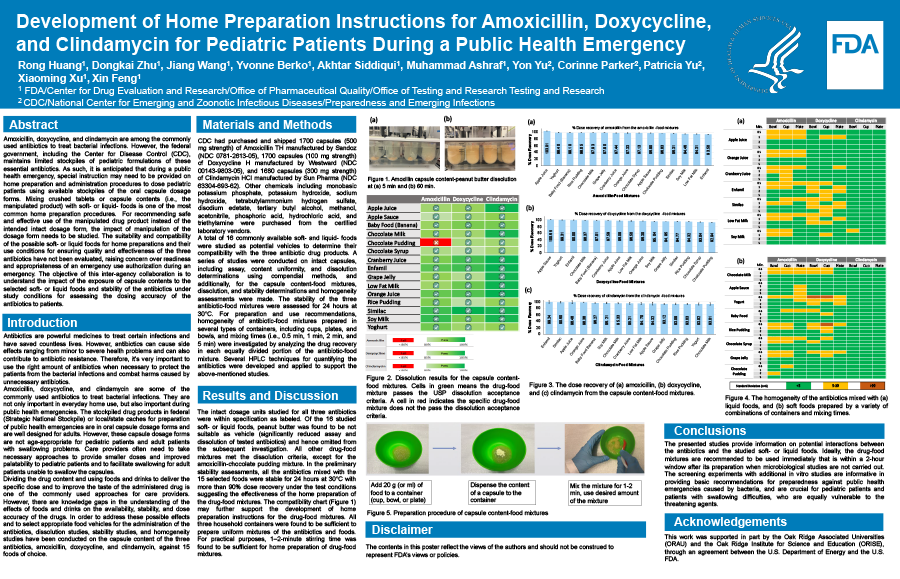
Sixteen commonly available soft and liquid foods were studied to determine their compatibility with amoxicillin, doxycycline, and clindamycin. Assay, content uniformity, and dissolution were conducted on drug from intact capsules. Dissolution, stability, and homogeneity assessments were made using capsule content-food mixtures.
RESULTS:
The assay for all three antibiotics capsules were within specification as labeled. The peanut butter-drug mixtures failed both USP assay and dissolution criteria because the peanut butter significantly affected the solubility of the drugs, and hence it was omitted from further study. All other drug-food mixtures met the dissolution criteria, except for the amoxicillin-chocolate pudding mixture. In the preliminary stability assessments, all three antibiotics were stable for up to 24 hours at 30 °C after mixing with the 15 selected foods, with more than 90% drug recovery. In terms of mixing procedure, 1-2-minute stirring time in all three tested household containers (bowl, cup, plate) was found to be sufficient to achieve homogenous mixture (Figure 1).
CONCLUSIONS:
The presented studies provide information on compatibility of antibiotics in the studied liquid and soft foods. The screening experiments with additional in vitro studies are informative to support future development of at-home preparation instructions to dose pediatric patients, which enables preparedness against potential future public health emergencies.