2023 FDA Science Forum
Application Of Cold Atmospheric Plasma In The Treatment Of Viruses And Decontamination
- Authors:
- Center:
-
Contributing OfficeOffice of the Commissioner
Abstract
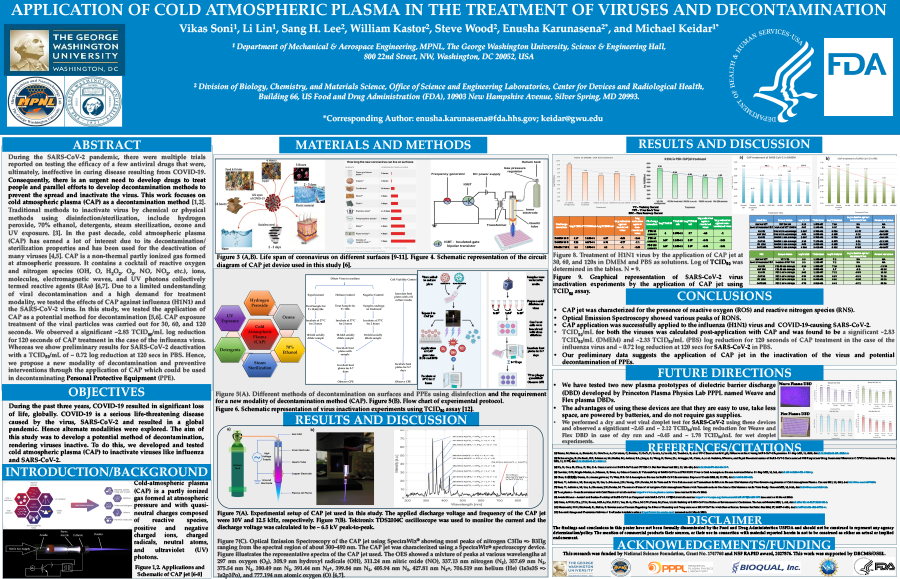
During the SARS-CoV-2 pandemic, there is an urgent need to develop better treatment methods to decontaminate and inactivate the virus from hospital personal protective equipment (PPE). [1,2]. In the past decade, cold atmospheric plasma (CAP) has garnered a lot of interest due to the simplicity of its decontamination/ sterilization properties and has been used for the deactivation of many viruses [4,5] which may be more convenient than. the current chemical and physical methods using in disinfection/sterilization, include hydrogen peroxide, 70% ethanol, detergents, steam sterilization, ozone and UV exposure. [3]. CAP is a non-thermal partly ionized gas formed at atmospheric pressure. It contains a cocktail of reactive oxygen and nitrogen species (OH, O, H2O2, O3, NO, NO2, etc.), ions, molecules, electromagnetic waves, and UV photons collectively termed reactive agents (RAs) [6,7]. Due to a limited understanding of viral decontamination and a high demand for treatment modality, we tested the effects of CAP as a potential method for decontamination against influenza (H1N1) and the SARS-CoV-2 virus (on inoculated plates/PPE). CAP exposure treatment of the viral particles was carried out for 30, 60, and 120 seconds. For samples of the influenza virus, we observed a significant ~2.83 TCID50/mL (tissue culture infectious dose) log unit reduction following 120 seconds of CAP treatment. Whereas our preliminary results for SARS-CoV-2 deactivation with a TCID50/mL show ~ 0.72 log reduction at 120 secs in PBS. Hence, we our new CAP method of PPE decontamination could have clinical utility as a more practical and rapid viral inactivation method.