


OCI History

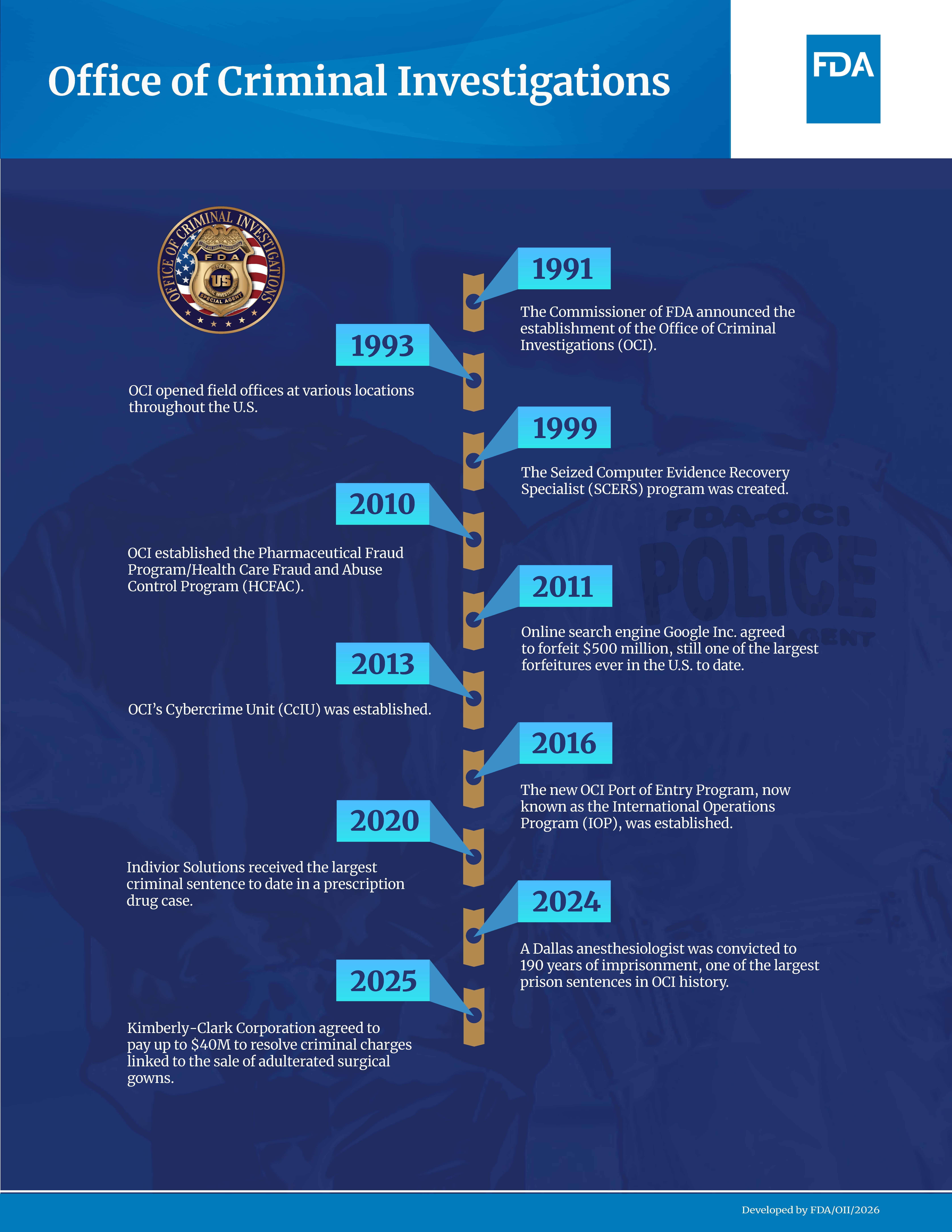
[Download OCI History Timeline - PDF version]
1991
The Commissioner of FDA announced the establishment of the Office of Criminal Investigations (OCI) created in response to growing concerns over counterfeit prescription drugs, drug diversion, importation of unapproved drugs, and other criminal violations of the Food Drug and Cosmetics Act.
1993
To expand its national footprint, in January 1993, OCI opened its first three field offices in Kansas City, Miami, and San Diego. In the summer of 1993, OCI opened three more offices in Chicago, New York and Metropolitan Washington, DC. After opening its six field offices, OCI added six resident offices and 26 domicile offices to become operational throughout the United States and Puerto Rico.
1999
The Seized Computer Evidence Recovery Specialist (SCERS) program was created. SCERS was established to support OCI special agents with specialized training and skills that allow them to handle a variety of technical issues related to digital forensics, including digital evidence collection, acquisitions, and analysis. This program is now known as the Digital Forensics Unit (DFU).
2010
OCI established the Pharmaceutical Fraud Program/Health Care Fraud and Abuse Control Program (HCFAC) to support investigations in pharmaceutical, biologic, and medical device fraud.
2011
Online search engine Google Inc. agreed to forfeit $500 million for allowing online Canadian pharmacies to place advertisements through its AdWords program targeting consumers in the U.S., resulting in the unlawful importation of controlled and non-controlled prescription drugs into the U.S.. The forfeiture is still one of the largest ever in the U.S. to date.
2013
OCI’s Cybercrime Unit (CcIU) was established to centralize efforts against the illegal sale of FDA-regulated products on the internet by transnational organized crime groups.
2016
The new OCI Port of Entry Program was established to coordinate efforts alongside U.S. Customs & Border Protection to stop the smuggling of unapproved products into the country. The program was later renamed the International Operations Program (IOP).
2020
Indivior Solutions, its CEO, and medical director were sentenced as part of $2 billion resolution of false safety claims concerning suboxone. Indivior Solutions admitted to making false statements to the Massachusetts Medicaid program (MassHealth) related to the relative safety of Suboxone Film, a version of Suboxone, around children. This remains one of the largest criminal sentences to date in a prescription drug case.
2024
A Dallas anesthesiologist was convicted for tampering resulting in serious bodily injury and intentional adulteration of a drug at a surgical center. In at least ten instances, the anesthesiologist tampered with IV bags of saline, surreptitiously injecting them with a nerve-blocking agent, a stimulant, and an anesthetic, to be used in colleagues’ surgeries. The tampering caused repeated cardiac emergencies and a death. His medical license was suspended, and he was sentenced to 190 years in prison. This is one of the largest prison sentences in OCI history.
2025
Kimberly-Clark Corporation agreed to pay up to $40M to resolve criminal charges linked to the sale of adulterated surgical gowns.