


Imogene Gollinger, FDA’s First Field Woman Investigator in Her Own Words
By Erin Peabody, OO-Office of External Affairs
Imogene Gollinger is a familiar name to many of us in the Office of Inspections and Investigations (OII). The agency’s first female field investigator was hired in 1965, a year after passage of the landmark Civil Rights Act of 1964 that prohibited discriminatory hiring practices based on race, color, religion, sex, or national origin.
Many decades later and Gollinger’s story is still a powerful one. Her demonstrated courage, tenacity, and dedication to public service reflect the challenges investigators continue to face today, including navigating complex regulatory environments, managing competing priorities, and addressing evolving public health risks.
In light of the agency’s 120th anniversary, and in recognition of our own hard-working and dedicated food and drug investigators, it’s worth revisiting Imogene Gollinger’s FDA journey—including the day in 1965 when the young New York City science teacher was sworn in, possessing an indomitable confidence and grit that would serve her time and time again.
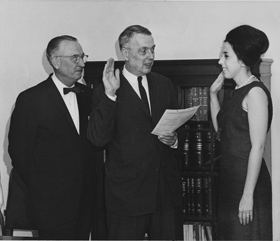
“I don’t think that it was until the day I came to be sworn in, with my beehive updo and A-line dress, that I realized that I was the first woman to have this job. I didn’t think that this was that big of a deal. A man they called Commissioner Larrick was there. Well, I might as well have been on Mars, meeting spacemen.”
I had barely heard of the FDA before this, and I had no idea who these people were, or any idea of what was actually to come. All I knew was that I had landed a very good job, and I was very, very happy.”
Gollinger’s gender almost immediately became an issue, starting with her uniform. A lively debate ensued among her peers about whether she should wear the standard issue coveralls or something else. (The coveralls featured small slits that risked opening on the sides.)
Ultimately, the decision was made for her: While in the field, the first woman investigator would wear specially ordered coveralls and—a hair net.
In time, though, Gollinger learned to navigate the societal and cultural norms of 1960s America, and the technical demands of the job. Even when firms underestimated her, she conducted thorough inspections that uncovered serious sanitation issues in facilities with poor manufacturing practices. Her work highlights the critical role investigators continue to play today with identifying risks, ensuring compliance, and conducting rigorous on-site inspections.
“In the field, the business owners seemed glad to see a woman. They imagined that I would be dumb and easy. As time went on, I found this to be a tremendous advantage. Inspectees would talk and talk to me without the fear that they had of men.
This, they would come to discover, was a huge mistake. I was extremely motivated to protect consumers from some of the bad conditions that we found.”
Those bad conditions included bakeries and candy-making facilities where Gollinger uncovered rodent hairs and other filth, and blocked those goods from reaching consumers. On another occasion, Gollinger found herself inside a large flour-packing warehouse, climbing vertical stacks of paper-wrapped flour to retrieve evidence of bird feces. Her actions led to the seizure of the tainted goods with the help of the U.S. Marshals Service.
Gollinger also travelled as an investigator on work assignments, at a time when women rarely ever traveled alone, especially on business.
Today’s investigators still travel frequently to inspect facilities and help keep the public safe, often facing long trips, tight schedules, and time away from home. The difference is that today, investigators have access to resources and travel tips that can help them prepare and navigate these challenges, something Gollinger didn’t have at the time.
Gollinger faced other hurdles and restraints that her peers never did, including lewd insults not fit to be printed here. And despite her high productivity and results, she became abruptly aware of her professional limitations.
"My promotions came on time, as I had worked very hard, but I didn’t realize that I was fast approaching a low glass ceiling.”
When opportunities to attend “Advanced Drug School” and become a supervisor were denied Gollinger, she left the FDA to attend graduate school and start a family. By 1978, Gollinger was a single parent, who worked briefly again for the agency to support her children before becoming a consultant for a medical device company.
Proving her resilience and financial savviness too, Gollinger made income renting out the houses she had acquired when travelling as an FDA investigator and in her consultancy work. She eventually remarried again, quite happily, she later noted, with a family that included two children and eventually three grandchildren.
Despite the professional and cultural obstacles that Gollinger faced throughout her career, the investigator’s humility and optimism continued to shine through when she offered these parting words at a ceremony in 2000 hosted by FDA’s History Office and Office of Women’s Health:
“I learned so much at FDA. I still always carry a pocketknife and a notebook. I learned enough for an interesting and sustaining career that occupied me for 32 years. I learned how a factory works, and how devoted so many government employees are. I learned how foods and drugs are made.
I learned to operate independently in the field. I learned to have great confidence in myself, and I learned what I was capable of accomplishing.”