2023 FDA Science Forum
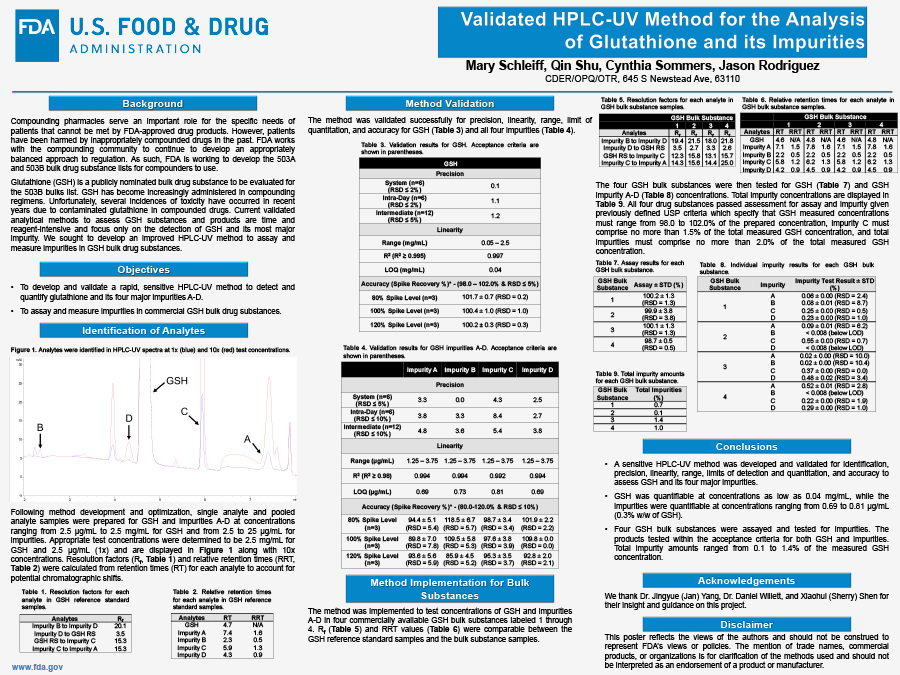
Validation of an HPLC-UV method for the analysis of glutathione and its impurities
- Authors:
- Center:
-
Contributing OfficeCenter for Drug Evaluation and Research
Abstract
Background:
Reduced glutathione (GSH) is an endogenous, antioxidant peptide which is critical to a variety of physiological and pathological activities. GSH is sold frequently as an over-the-counter dietary supplement for the treatment and prevention of a variety of ailments including cancer, heart disease, Alzheimer’s disease, and glaucoma. Given its broad use, GSH is also frequently compounded with other drugs to potentially improve clinical outcomes. However, several incidences of toxicity have occurred in recent years due to endotoxin or otherwise contaminated glutathione in compounded drugs. GSH was nominated for the 503B bulk drug substances list and is under evaluation by the FDA.
Purpose:
Analytical methods are required for assessing the quality of GSH drug substance and drug product as a part of FDA’s evaluation. HPLC-UV methods are commonly employed to analyze GSH samples. However, few validated compendial HPLC methods exist to identify and assay GSH drug substances and the more complex drug products. Further, there is only one HPLC-UV USP method designed for assessment of glutathione impurities and it is solely focused on a single, undefined impurity. As such, an HPLC-UV method is needed to characterize GSH drug substance and GSH impurities simultaneously.
Methodology:
We developed and validated an HPLC-UV method for precision, accuracy, linearity, limits of detection (LOQ), and limits of quantitation (LOQ) for the quantitative analysis of both GSH and four associated impurities A-D.
Results:
The HPLC method for the associated four glutathione impurities A-D was validated at 0.1% w/w and impurities were quantifiable at concentrations as low as 0.03% w/w. Following validation, the method was used to evaluate the quality of four commercial GSH API products.
Conclusion:
Development and validation of comprehensive analytical methods such as the one described are crucial to protect consumers from contaminated or otherwise poorly prepared GSH drug products.