2021 FDA Science Forum
Validation of a CRISPR-Cas Nuclease-Based Diagnostic Test for the Rapid Detection of Antimalarial Drug Resistance
- Authors:
- Center:
-
Contributing OfficeCenter for Biologics Evaluation and Research
Abstract
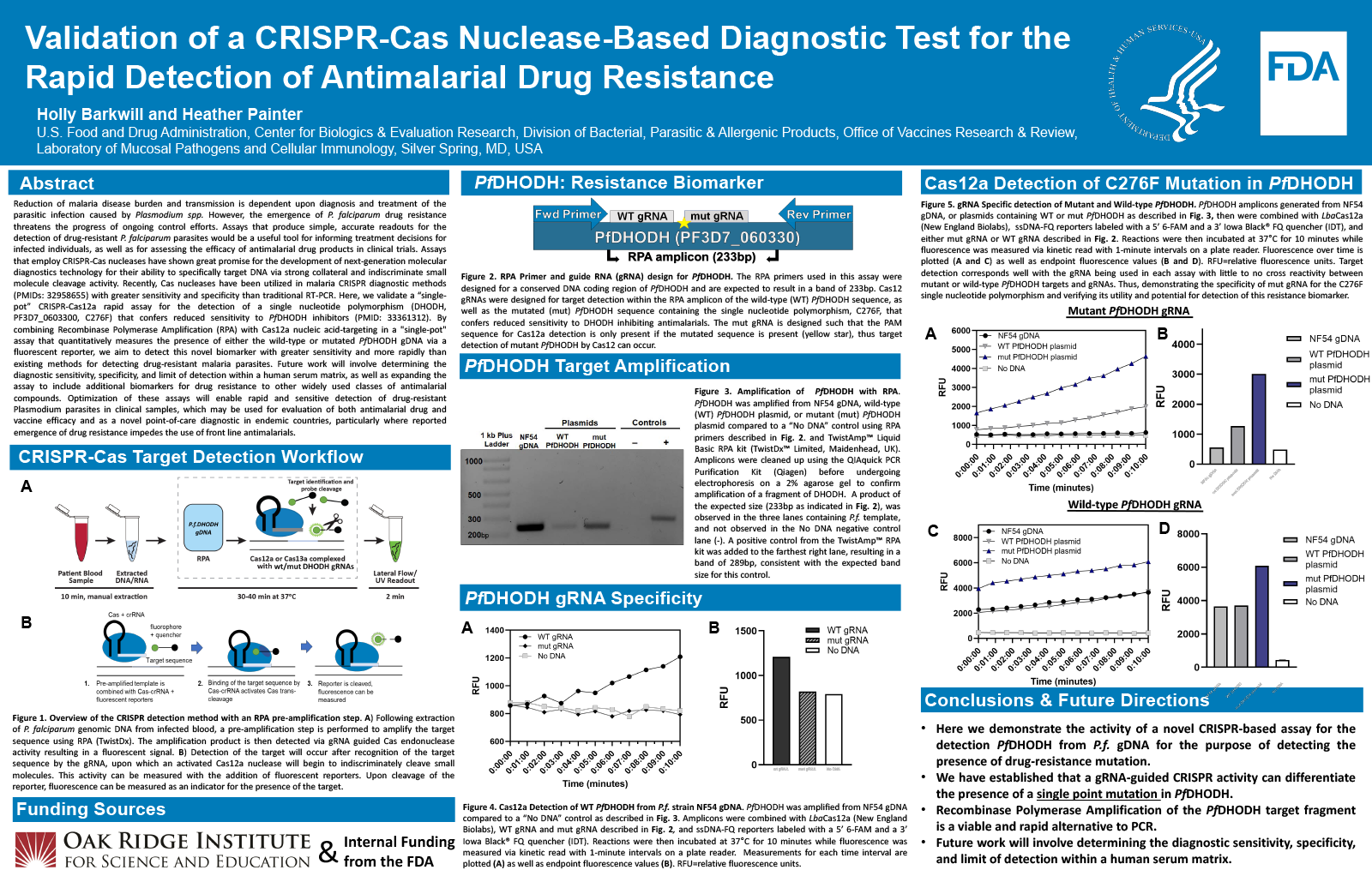
Reduction of malaria disease burden and transmission is dependent upon diagnosis and treatment of the parasitic infection caused by Plamodium spp. However, the emergence of P. falciparum drug resistance threatens the progress of ongoing control efforts. Assays that produce simple, accurate readouts for the detection of drug-resistant P. falciparum parasites would be a useful tool for informing treatment decisions for infected individuals, as well as for assessing the efficacy of antimalarial drug products in clinical trials. Assays that employ CRISPR-Cas nucleases have shown great promise for the development of next-generation molecular diagnostics technology for their ability to specifically target DNA via strong collateral and indiscriminate small molecule cleavage activity. Recently, Cas nucleases have been utilized in malaria CRISPR diagnostic methods (PMIDs: 32958655) with greater sensitivity and specificity than traditional RT-PCR. Here, we validate a “single-pot” CRISPR-Cas12a rapid assay for the detection of a single nucleotide polymorphism (DHODH, PF3D7_0603300, C276F) that confers reduced sensitivity to PfDHODH inhibitors (PMID: 33361312). By combining Recombinase Polymerase Amplification (RPA) with Cas12a nucleic acid-targeting in a "single-pot" assay that quantitatively measures the presence of either the wild-type or mutated pfdhodh gDNA via a fluorescent reporter, we aim to detect this novel biomarker with greater sensitivity and more rapidly than existing methods for detecting drug-resistant malaria parasites. Future work will involve determining the diagnostic sensitivity, specificity, and limit of detection within a human serum matrix, as well as expanding the assay to include additional biomarkers for drug resistance to other widely used classes of antimalarial compounds. Optimization of these assays will enable rapid and sensitive detection of drug-resistant Plasmodium parasites in clinical samples, which may be used for evaluation of both antimalarial drug and vaccine efficacy and as a novel point-of-care diagnostic in endemic countries, particularly where reported emergence of drug resistance impedes the use of front line antimalarials.