2021 FDA Science Forum
Utility of Nonclinical Cardiac Repolarization Assays to Predict Clinical QTC Outcomes for Peptide and Protein Therapeutics
- Authors:
- Center:
-
Contributing OfficeCenter for Drug Evaluation and Research
Abstract
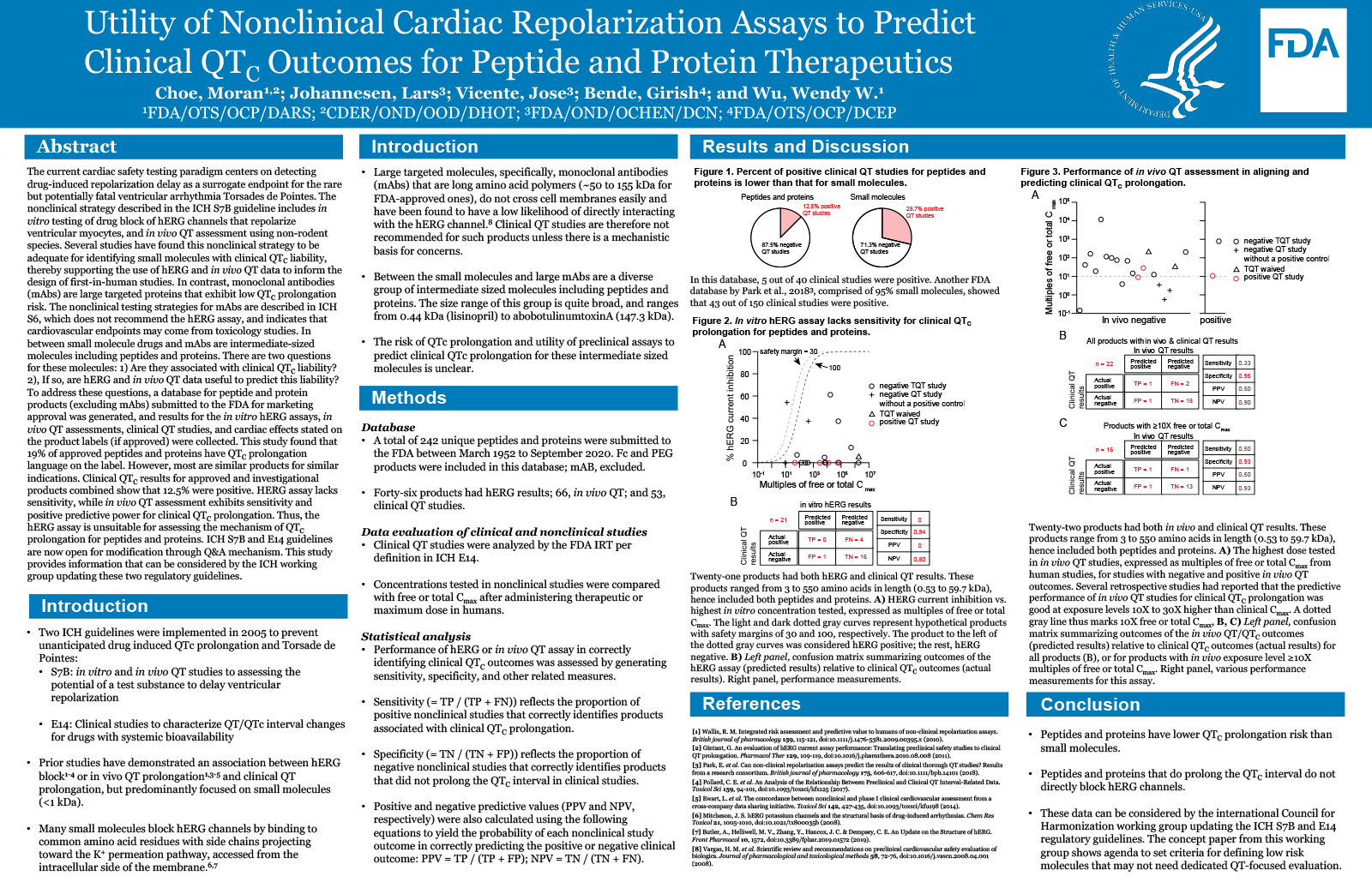
The current cardiac safety testing paradigm centers on detecting drug-induced repolarization delay as a surrogate endpoint for the rare but potentially fatal ventricular arrhythmia Torsades de Pointes. The nonclinical strategy described in the ICH S7B guideline includes in vitro assessment of drug block of hERG channels that repolarize ventricular myocytes and in vivo QT assessment using non-rodent species. Several studies have found this nonclinical strategy to be adequate for identifying small molecules with clinical QTC liability, thereby supporting the use of hERG and in vivo QT data to inform the design of first-in-human studies. In contrast, monoclonal antibodies (mAbs) are large targeted proteins that exhibit low QTC prolongation risk. The nonclinical testing strategies for mAbs are described in ICH S6, which does not recommend the hERG assay, and indicates that cardiovascular endpoints may be derived from toxicology studies. In between small molecule drugs and mAbs are intermediate-sized molecules including peptide and protein products. There are two regulatory questions for these molecules: 1) Are they associated with clinical QTC liability? 2), If so, are hERG and in vivo QT data useful to predict this liability? To address these questions, a database for peptide and protein products (excluding mAbs) submitted to the FDA for marketing approval was generated, and results for the in vitro hERG assays, in vivo QT assessments, clinical QT studies, and cardiac effects stated on the product labels (if approved) were collected. This study found that 19% of approved peptides and proteins have QTC prolongation language on the label. However, most are similar products for similar indications. Clinical QTC results for approved and investigational products combined show that 12.5% were positive. HERG assay lacks sensitivity, while in vivo QT assessment exhibits sensitivity and positive predictive power for clinical QTC prolongation. Thus, the hERG assay is unsuitable for assessing the mechanism of QTC prolongation for peptides and proteins. ICH S7B and E14 guidelines are now open for modification through Q&A mechanism. This study provides information that can be considered by the ICH working group updating these two regulatory guidelines.