2023 FDA Science Forum
Utility of Computational Toxicology at FDA Center for Tobacco Products in Evaluation of Potential Hazards Due to Ingredients in Tobacco Products
- Authors:
- Center:
-
Contributing OfficeCenter for Tobacco Products
Abstract
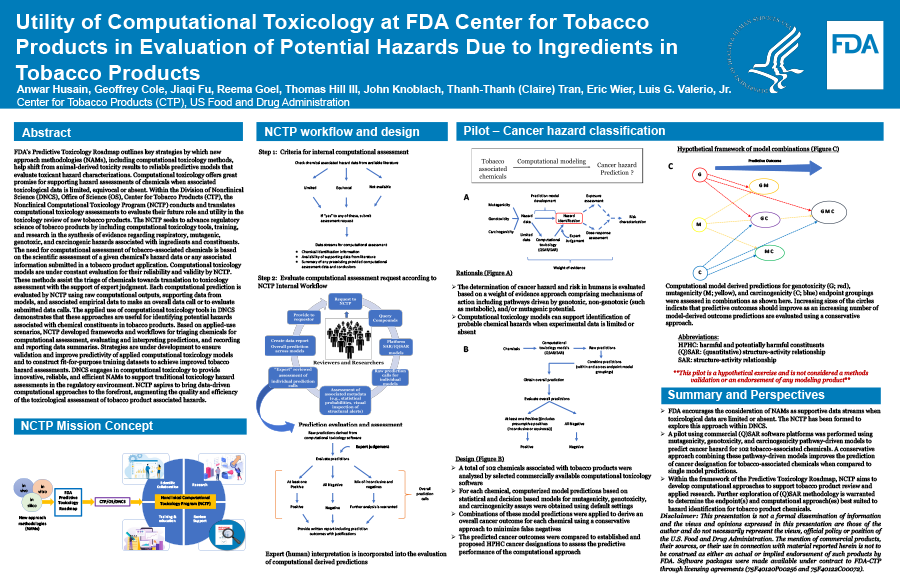
FDA's Predictive Toxicology Roadmap outlines key strategies by which new approach methodologies (NAMs), including computational toxicology methods, help shift from animal-derived toxicity results to reliable predictive models that evaluate toxicant hazard characterizations. Computational toxicology offers great promise for supporting hazard assessments of chemicals when associated toxicological data is limited, equivocal or absent. Within the Division of Nonclinical Science (DNCS), Office of Science (OS), Center for Tobacco Products (CTP), the Nonclinical Computational Toxicology Program (NCTP) conducts and translates computational toxicology assessments to evaluate their future role and utility in the toxicology review of new tobacco products. The NCTP seeks to advance regulatory science of tobacco products by including computational toxicology tools, training, and research in the synthesis of evidence regarding respiratory, mutagenic, genotoxic, and carcinogenic hazards associated with ingredients and constituents. The need for computational assessment of tobacco-associated chemicals is based on the scientific assessment of a given chemical’s hazard data or any associated information submitted in a tobacco product application. Computational toxicology models are under constant evaluation for their reliability and validity by NCTP. These methods assist the triage of chemicals towards translation to toxicology assessment with the support of expert judgment. Each computational prediction is evaluated by NCTP using raw computational outputs, supporting data from models, and associated empirical data to make an overall data call or to evaluate submitted data calls. The applied use of computational toxicology tools in DNCS demonstrates that these approaches are useful for identifying potential hazards associated with chemical constituents in tobacco products. Based on applied-use scenarios, NCTP developed frameworks and workflows for triaging chemicals for computational assessment, evaluating and interpreting predictions, and recording and reporting data summaries. Strategies are under development to ensure validation and improve predictivity of applied computational toxicology models and to construct fit-for-purpose training datasets to achieve improved tobacco hazard assessments. DNCS engages in computational toxicology to provide innovative, reliable, and efficient NAMs to support traditional toxicology hazard assessments in the regulatory environment. NCTP aspires to bring data-driven computational approaches to the forefront, augmenting the quality and efficiency of the toxicological assessment of tobacco product associated hazards.