2021 FDA Science Forum
Use of Natural Language Processing Text-Mining to Identify Differences in the OVERDOSAGE Section of Drug Labeling
- Authors:
- Center:
-
Contributing OfficeCenter for Drug Evaluation and Research
Abstract
Background
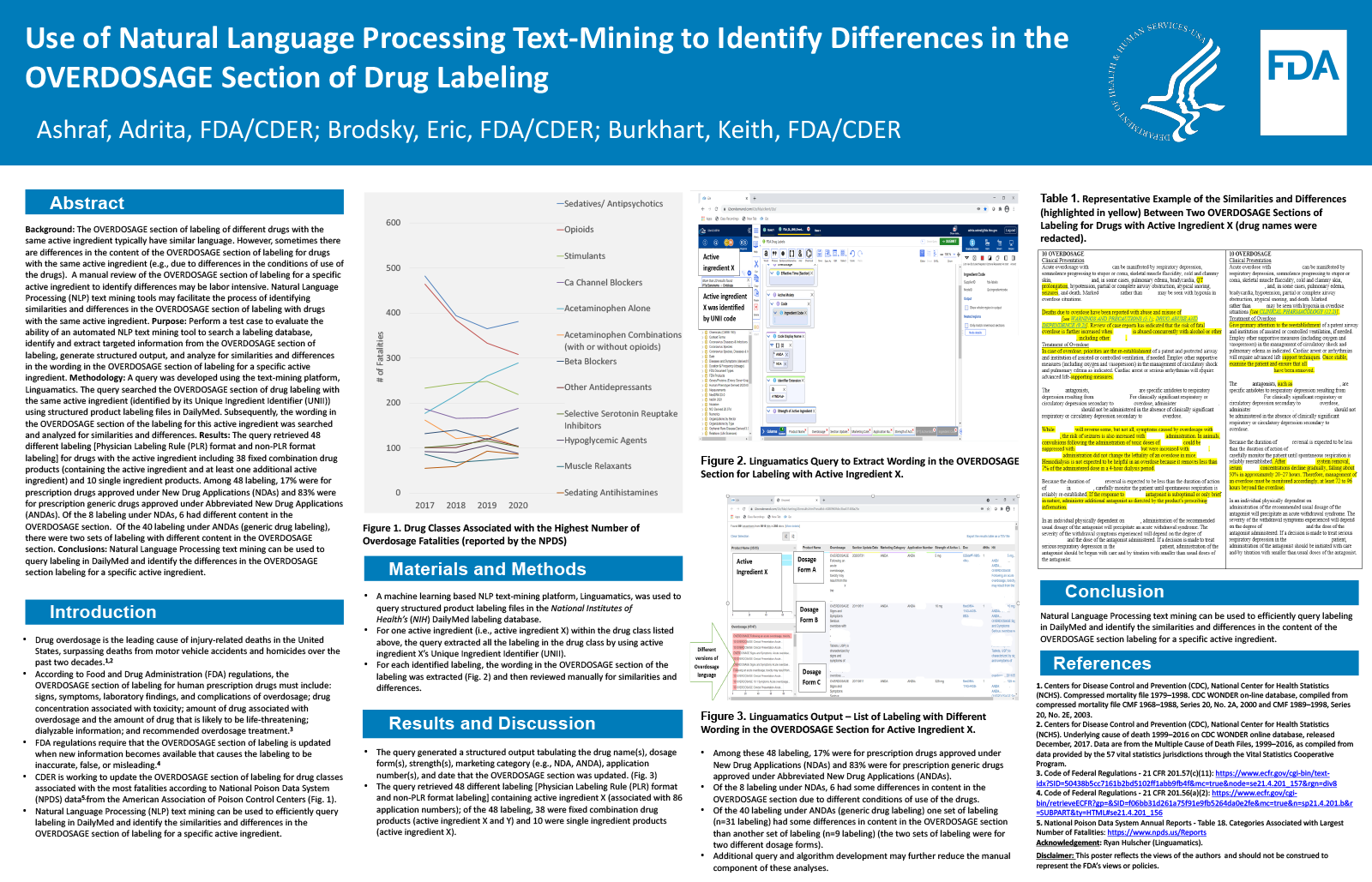
The OVERDOSAGE section of labeling of different drugs with the same active ingredient typically have similar language. However, sometimes there are differences in the content of the OVERDOSAGE section of labeling for drugs with the same active ingredient (e.g., due to differences in the conditions of use of the drugs). A manual review of the OVERDOSAGE section of labeling for a specific active ingredient to identify differences may be labor intensive. Natural Language Processing (NLP) text mining tools may facilitate the process of identifying similarities and differences in the OVERDOSAGE section of labeling with drugs with the same active ingredient.
Purpose
Perform a test case to evaluate the ability of an automated NLP text mining tool to search a labeling database, identify and extract targeted information from the OVERDOSAGE section of labeling, generate structured output, and analyze for similarities and differences in the wording in the OVERDOSAGE section of labeling for a specific active ingredient.
Methodology
A query was developed using the text-mining platform, Linguamatics. The query searched the OVERDOSAGE section of drug labeling with the same active ingredient (identified by its Unique Ingredient Identifier (UNII)) using structured product labeling files in DailyMed. Subsequently, the wording in the OVERDOSAGE section of the labeling for this active ingredient was searched and analyzed for similarities and differences.
Results
The query retrieved 48 different labeling [Physician Labeling Rule (PLR) format and non-PLR format labeling] for drugs with the active ingredient including 38 fixed combination drug products (containing the active ingredient and at least one additional active ingredient) and 10 single ingredient products. Among 48 labeling, 17% were for prescription drugs approved under New Drug Applications (NDAs) and 83% were for prescription generic drugs approved under Abbreviated New Drug Applications (ANDAs). Of the 8 labeling under NDAs, 6 had different content in the OVERDOSAGE section. Of the 40 labeling under ANDAs (generic drug labeling), there were two sets of labeling with different content in the OVERDOSAGE section.
Conclusions
Natural Language Processing text mining can be used to query labeling in DailyMed and identify the differences in the OVERDOSAGE section labeling for a specific active ingredient.