2021 FDA Science Forum
The Use of DART-HRMS for the Rapid Identification Chemical Substances in Food Contact Materials
- Authors:
- Center:
-
Contributing OfficeCenter for Food Safety and Applied Nutrition
Abstract
Background
In 2005, Cody et al. introduced a new ionization source: Direct analysis in real time (DART), which when coupled to a high-resolution mass spectrometer (HRMS), can be used as ambient mass spectrometric sample introduction technique. The main advantage of this technique is that can identify chemical substances in different types of matrices and obtain reliable results in minutes without any sample preparation.
Purpose
The Division of Analytical Chemistry (DAC) at the Center for Food Safety and Applied Nutrition (CFSAN) has been using DART-HRMS for the rapid identification of potential migrants in food contact materials (FCMs) for over 10 years. Monomers and additives used in the manufacture of FCMs as well contaminants, have been successfully identified in almost any type of analyzed matrix (e.g. plastics, food simulants, and foods). Thus, the purpose of this poster is to summarize the obtained identification results to date and the implications for future research in the food safety field.
Methodology
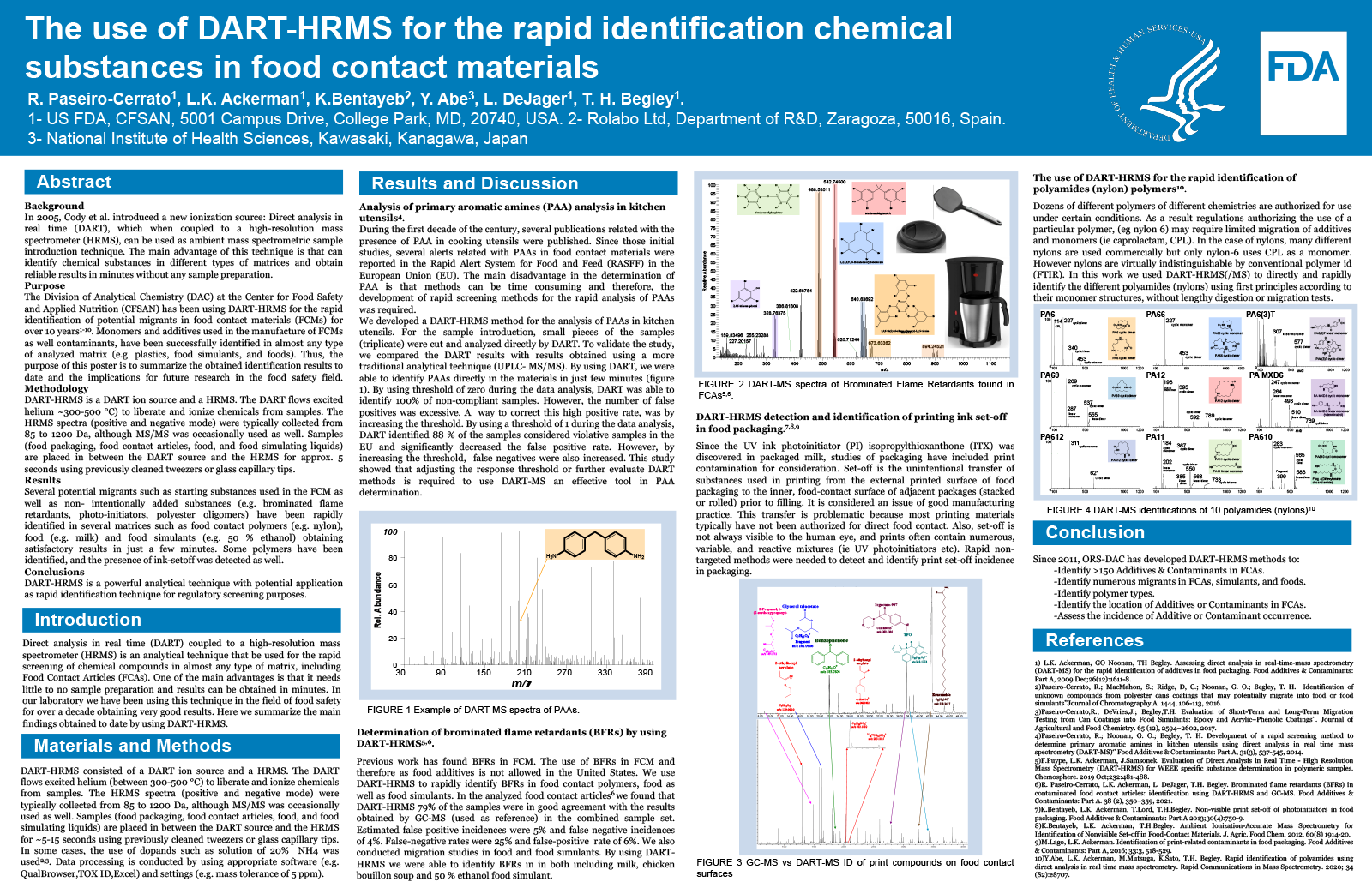
DART-HRMS consisted of a DART ion source and a HRMS. The DART flows excited helium (between 300-500 °C) to liberate and ionize chemicals from samples. The HRMS spectra (positive and negative mode) were typically collected from 85 to 1200 Da, although MS/MS was occasionally used as well. Samples (food packaging, food contact articles, food, and food simulating liquids) are placed in between the DART source and the HRMS for approx. 5 seconds using previously cleaned tweezers or glass capillary tips.
Results
Several potential migrants such as starting substances used in the FCM as well as non- intentionally added substances (e.g. brominated flame retardants, photo-initiators, polyester oligomers) have been rapidly identified in several matrices such as food contact polymers (e.g. nylon), food (e.g. milk) and food simulants (e.g. 50 % ethanol) obtaining satisfactory results in just a few minutes. Some polymers have been identified, and the presence of ink-setoff was detected as well.
Conclusions
DART-HRMS is a powerful analytical technique with potential application as rapid identification technique for regulatory screening purposes.