2023 FDA Science Forum
The Translational Value of Secondary Pharmacology Assays for Nonclinical and Clinical Findings
- Authors:
- Center:
-
Contributing OfficeCenter for Drug Evaluation and Research
Abstract
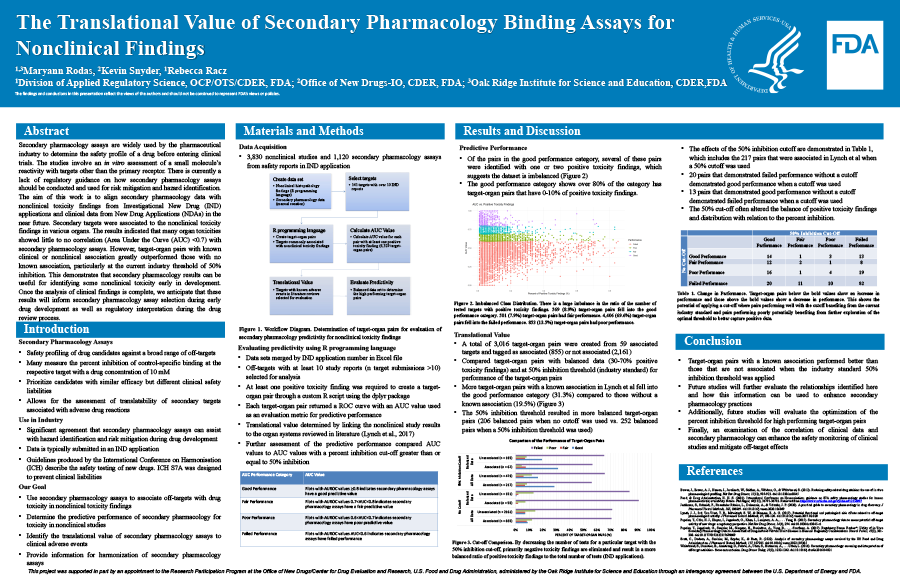
Secondary pharmacology assays are widely used by the pharmaceutical industry to determine the safety profile of a drug before entering clinical trials. The studies involve an in vitro assessment of a small molecule’s reactivity with targets other than the primary receptor. There is currently a lack of regulatory guidance on how secondary pharmacology assays should be conducted and used for risk mitigation and hazard identification. The aim of this work is to align secondary pharmacology data with nonclinical histopathology findings from Investigational New Drug (IND) applications and clinical data from New Drug Applications (NDAs). While review of the clinical data is still underway, secondary targets were associated to the nonclinical histopathology findings in various organs. The results indicated that many organ toxicities showed little to no correlation (Area Under the Curve (AUC) <0.7) with secondary pharmacology assays, with exception of three target-organ pairs. Generally, this study demonstrated that nonclinical histopathology findings have little to no correlation with secondary pharmacology data. Once the analysis of clinical findings is complete, we anticipate that these results will inform secondary pharmacology assay selection during early drug development as well as regulatory interpretation during the drug review process.