2021 FDA Science Forum
Synergistic Genotoxicity of Alcohol and Benzo[a]pyrene In Vitro
- Authors:
- Center:
-
Contributing OfficeNational Center for Toxicological Research
Abstract
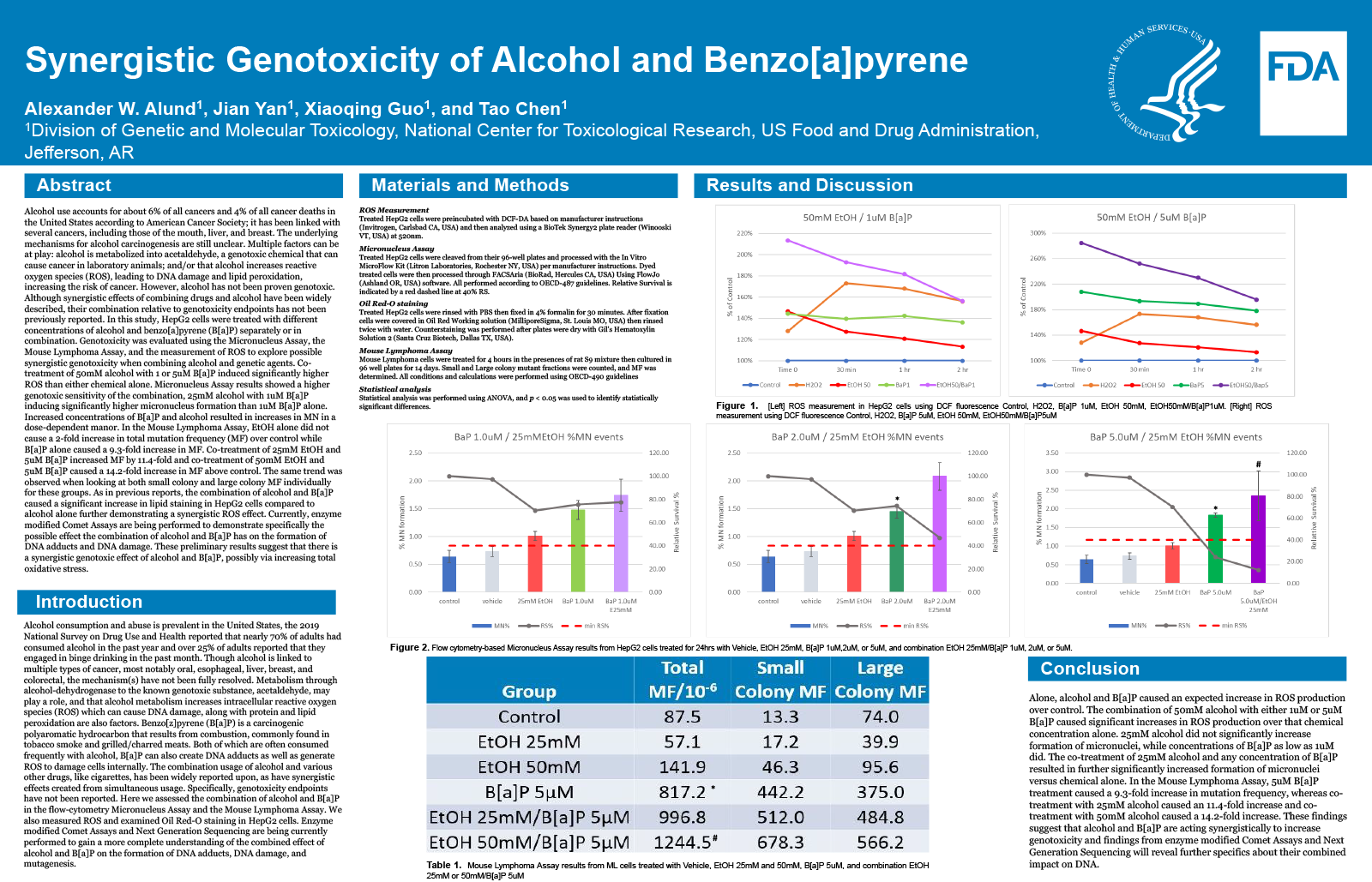
Alcohol use accounts for about 6% of all cancers and 4% of all cancer deaths in the United States according to American Cancer Society; it has been linked with several cancers, including those of the mouth, liver, and breast. The underlying mechanisms for alcohol carcinogenesis are still unclear. Multiple factors can be at play: alcohol is metabolized into acetaldehyde, a genotoxic chemical that can cause cancer in laboratory animals; and/or that alcohol increases reactive oxygen species (ROS), leading to DNA damage and lipid peroxidation, increasing the risk of cancer. However, alcohol has not been proven genotoxic. Although synergistic effects of combining drugs and alcohol have been widely described, their combination relative to genotoxicity endpoints has not been previously reported. In this study, HepG2 cells were treated with different concentrations of alcohol and benzo[a]pyrene (B[a]P) separately or in combination. Genotoxicity was evaluated using the Micronucleus Assay, the Mouse Lymphoma Assay, and the measurement of ROS to explore possible synergistic genotoxicity when combining alcohol and genetic agents. Co-treatment of 50mM alcohol with 1 or 5 uM B[a]P induced significantly higher ROS than either chemical alone. Micronucleus Assay results showed a higher genotoxic sensitivity of the combination, 25mM alcohol with 1uM B[a]P inducing significantly higher micronucleus formation than 1uM B[a]P alone. Increased concentrations of B[a]P and alcohol resulted in increases in MN in a dose-dependent manor. In the Mouse Lymphoma Assay, EtOH alone did not cause a 2-fold increase in total mutation frequency (MF) over control while B[a]P alone caused a 9.3-fold increase in MF. Co-treatment of 25mM EtOH and 5uM B[a]P increased MF by 11.4-fold and co-treatment of 50mM EtOH and 5uM B[a]P caused a 14.2-fold increase in MF above control. The same trend was observed when looking at both small colony and large colony MF individually for these groups. As in previous reports, the combination of alcohol and B[a]P caused a significant increase in lipid staining in HepG2 cells compared to alcohol alone further demonstrating a synergistic ROS effect. Currently, enzyme modified Comet Assays are being performed to demonstrate specifically the possible effect the combination of alcohol and B[a]P has on the formation of DNA adducts and DNA damage. These preliminary results suggest that there is a synergistic genotoxic effect of alcohol and B[a]P, possibly via increasing total oxidative stress.