2021 FDA Science Forum
Study on the Role of Core 3 O-Glycans in Colorectal Cancer Using Cell Models
- Authors:
- Center:
-
Contributing OfficeCenter for Drug Evaluation and Research
Abstract
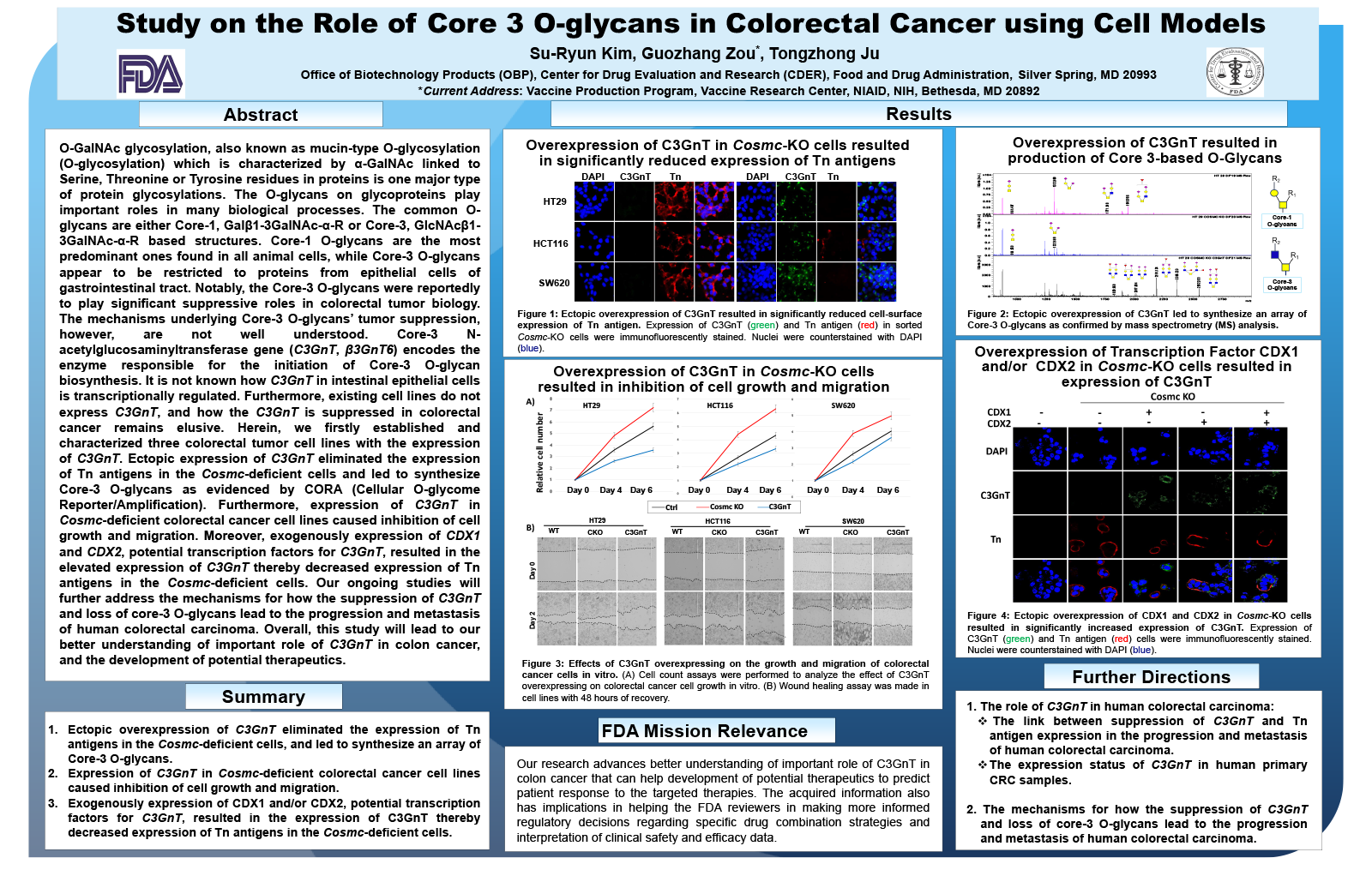
O-GalNAc glycosylation, also known as mucin-type O-glycosylation (O-glycosylation) which is characterized by ?-GalNAc linked to Serine, Threonine or Tyrosine residues in proteins is one major type of protein glycosylations. The O-glycans on glycoproteins play important roles in many biological processes. The common O-glycans are either Core-1, Gal?1-3GalNAc-?-R or Core-3, GlcNAc?1-3GalNAc-?-R based structures. Core-1 O-glycans are the most predominant ones found in all animal cells, while Core-3 O-glycans appear to be restricted to proteins from epithelial cells of gastrointestinal tract. Notably, the Core-3 O-glycans were reportedly to play significant suppressive roles in colorectal tumor biology. The mechanisms underlying Core-3 O-glycans’ tumor suppression, however, are not well understood. Core-3 N-acetylglucosaminyltransferase gene (C3GnT, ?3GnT6) encodes the enzyme responsible for the initiation of Core-3 O-glycan biosynthesis. It is not known how ?3GnT6 in intestinal epithelial cells is transcriptionally regulated. Furthermore, existing cell lines do not express ?3GnT6, and how the ?3GnT6 is suppressed in colorectal cancer remains elusive. Herein, we firstly established characterize three colorectal tumor cell lines with the expression of ?3GnT6. Ectopic expression of ?3GnT6 eliminated the expression of Tn antigens in the Cosmc-deficient cells and led to synthesize Core-3 O-glycans as evidenced by CORA (Cellular O-glycome Reporter/Amplification). Furthermore, expression of ?3GnT6 in Cosmc-deficient colorectal cancer cell lines caused inhibition of cell growth and migration. Moreover, exogenously expression of CDX1 and CDX2, potential transcription factors for ?3GnT6, resulted in the elevated expression of ?3GnT6 thereby decreased expression of Tn antigens in the Cosmc-deficient cells. Our ongoing studies will further address the mechanisms for how the suppression of ?3GnT6 and loss of core-3 O-glycans lead to the progression and metastasis of human colorectal carcinoma. Overall, this study will lead to our better understanding of important role of ?3GnT6 in colon cancer, and the development of potential therapeutics.