2021 FDA Science Forum
Solubility-Physicochemical-Thermodynamic Theory of Penetration Enhancer Mechanism of Action
- Authors:
- Center:
-
Contributing OfficeCenter for Drug Evaluation and Research
Abstract
Purpose
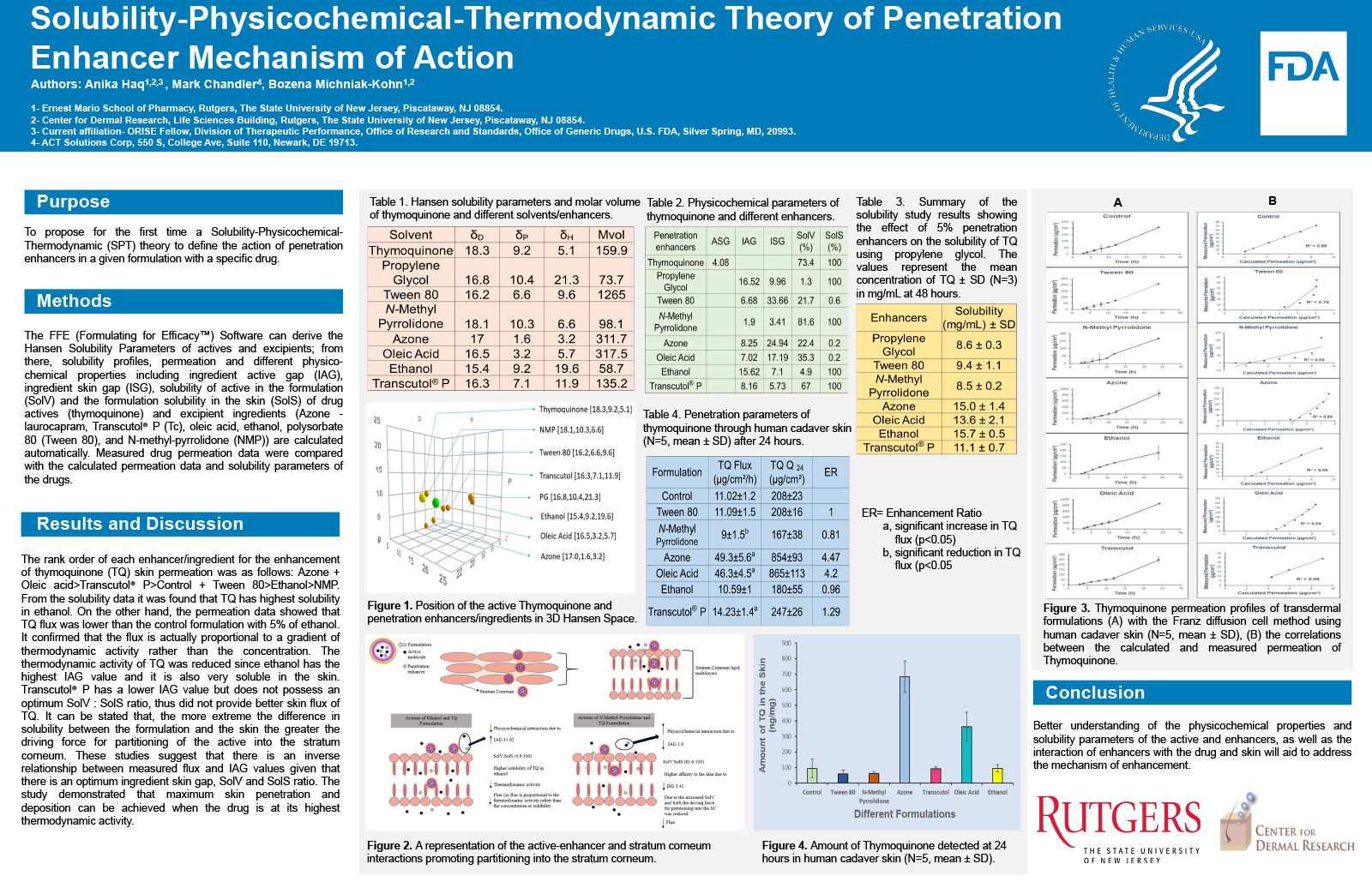
To propose for the first time a Solubility-Physicochemical-Thermodynamic (SPT) theory to define the action of penetration enhancers in a given formulation with a specific drug.
Methods
The FFE (Formulating for EfficacyTM) Software can derive the Hansen Solubility Parameters of actives and excipients; from there, solubility profiles, permeation and different physico-chemical properties including ingredient active gap (IAG), ingredient skin gap (ISG), solubility of active in the formulation (SolV) and the formulation solubility in the skin (SolS) of drug actives (thymoquinone) and excipient ingredients (Azone -laurocapram, Transcutol ® P (Tc), oleic acid, ethanol, polysorbate 80 (Tween 80), and N-methyl-pyrrolidone (NMP)) are calculated automatically. Measured drug permeation data were compared with the calculated permeation data and solubility parameters of the drugs.
Results
The rank order of each enhancer/ingredient for the enhancement of thymoquinone (TQ) skin permeation was as follows: Azone + Oleic acid>Transcutol ® P>Control + Tween 80>Ethanol>NMP. From the solubility data it was found that TQ has highest solubility in ethanol. On the other hand, the permeation data showed that TQ flux was lower than the control formulation with 5% of ethanol. It confirmed that the flux is actually proportional to a gradient of thermodynamic activity rather than the concentration. The thermodynamic activity of TQ was reduced since ethanol has the highest IAG value and it is also very soluble in the skin. Transcutol ® P has a lower IAG value but does not possess an optimum SolV : SolS ratio, thus did not provide better skin flux of TQ. It can be stated that, the more extreme the difference in solubility between the formulation and the skin the greater the driving force for partitioning of the active into the stratum corneum. These studies suggest that there is an inverse relationship between measured flux and IAG values given that there is an optimum ingredient skin gap, SolV and SolS ratio. The study demonstrated that maximum skin penetration and deposition can be achieved when the drug is at its highest thermodynamic activity.
Conclusions
Better understanding of the physicochemical properties and solubility parameters of the active and enhancers, as well as the interaction of enhancers with the drug and skin will aid to address the mechanism of enhancement.