2021 FDA Science Forum
Skin Sensitization Potential of German Chamomile – a Case Study for Integrated Testing Approaches to the Safety Evaluation of Botanical Ingredients
- Authors:
- Center:
-
Contributing OfficeCenter for Food Safety and Applied Nutrition
Abstract
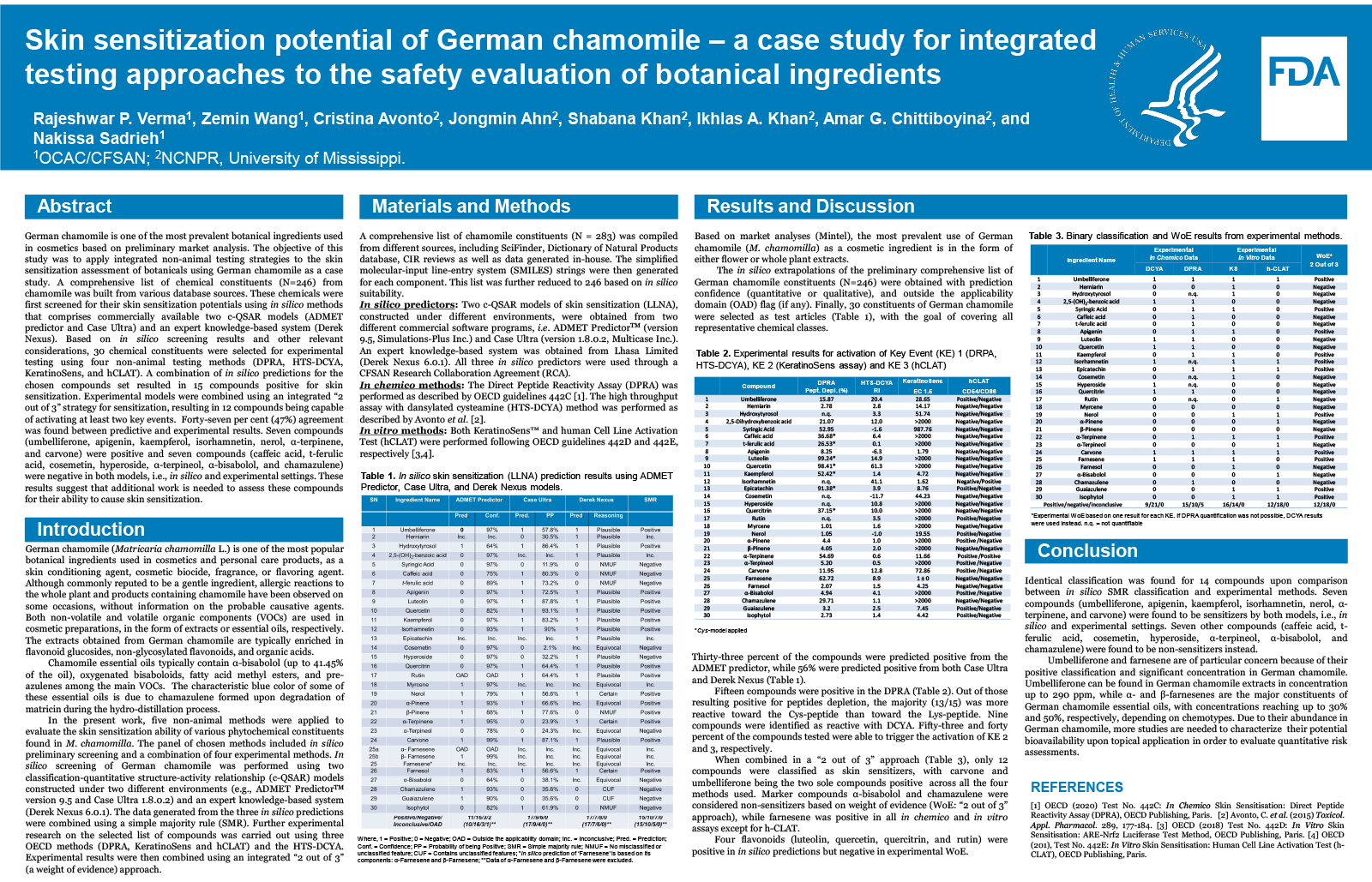
German chamomile is one of the most prevalent botanical ingredients used in cosmetics based on preliminary market analysis. The objective of this study was to apply integrated non-animal testing strategies to the skin sensitization assessment of botanicals using German chamomile as a case study. A comprehensive list of chemical constituents (N=246) from chamomile was built from various database sources. These chemicals were first screened for their skin sensitization potentials using in silico methods that comprises commercially available two c-QSAR models (ADMET predictor and Case Ultra) and an expert knowledge-based system (Derek Nexus). Based on in silico screening results and other relevant considerations, 30 chemical constituents were selected for experimental testing using four non-animal testing methods (DPRA, HTS-DCYA, KeratinoSens, and hCLAT). A combination of in silico predictions for the chosen compounds set resulted in 15 compounds positive for skin sensitization. Experimental models were combined using an integrated “2 out of 3” strategy for sensitization, resulting in 12 compounds being capable of activating at least two key events. Forty-seven per cent (47%) agreement was found between predictive and experimental results. Seven compounds (umbelliferone, apigenin, kaempferol, isorhamnetin, nerol, α-terpinene, and carvone) were positive and seven compounds (caffeic acid, t-ferulic acid, cosemetin, hyperoside, α-terpineol, α-bisabolol, and chamazulene) were negative in both models, i.e., in silico and experimental settings. These results suggest that additional work is needed to assess these compounds for their ability to cause skin sensitization.