2021 FDA Science Forum
Skin-Mimicking Phantoms for Assessing Performance of Emerging Photoacoustic Microscopy Devices
- Authors:
- Center:
-
Contributing OfficeCenter for Devices and Radiological Health
Abstract
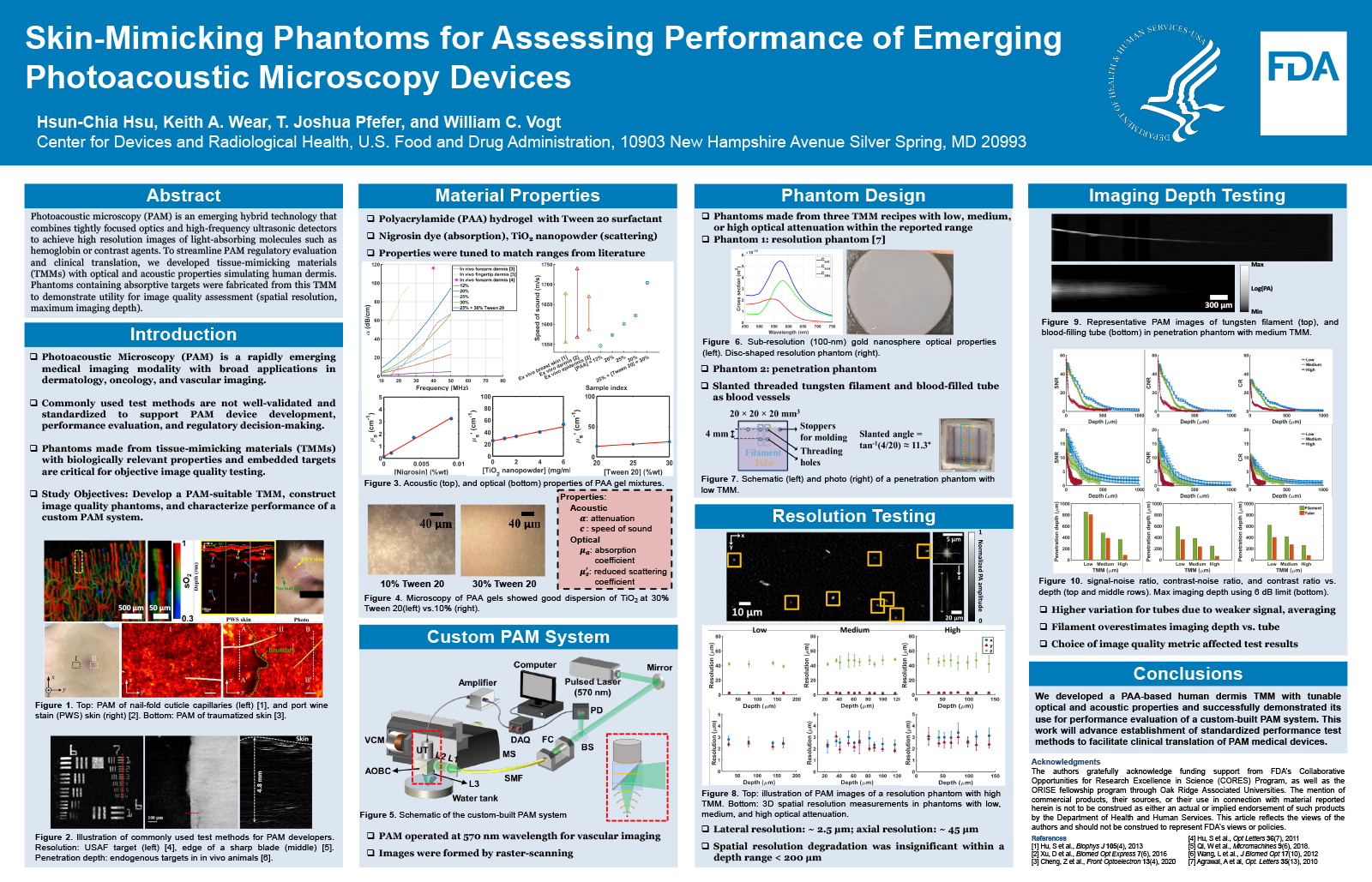
Photoacoustic microscopy (PAM) is a rapidly emerging hybrid technology that combines tightly focused optics and high-frequency ultrasonic detectors to achieve high resolution images of light-absorbing molecules such as hemoglobin or contrast agents. The exponential growth of research and development over the past decade, as well as establishment of companies developing PAM for preclinical research and clinical applications, indicates that FDA needs to anticipate PAM-based medical devices and be prepared to evaluate their safety and effectiveness. Regulatory evaluation of imaging devices often includes bench test methods in tissue-mimicking phantoms that enable objective, quantitative, and reproducible evaluation of image quality characteristics (e.g., spatial resolution, maximum imaging depth). Currently available tissue-mimicking materials (TMMs) used in phantoms for testing macroscopic photoacoustic imaging systems are not adequate for PAM evaluation because they are designed for low acoustic frequencies and to simulate deeper tissues such as muscle and fat, not superficial skin. To address this regulatory science need, we formulated a tunable polyacrylamide (PAA) TMM to mimic the acoustic and optical properties of human dermis. Acoustic properties were characterized over 10 – 50 MHz using a pulse transmission substitution method, and optical properties were characterized over 400 – 1000 nm using integrating sphere spectrophotometry. Two phantoms were constructed using this TMM and used to characterize performance of a custom-built PAM system. A “resolution” phantom contained sparsely dispersed gold nanospheres (100 nm) to serve as strong sub-resolution contrast agents for evaluating point spread function. A second “contrast” phantom contained a tungsten filament (25 µm) and a polyethylene microcatheter (ID = 280 µm; OD = 610 µm) obliquely inserted into the phantom materials to measure penetration depth and assess detectability of flowing nanoparticles in blood. Preliminary results indicate that this PAM system achieved lateral resolution of 2.5 µm +/- 0.65 µm and axial resolution 50 µm +/- 7 µm within 120 µm depth range. Maximum visualization depth of blood-filled target was deeper than 200 µm. These phantom-based test methods may provide device developers with regulatory science tools that can provide high-quality data to support regulatory evaluation of PAM devices.