2021 FDA Science Forum
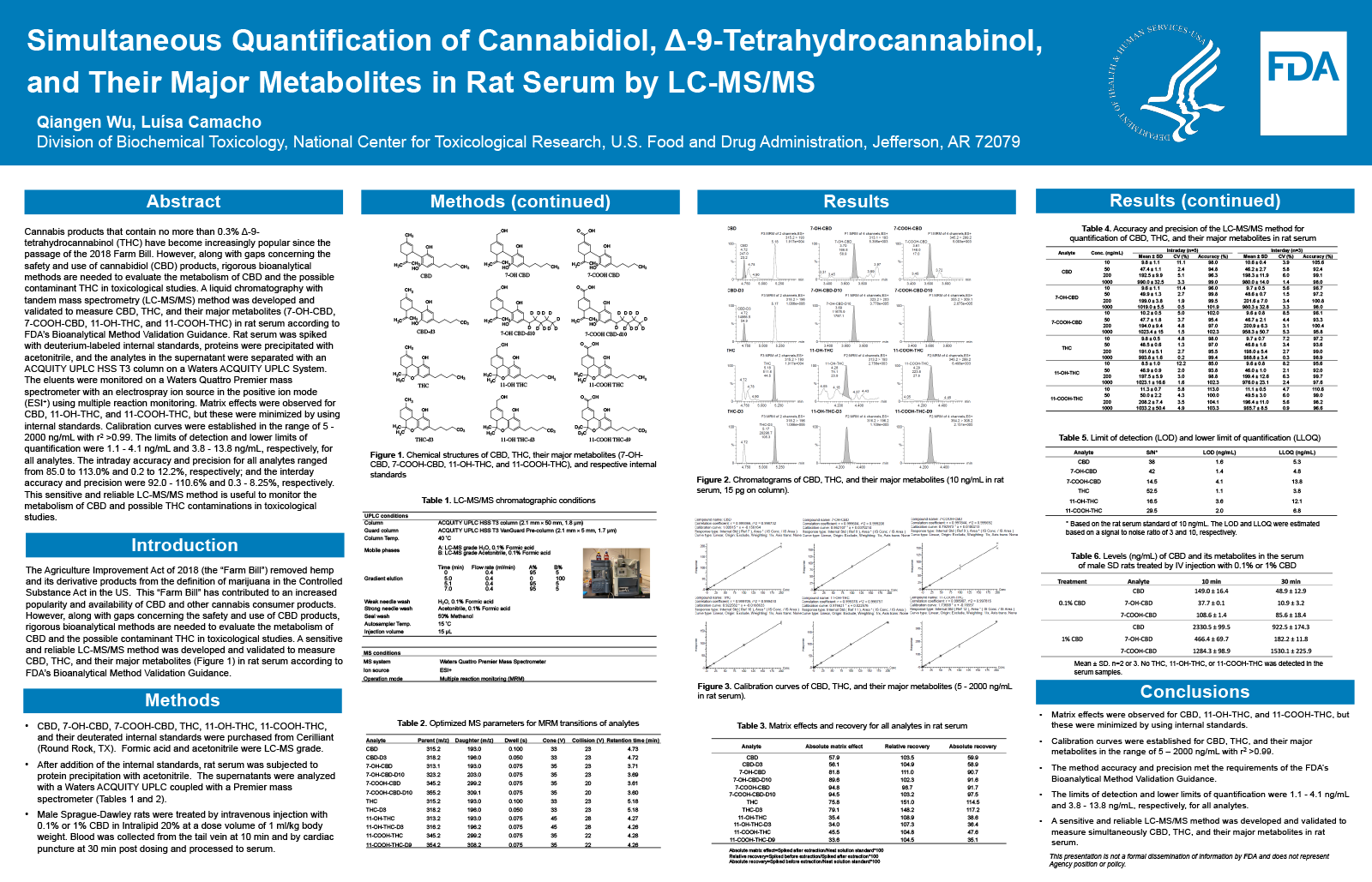
Simultaneous Quantification of Cannabidiol, Δ-9-Tetrahydrocannabinol, and Their Major Metabolites in Rat Serum by LC-MS/MS
- Authors:
- Center:
-
Contributing OfficeNational Center for Toxicological Research
Abstract
Cannabis products that contain no more than 0.3% Δ-9-tetrahydrocannabinol (THC) have become increasingly popular since the passage of the 2018 Farm Bill. However, along with gaps concerning the safety and use of cannabidiol (CBD) products, rigorous bioanalytical methods are needed to evaluate the metabolism of CBD and the possible contaminant THC in toxicological studies. A liquid chromatography with tandem mass spectrometry (LC-MS/MS) method was developed and validated to measure CBD, THC, and their major metabolites (7-OH-CBD, 7-COOH-CBD, 11-OH-THC, and 11-COOH-THC) in rat serum according to FDA’s Bioanalytical Method Validation Guidance. Rat serum was spiked with deuterium-labeled internal standards, proteins were precipitated with acetonitrile, and the analytes in the supernatant were separated with an ACQUITY UPLC HSS T3 column on a Waters ACQUITY UPLC System. The eluents were monitored on a Waters Quattro Premier mass spectrometer with an electrospray ion source in the positive ion mode (ESI+) using multiple reaction monitoring. Matrix effects were observed for CBD, 11-OH-THC, and 11-COOH-THC, but these were compensated by using internal standards. Calibration curves were established in the range of 5 - 2000 ng/mL with r2 >0.99. The limits of detection and limits of quantification were 1.1 - 4.1 ng/mL and 3.8 - 13.8 ng/mL, respectively, for all analytes. The intraday accuracy and precision for all analytes ranged from 85.0 to 113.0% and 0.2 to 12.2%, respectively; and the interday accuracy and precision were 92.0 - 110.6% and 0.3 - 8.25%, respectively. This sensitive and reliable LC-MS/MS method is useful to monitor the metabolism of CBD and possible THC contaminations in toxicological studies.