2021 FDA Science Forum
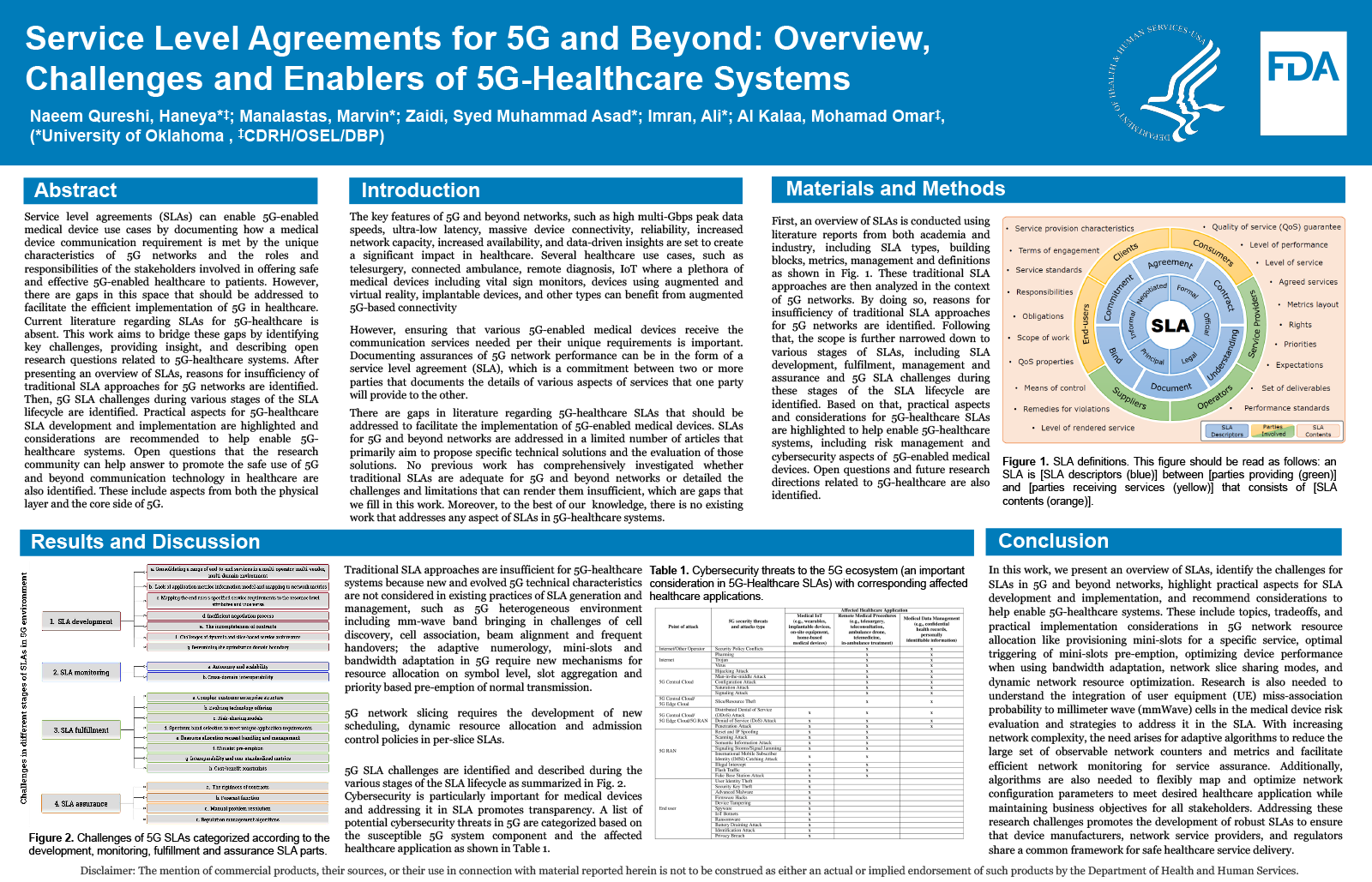
Service Level Agreements for 5G and Beyond: Overview, Challenges and Enablers of 5G-Healthcare Systems
- Authors:
- Center:
-
Contributing OfficeCenter for Devices and Radiological Health
Abstract
Service level agreements (SLAs) can enable 5G-enabled medical device use cases by documenting how a medical device communication requirement are met by the unique characteristics of 5G networks and the roles and responsibilities of the stakeholders involved in offering safe and effective 5G-enabled healthcare to patients. However, there are gaps in this space that should be addressed to facilitate the efficient implementation of 5G in healthcare. Current literature regarding SLAs for 5G-healthcare is absent. This work aims to bridge these gaps by identifying key challenges, providing insight, and describing open research questions related to SLAs in 5G and specifically 5G-healthcare systems. This can facilitate collaboration between medical device innovators and 5G network providers to enable safe patient access to 5G-enabled medical devices and services. First, an overview of SLAs is presented. Then, reasons for insufficiency of traditional SLA approaches for 5G networks are identified. Following that, 5G SLA challenges during various stages of the SLA lifecycle are identified. Based on that, practical aspects for 5G-healthcare SLA development and implementation are highlighted and several considerations are recommended to help enable 5G-healthcare systems. Open questions that the research community can help answer to promote the safe use of 5G and beyond communication technology in healthcare are identified. These include topics, tradeoffs, and practical implementation considerations in 5G network resource allocation like provisioning minislots for a specific service, optimal triggering of minislots pre-emption, optimizing device performance when using bandwidth adaptation, network slice sharing modes, and dynamic network resource optimization. Research is also needed to understand the integration of user equipment miss-association probability to mmWave cells in the medical device risk evaluation and strategies to address it in the SLA. The need for adaptive algorithms to reduce the large set of observable network counters and metrics and facilitate efficient network monitoring for service assurance also arises. Algorithms are also needed to flexibly map and optimize network configuration parameters to meet desired healthcare application while maintaining business objectives for all stakeholders. The heterogenous and multi-domain nature of 5G and beyond network illustrate the opportunity to develop collaboration frameworks to promote interoperability and service delivery.