2021 FDA Science Forum
Scientific Gap Analysis of Polymeric In Situ Forming Depot Products for the Development of GDUFA Research Projects
- Authors:
- Center:
-
Contributing OfficeCenter for Drug Evaluation and Research
Abstract
Purpose
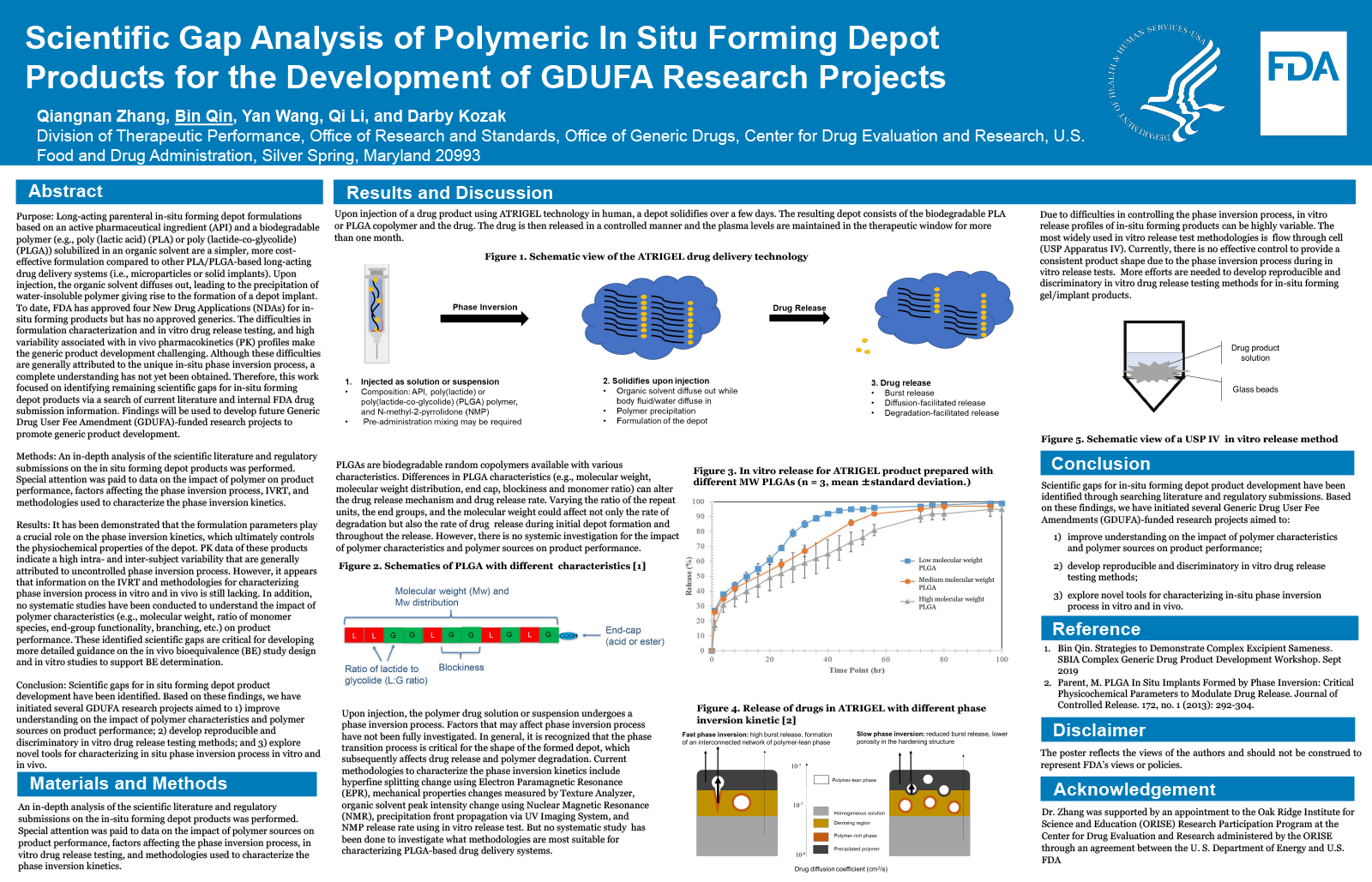
Parenteral in situ forming formulation, composed of the biodegradable polymer in organic solvent, solidifies to a depot upon injection for long-term drug release. The difficulties in formulation characterization and in vitro release testing (IVRT) as well as the high variability associated with in vivo pharmacokinetics (PK) profiles make the generic product development challenging. Although these difficulties are generally attributed to the unique in situ phase inversion process, a complete understanding has not yet been obtained. Therefore, this work focused on identifying remaining scientific gaps for in situ forming depot products. Findings has been used to develop Generic Drug User Fee Amendment (GDUFA)-funded research projects to promote generic product development.
Methods
An in-depth analysis of the scientific literature and FDA database on the in situ forming depot products was performed. Special attention was paid to data on the impact of polymer on product performance, factors affecting the phase inversion process, IVRT, and methodologies used to characterize the phase inversion kinetics.
Results
It has been demonstrated that the formulation parameters play a crucial role on the phase inversion kinetics, which ultimately controls the physiochemical properties of the depot. PK data of these products indicate a high intra- and inter-subject variability that are generally attributed to uncontrolled phase inversion process. However, it appears that information on the IVRT and methodologies for characterizing phase inversion process in vitro and in vivo is still lacking. In addition, no systematic studies have been conducted to understand the impact of polymer characteristics (e.g., molecular weight, ratio of monomer species, end-group functionality, branching, etc.) on product performance. These identified scientific gaps are critical for developing more detailed guidance on the in vivo bioequivalence (BE) study design and in vitro studies to support BE determination.
Conclusion
Scientific gaps for in situ forming depot product development have been identified. Based on these findings, we have initiated several GDUFA research projects aimed to 1) improve understanding on the impact of polymer characteristics and polymer sources on product performance; 2) develop reproducible and discriminatory in vitro drug release testing methods; and 3) explore novel tools for characterizing in situ phase inversion process in vitro and in vivo.