2023 FDA Science Forum
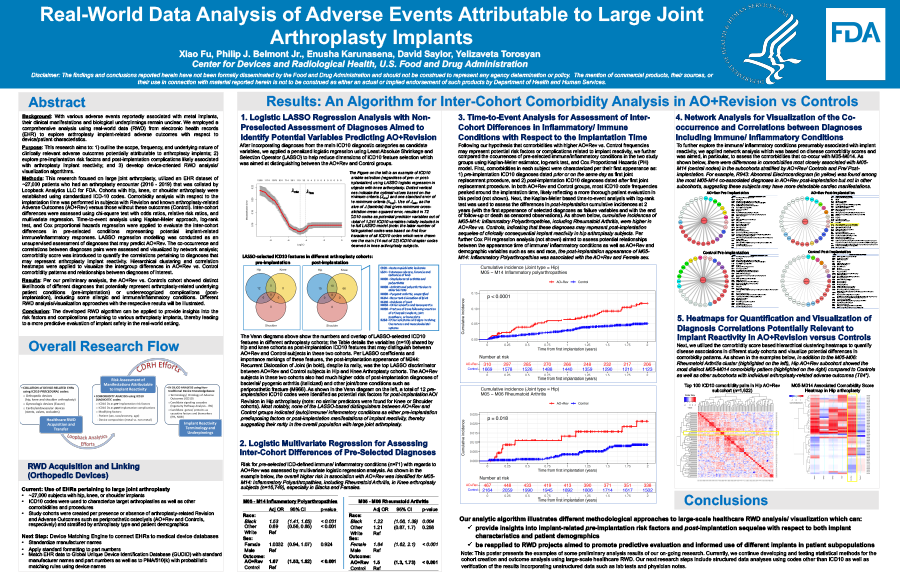
Real-World Data Analysis of Adverse Events Attributable to Large Joint Arthroplasty Implants
- Authors:
- Center:
-
Contributing OfficeCenter for Devices and Radiological Health
Abstract
Background:
With various adverse events reportedly associated with metal implants, their clinical manifestations and biological underpinnings remain unclear. We employed a comprehensive analysis using real-world data (RWD) from electronic health records (EHR) to explore arthroplasty implant-related adverse outcomes with respect to device/patient characteristics.
Purpose:
This research aims to: 1) outline the scope, frequency, and underlying nature of clinically relevant adverse outcomes potentially attributable to arthroplasty implants; 2) explore pre-implantation risk factors and post-implantation complications likely associated with arthroplasty implant reactivity; and 3) develop device-oriented RWD analysis/visualization algorithms.
Methods:
This research focused on large joint arthroplasty,utilized an EHR dataset of ~27,000 patients who had an arthroplasty encounter (2016 - 2019) that was collated by Loopback Analytics LLC for FDA. Cohorts with hip, knee, or shoulder arthroplasty were established using standardized ICD-10 codes. Comorbidity analysis with respect to the implantation time was performed in subjects with Revision and known arthroplasty-related Adverse Outcomes (AO+Rev) versus those without these outcomes (Control). Inter-cohort differences were assessed using chi-square test with odds ratios, relative risk ratios, and multivariate regression. Time-to-event analysis using Kaplan-Meier approach, log-rank test, and Cox proportional hazards regression were applied to evaluate the inter-cohort differences in pre-selected conditions representing potential implant-related immune/inflammatory responses. LASSO regression modelling was conducted as an unsupervised assessment of diagnoses that may predict AO+Rev. The co-occurrence and correlations between diagnoses pairs were assessed and visualized by network analysis; comorbidity score was introduced to quantify the correlations pertaining to diagnoses that may represent arthroplasty implant reactivity. Hierarchical clustering and correlation heatmaps were applied to visualize the intergroup differences in AO+Rev vs. Control comorbidity patterns and relationships between diagnoses of interest.
Results:
Compared to Controls, the AO+Rev cohort showed distinct likelihoods of different diagnoses that potentially represent arthroplasty-related underlying patient conditions (pre-implantation) or underrecognized complications (post-implantation), including some allergic and immune/inflammatory conditions. Different RWD analysis/visualization approaches with the respective results will be illustrated.
Conclusion:
The developed RWD algorithm can be applied for providing insights into the risk factors and complications pertaining to various arthroplasty implants, thereby optimizing leading to a more predictive evaluation of implant safety in the real-world setting.