2023 FDA Science Forum
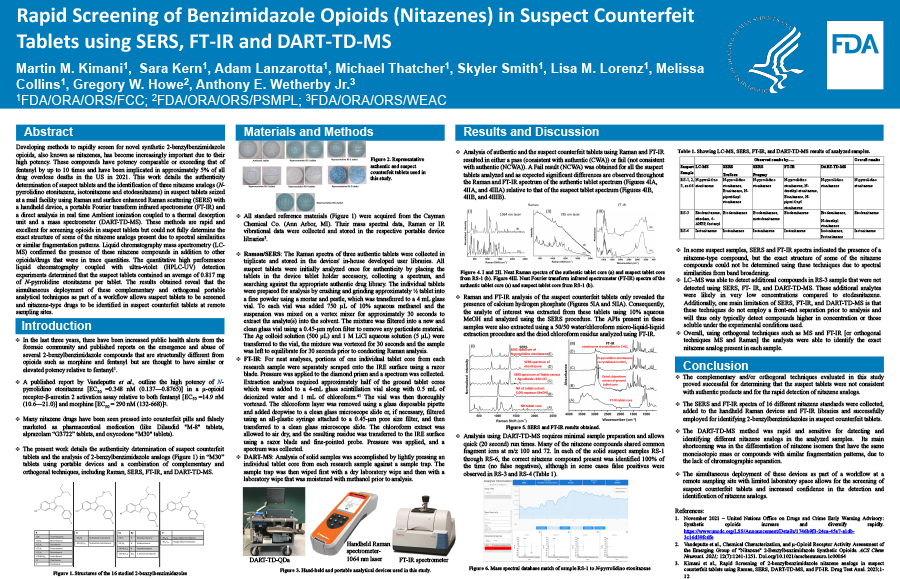
Rapid screening of 2-benzylbenzimidazole nitazene analogs in suspect counterfeit tablets using Raman, SERS, FT-IR, and DART-TD-MS
- Authors:
- Center:
-
Contributing OfficeOffice of Regulatory Affairs
Abstract
The Centers for Disease Control and Prevention estimated 107,000 drug overdose deaths in the U.S. during a 12-month period ending in August 2022, mostly attributed to synthetic opioids. The smuggling of illicit synthetic drugs such as fentanyl and 2-benzylbenzimidazole opioids through the international mail is also a growing concern and has negatively impacted the fight against the opioid epidemic in the U.S. Developing methods to rapidly screen for novel synthetic 2-benzylbenzimidazole opioids, also known as nitazenes, has become increasingly important due to their high potency. These compounds have potency comparable to or exceeding that of fentanyl by up to 10 times and have been implicated in approximately 5% of all drug overdose deaths in the U.S. in 2021. This presentation details the authenticity determination of suspect tablets and the identification of three nitazene analogs (N-pyrrolidino etonitazene, isotonitazene and etodesnitazene) in suspect tablets collected at an international mail facility using a portable device toolkit. This toolkit consisted of a handheld Raman spectrometer utilizing surface enhanced Raman scattering (SERS), a portable Fourier transform infrared (FT-IR) spectrometer and a direct analysis in real time ambient ionization coupled to a thermal desorption unit and a mass spectrometer (DART-TD-MS). These methods are rapid and excellent for screening opioids in suspect tablets but have limitations that will be discussed in detail. Liquid chromatography with mass spectral detection (LC-MS) confirmed the presence of these nitazene compounds in addition to other opioids/drugs that were present in trace quantities. Quantitative high performance liquid chromatography coupled with ultraviolet (HPLC-UV) detection determined that the composite from suspect tablets identified as RS-1 and RS-2 contained an average of 0.817 mg of N-pyrrolidine etonitazene per tablet. The minimum detectable concentration (Cmin) of nitazene opioid analogs obtained using SERS with handheld Raman spectrometers ranged from 25 ng/mL to 1 µg/mL for standards and 1.25 µg to 2.5 µg of N-pyrrolidino etonitazene per tablet for the samples. The data presented will show that the simultaneous deployment of these complementary and orthogonal portable analytical techniques, as part of a workflow, allows suspect tablets to be screened and nitazene-type drugs to be identified at remote sampling sites.