2021 FDA Science Forum
Pregnancy PBPK Modeling of UGT Substrate Labetalol: An Application of Parameter Contribution Analysis to Guide Predictive Performance of Life-Stage Models
- Authors:
- Center:
-
Contributing OfficeNational Center for Toxicological Research
Abstract
Background
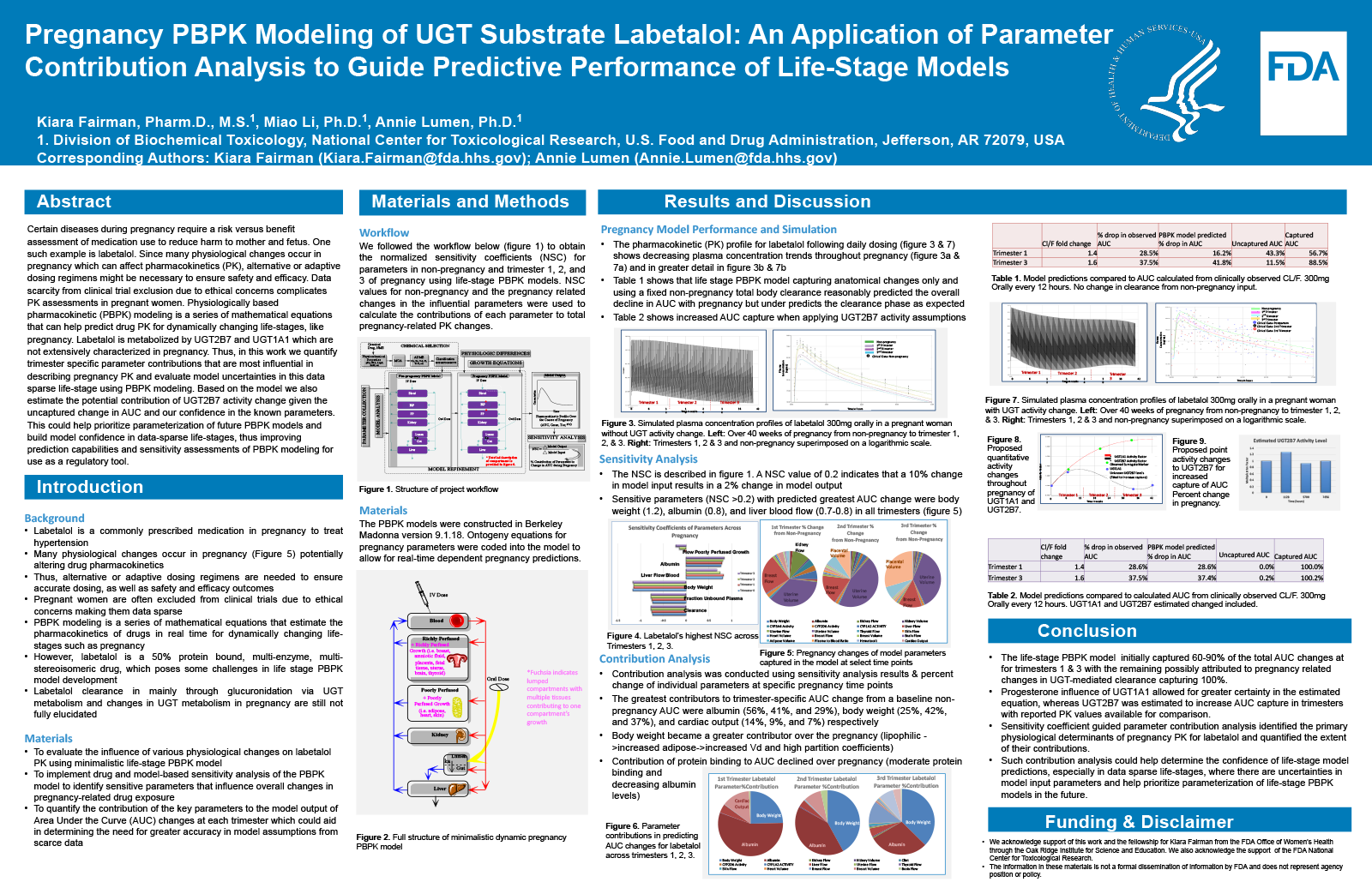
Certain diseases during pregnancy require a risk versus benefit assessment of medicine use to reduce harm to mother and fetus. One such example is labetalol commonly prescribed for gestational hypertension. Since many physiological changes occur in pregnancy which can affect pharmacokinetics (PK), alternative or adaptive dosing regimens might be necessary to ensure efficacious and safe drug therapy. Still, it is can be difficult to accurately dose pregnant women based on data as they are often excluded from clinical trials due to ethical concerns.
Purpose
Physiologically based pharmacokinetic (PBPK) modeling is a series of mathematical equations that can predict drug PK for dynamically changing life-stages, like pregnancy. Labetalol is metabolized by UGT2B7 and UGT1A1 which are not extensively characterized in pregnancy. The goal of this work is to quantify parameter contributions most influential in describing pregnancy PK and evaluate model uncertainties in data sparse life-stages using PBPK modeling.
Methodology
The pregnancy PBPK model for labetalol was constructed de novo and was evaluated using clinical PK data. Trimester-specific parameter sensitivities and their respective pregnancy related physiological changes were used to estimate individual parameter contributions to the cumulative change in AUC.
Results
For a highly lipophilic and protein bound compound, change in body weight (BW) and albumin (Alb) contributed greatly to the overall changes in AUC across trimesters (BW: 25%, 42%, 37%; Alb: 56%, 41%, 29%, respectively). Although UGT1A1 ontogeny was characterized with the limited available data, the activity change of the main metabolizing enzyme, UGT2B7, during pregnancy was not described a priori due to lack of data. The pregnancy PBPK model lacking this component still captured 56.7% of total change in AUC for trimester 1 and 88.5% in trimester 3. Based on the model analysis the potential contribution of UGT2B7 activity change was estimated.
Conclusion
The described method allows for the estimation of the extent each parameter contributes to pregnancy related PK changes. This could help prioritize parameterization of future PBPK models and build model confidence in data-sparse life-stages, thus improving prediction capabilities and sensitivity assessments of PBPK modeling for use as a regulatory tool.