2023 FDA Science Forum
Predictive Residence Time Distribution Models for Continuous Powder Blending
- Authors:
- Center:
-
Contributing OfficeCenter for Drug Evaluation and Research
Abstract
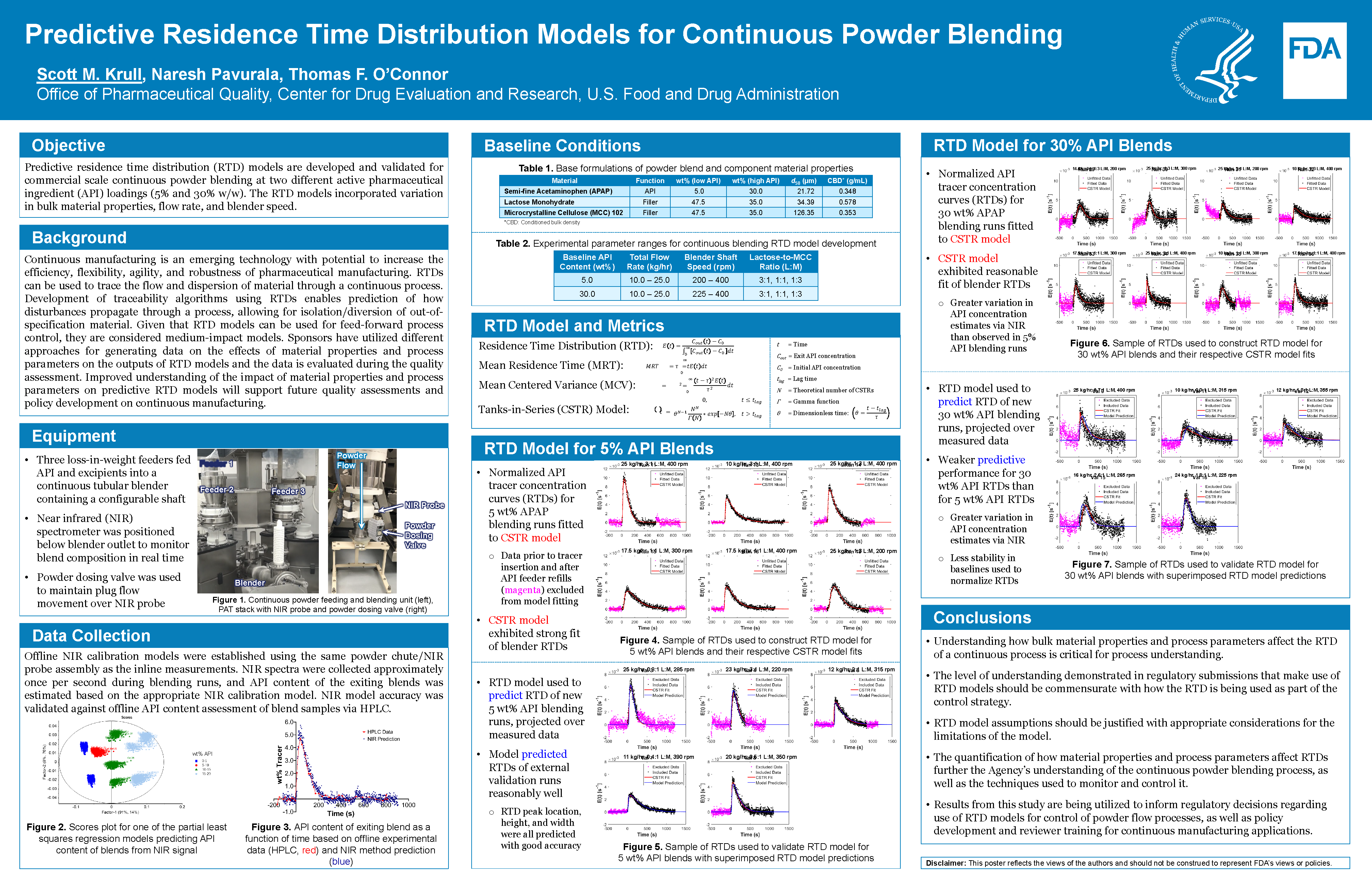
Continuous manufacturing is an emerging technology with potential to increase the efficiency, flexibility, agility, and robustness of pharmaceutical manufacturing. Residence time distributions (RTDs) can be used to trace the flow and dispersion of material through a continuous process. Development of traceability algorithms using RTDs enables prediction of how disturbances propagate through a process, allowing for isolation/diversion of out-of-specification material. Given that RTD models used for feed-forward process control are considered medium-impact, properly accounting for the effects of material properties and process parameters in such models is critical to ensure product quality in continuous manufacturing processes. Micronized acetaminophen was used as the model active pharmaceutical ingredient (API), and the bulk material was a mixture of lactose monohydrate and microcrystalline cellulose. Three loss-in-weight feeders fed API and excipients into a continuous tubular blender containing a configurable shaft. A near infrared (NIR) spectrometer was positioned below the blender outlet to monitor the composition of the blend in real time. In order to verify the accuracy of the NIR models, blend samples were taken before and after all runs, as well as once every 15 seconds for select runs, and their composition was confirmed off-line via high-performance liquid chromatography. Predictive models for the RTD of an API in a commercial scale continuous powder blender were developed at two different API loadings (5% and 30% w/w), incorporating the effects of total flow rate, blender speed, and bulk material properties. The predictive RTD models developed for each API loading were then validated against independent blending runs to assess model performance. Although reasonable predictability was observed for both API loadings, the 5% API model exhibited better performance. Additionally, challenge runs involving different particle sizes of API were performed to test the robustness and accuracy of the RTD model in different particle size ranges. The RTD model exhibited better predictive performance for blends made using smaller API particle size than blends made using larger API particle size. The quantification of how material properties and process parameters affect RTDs further understanding of the continuous powder blending process, as well as the techniques used to monitor and control it. Disclaimer: This abstract reflects the views of the authors and should not be construed to represent FDA’s views or policies.