2023 FDA Science Forum
Predicting Solvent Exchange Recovery from Solvent Partition Coefficients
- Authors:
- Center:
-
Contributing OfficeCenter for Devices and Radiological Health
Abstract
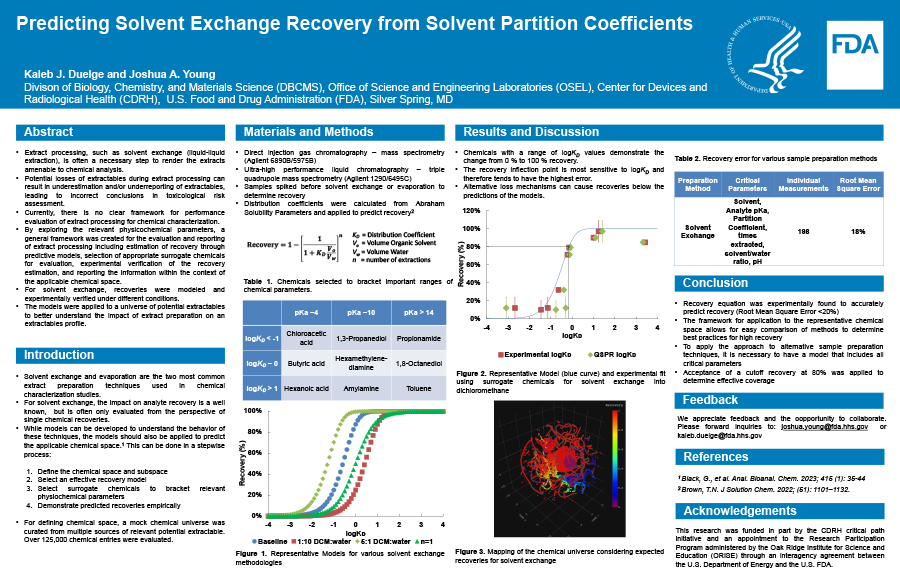
Chemical characterization of medical devices is used to address some biocompatibility endpoints instead of animal testing. However, certain challenges in conducting chemical characterization, such as selection of appropriate extract preparation methods, require refinement to ensure reliable chemistry data is obtained. This work demonstrates predictable recoveries during common sample preparation techniques needed for analytical instrumentation used for chemical characterization. Specifically, the systematic evaluation of solvent exchange practices is explored herein, where analytes of interest are transferred from a water extract to dichloromethane. The framework for predicting recovery includes four steps:
- Define a chemical subspace: all the possible chemicals that are of interest for the analysis.
- Choose a model that describes that recovery of the sample preparation technique.
- Choose surrogate chemicals with different values for a property of interest that governs recovery.
- Measure the experimental recovery to verify the model.
The recovery measurements were made using gas chromatography - mass spectrometry by comparing samples prepared directly in dichloromethane with those prepared in water and exchanged into dichloromethane. Recovery measurements were made using 9 chemicals with a range of pKa values and partition coefficients (the governing properties). Shifts in the sigmoidal recovery distribution (recovery vs. partition coefficient) were demonstrated for various solvent exchange scenarios such as dichloromethane to water volume ratio and exchange iterations. The experimental measurements of recovery were compared to predicted recoveries to demonstrate efficacy of the model and a 70% recovery cut-off was selected as the minimum recovery for an analyte to be considered successfully solvent exchanged.
The model was then applied to the entire chemical subspace to determine recovery performance of any permutation of solvent exchange parameters. This approach demonstrates the ability to predict the recovery of a wide range of chemicals using different solvent exchange methods. The flexibility of the approach avoids recommending a best practice approach that may not be applicable to all scenarios. Additionally, the framework of this approach can be extended to a variety of other sample preparation techniques, such as sample evaporation to increase concentration.