2021 FDA Science Forum
Preclinical Performance Testing of Medical Devices with Antimicrobial Effects: Shifting the Focus from “Bench” to “Bedside”
- Authors:
- Center:
-
Contributing OfficeCenter for Devices and Radiological Health
Abstract
Preclinical testing is an important part of the feedback loop that precedes clinical testing and regulatory decision making. There are currently no standardized or widely recognized preclinical testing methods for medical devices and combination products with antimicrobial effects. In vitro methods for these devices have significant limitations and there is no consensus. It is important to develop an approach that can help determine the most effective methods for testing, and to identify gaps in current testing where standardized tests are needed. While in-vitro testing can’t replace most clinical studies at present, it has the potential to help select devices with superior safety and efficacy and to better understand factors that contribute to a successful device with antimicrobial effects, ultimately benefitting patients.
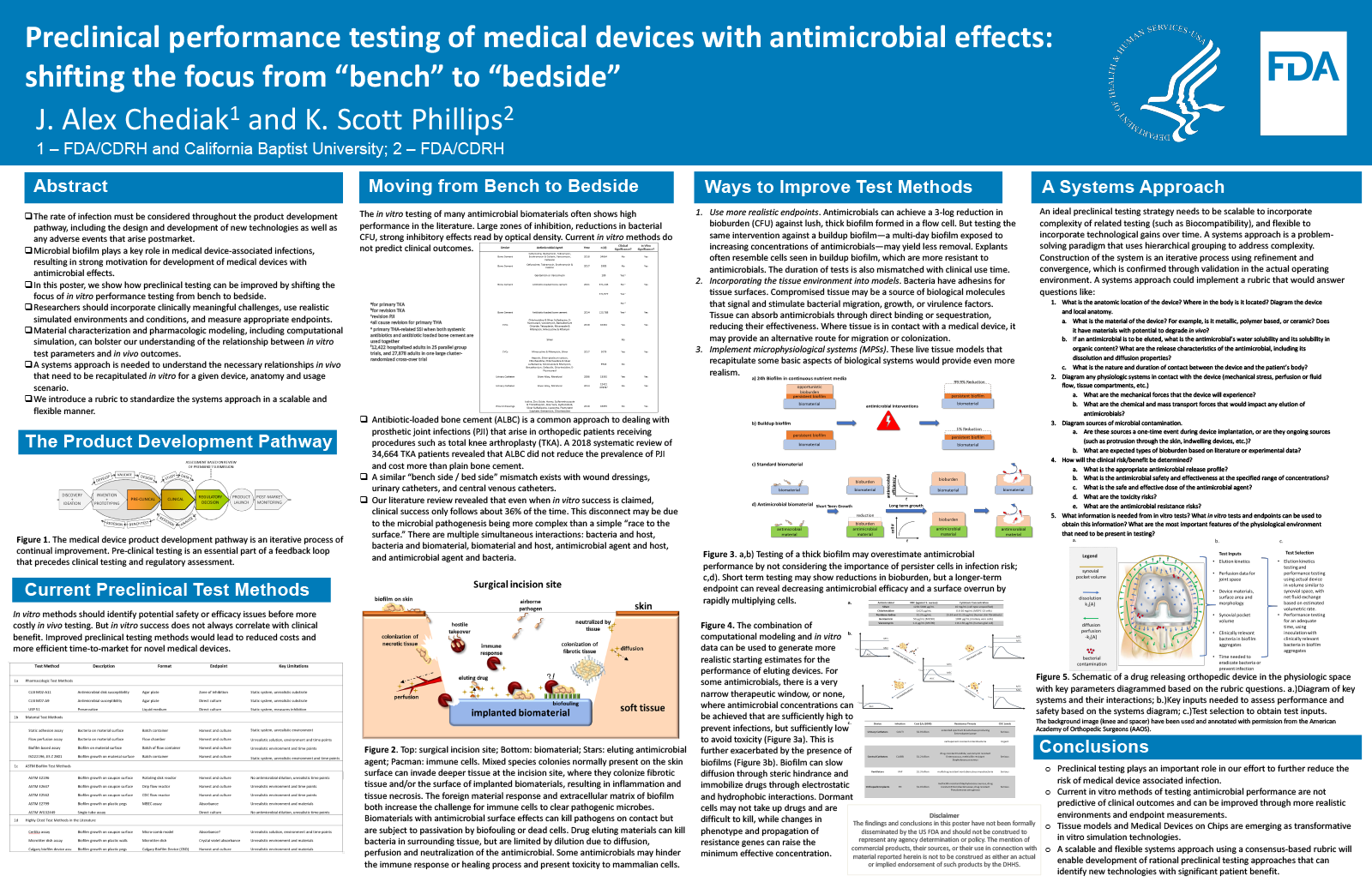
In this poster, we will first review four currently marketed combination products with antimicrobial effects (wound dressings, urinary catheters, bone cement and venous catheters) and review literature meta-analysis of clinical trials with these products. We will compare in vitro testing results in the literature for these devices with the outcomes on infection rates as determined by clinical studies. Next, we will discuss the limitations of current in vitro methods for predicting clinical performance. We will review current preclinical testing of an analogous combination product, drug eluting stents, to see what can be learned from existing approaches. Then we will introduce a new approach to thinking about in vitro testing for devices with antimicrobial effects using a systems approach. This approach includes a rubric that standardizes how an in vitro test approach is developed. It considers the anatomy, physiology and physical factors interacting with a device. From the rubric, the most appropriate test methods available at any given time can be chosen. We will consider the concept example of an orthopedic implant in the joint space to show how the rubric could simplify current approaches and achieve consensus among all stakeholders. We will also identify gaps in current in vitro testing and discuss two technologies with potential to radically transform the field: tissue models and medical devices-on-chips.