2023 FDA Science Forum
Polysorbate 20 degradation in biotherapeutic formulations and its impact on protein quality
- Authors:
- Center:
-
Contributing OfficeCenter for Drug Evaluation and Research
Abstract
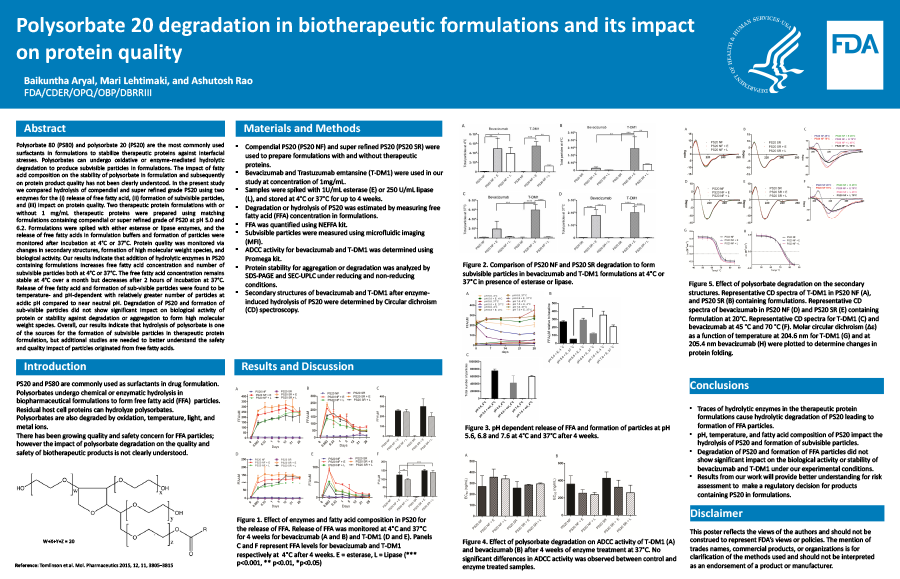
Polysorbate 80 and polysorbate 20 are the most commonly used surfactants in formulations to stabilize therapeutic proteins against interfacial stresses. Polysorbates can undergo oxidative or enzyme-mediated hydrolytic degradation to produce subvisible particles in formulations. The impact of fatty acid composition on the stability of polysorbate in formulation and subsequently on protein product quality has not been clearly understood. In the present study we compared the hydrolysis of compendial and super refine grade polysorbate 20 using two enzymes for the (i) release free fatty acid, (ii) formation of subvisible particles, and (iii) impact of polysorbate 20 degradation on protein quality.
Three therapeutic protein formulations with or without 1mg/mL therapeutic protein were prepared using matching formulation buffers containing compendial or super refine grade of polysorbate 20 with pH ranging from 4.0 to 6.2. Formulations were spiked with either esterase or lipase enzymes, and the release of free fatty acids in formulation buffers and formation of particles were monitored after incubation at 4°C or 37°C. Protein quality was monitored via changes in secondary structures, formation of high molecular weight species, and biological activity.
Our results indicate that addition of hydrolytic enzymes increase free fatty acid concentration and number of subvisible particles in formulation buffer at 4°C or 37°C for both grades of polysorbate 20. The free fatty acid concentration remains stable at 4°C over a month but decreases after 2 hours of incubation at 37°C. Release of free fatty acid and formation of sub-visible particles were found to be temperature- and pH-dependent with relatively greater number of particles at acidic pH compared to near neutral pH. Degradation of polysorbate 20 and formation of sub-visible particles did not show significant impact on biological activity of protein or stability against degradation or aggregation to form high molecular weight species. Overall, our results indicate that hydrolysis of polysorbate is one of the sources for the formation of subvisible particles in therapeutic protein formulation, but additional studies are required to better understand the safety and quality impact of particles originated from free fatty acids.