2023 FDA Science Forum
Pediatric-Specific Evaluations for Deep Learning CT Image Reconstruction and Denoising Techniques
- Authors:
- Center:
-
Contributing OfficeCenter for Devices and Radiological Health
Abstract
Background
Deep learning (DL)-based reconstruction and denoising techniques have potential to improve image quality in low-dose CT images and are already cleared by the FDA in several commercial products. These data-driven techniques might perform differently on different groups of patient population. Deeper understanding of the device performance on pediatric patient populations will significantly help us regulate this type of device.
Purpose
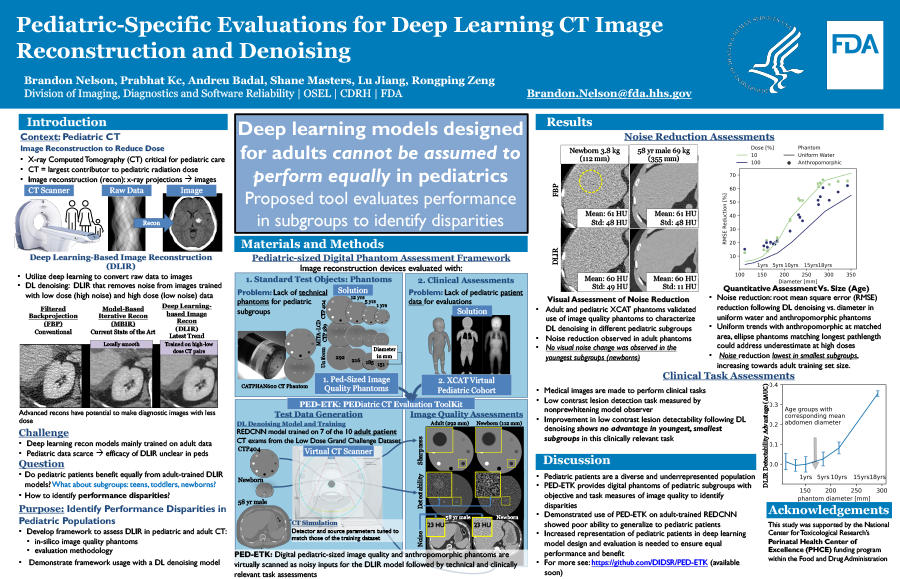
In silico quality control phantoms and evaluation methodology were designed to assess the performance of DL denoising in pediatric and adult CT scans. Preliminary evidence for a gap in image quality performance between pediatric and adult patients is shown through phantom simulation.
Methods
Pediatric-sized CATPHAN600 and MITA-LCD image quality (IQ) phantoms were simulated with effective diameters of patients ranging from newborns to 18 years old. Adult CT images were simulated using standard-size phantoms scanned with adult scan protocols. Pediatric images were simulated with pediatric-sized phantoms and adjusted pediatric protocols. REDCNN, a DL image denoising model trained on adult images, was used to process both adult and pediatric images. Noise texture, image sharpness, CT number accuracy, and low contrast detectability were used to evaluate and compare adult and pediatric groups with and without processing to assess group-dependent performance differences.
Results
We identified patient size differences between adult and pediatric patients to influence the DL model performance. When applied to adult images the DL model achieved a 60% reduction in standard deviation noise without loss in high contrast sharpness. However, in younger and smaller patients model performance dropped substantially yielding no change in image quality. A contributing factor was field of view (FOV) differences between adult and pediatric protocols influencing noise texture, a property previously identified to influence generalizability of DL-based CT denoising.
Conclusions
We developed a framework for pediatric evaluation of DL image reconstruction and denoising models. We identified that FOV differences between adult and pediatric protocols must be accounted for in model training. Furthermore, performance gaps were found in uniform phantoms only by changing their size. Future work will explore the impacts of anatomic variations between pediatrics and adults as well as protocol differences between these groups.