2021 FDA Science Forum
Novel Group Sequential Comparative Clinical Endpoint Bioequivalence Study
- Authors:
- Center:
-
Contributing OfficeCenter for Drug Evaluation and Research
Abstract
Background
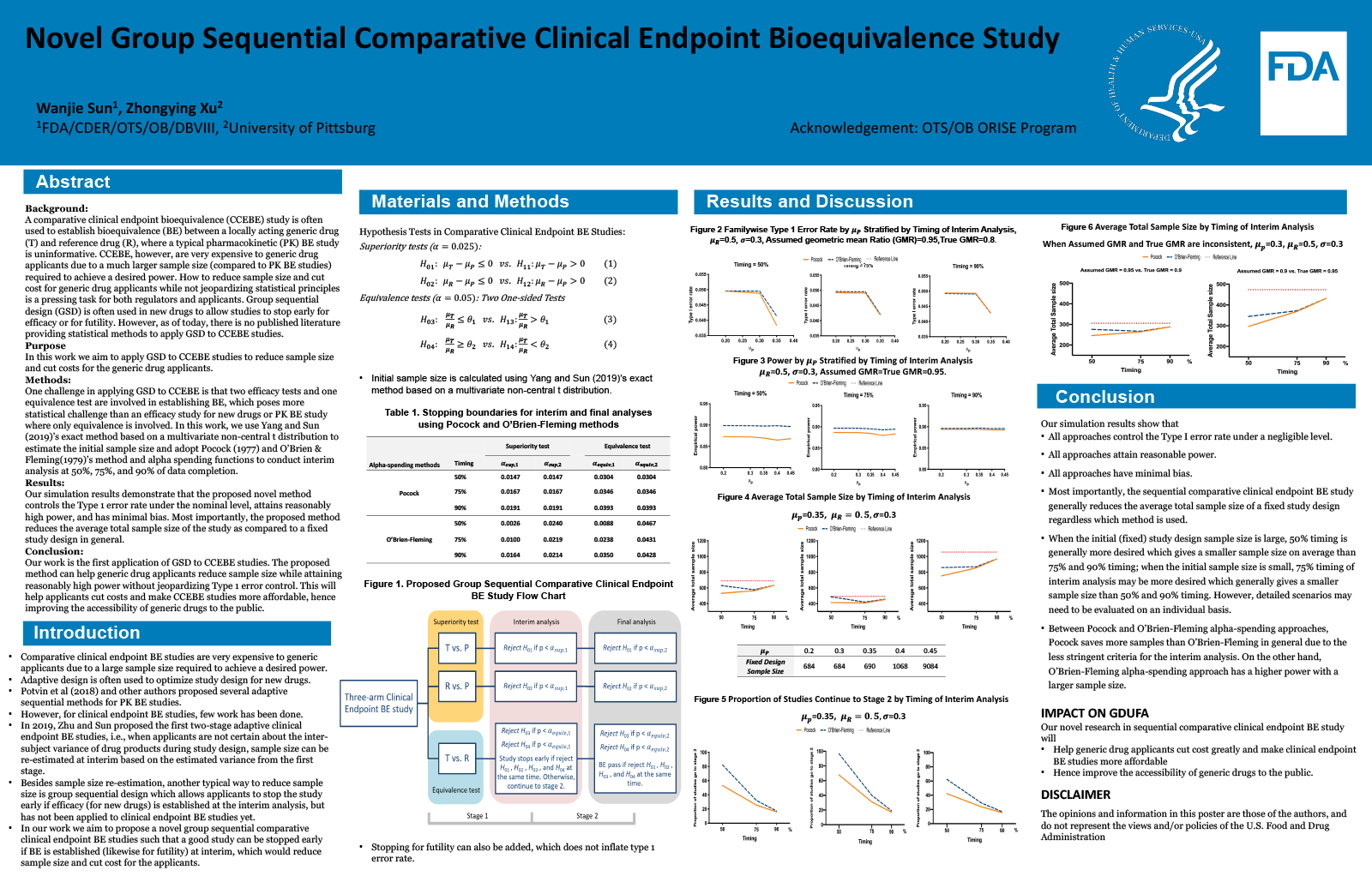
A comparative clinical endpoint bioequivalence (CCEBE) study is often used to establish bioequivalence (BE) between a locally acting generic drug (T) and reference drug (R), where a typical pharmacokinetic (PK) BE study is uninformative. CCEBE, however, are very expensive to generic drug applicants due to a much larger sample size (compared to PK BE studies) required to achieve a desired power. How to reduce sample size and cut cost for generic drug applicants while not jeopardizing statistical principles is a pressing task for both regulators and applicants. Group sequential design (GSD) is often used in new drugs to allow studies to stop early for efficacy or for futility. However, as of today, there is no published literature providing statistical methods to apply GSD to CCEBE studies.
Purpose
In this work we aim to apply GSD to CCEBE studies to reduce sample size and cut costs for the generic drug applicants.
Methods
One challenge in applying GSD to CCEBE is that two efficacy tests and one equivalence test are involved in establishing BE, which poses more statistical challenge than an efficacy study for new drugs or PK BE study where only equivalence is involved. In this work, we use Yang and Sun (2019)’s exact method based on a multivariate non-central t distribution to estimate the initial sample size and adopt Pocock (1977) and O’Brien & Fleming(1979)’s method and alpha spending functions to conduct interim analysis at 50%, 75%, and 90% of data completion.
Results
Our simulation results demonstrate that the proposed novel method controls the Type 1 error rate under the nominal level, attains reasonably high power, and has minimal bias. Most importantly, the proposed method reduces the average total sample size of the study as compared to a fixed study design in general.
Conclusion
Our work is the first application of GSD to CCEBE studies. The proposed method can help generic drug applicants reduce sample size while attaining reasonably high power without jeopardizing Type 1 error control. This will help applicants cut costs and make CCEBE studies more affordable, hence improving the accessibility of generic drugs to the public.