2023 FDA Science Forum
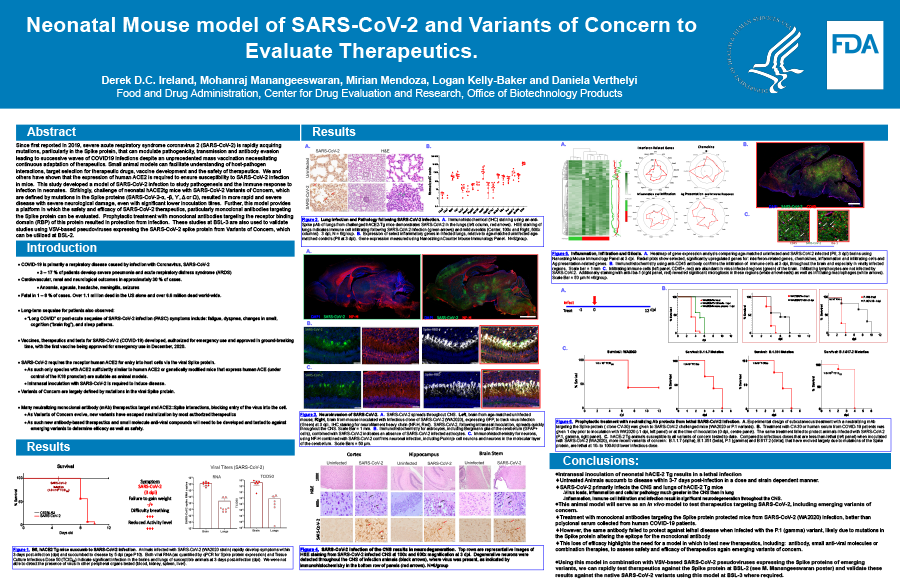
Neonatal Mouse model of SARS-CoV-2 and Variants of Concern to Evaluate Therapeutics
- Authors:
- Center:
-
Contributing OfficeCenter for Drug Evaluation and Research
Abstract
Since first reported in 2019, severe acute respiratory syndrome coronavirus 2 (SARS-CoV-2) is rapidly acquiring mutations, particularly in the Spike protein, that can modulate pathogenicity, transmission and antibody evasion leading to successive waves of COVID19 infections despite an unprecedented mass vaccination necessitating continuous adaptation of therapeutics. Small animal models can facilitate understanding of host-pathogen interactions, target selection for therapeutic drugs, vaccine development and the safety of therapeutics. We and others have shown that the expression of human ACE2 is required to ensure susceptibility to SARS-CoV-2 infection in mice. This study developed a model of SARS-CoV-2 infection to study pathogenesis and the immune response to infection in neonates. Strikingly, challenge of neonatal hACE2tg mice with SARS-CoV-2 Variants of Concern, which are defined by mutations in the Spike proteins (SARS-CoV-2-α, -β, ϒ, Δ or Ω), resulted in more rapid and severe disease with severe neurological damage, even with significant lower inoculation titres. Further, this model provides a platform in which the safety and efficacy of SARS-CoV-2 therapeutics, particularly monoclonal antibodies targeting the Spike protein can be evaluated. Prophylactic treatment with monoclonal antibodies targeting the receptor binding domain (RBP) of this protein resulted in protection from infection. These studies at BSL-3 are also used to validate studies using VSV-based pseudoviruses expressing the SARS-CoV-2 spike protein from Variants of Concern, which can be utilized at BSL-2.