2021 FDA Science Forum
NARMS* One Health Metagenomic Surveillance of Antimicrobial Resistance in Water
- Authors:
- Center:
-
Contributing OfficeCenter for Veterinary Medicine
Abstract
Antibiotic resistance (AMR) has been described as the biggest public health challenge of our time – an issue made even more significant as we face a global pandemic, where recovery from Coronavirus Disease 2019 intersects with a complex array of secondary infections and immune and microbiome mediated factors. A prominent focus of the National Antimicrobial Resistance Monitoring System (NARMS) of the Center for Veterinary Medicine’s One Health research program is the metagenomic, quasimetagenomic, genomic and microbiologic evaluation of water that intersects the human, animal and environmental health. Water is fundamental to healthy food, and antimicrobial resistance elements present in water are constituents of a baseline that is critical to surveil and steward. Collaborative work between FDA and USDA is optimizing sample collection protocols and laboratory and bioinformatic methods to identify resistance genes in environmental and food production water sources.
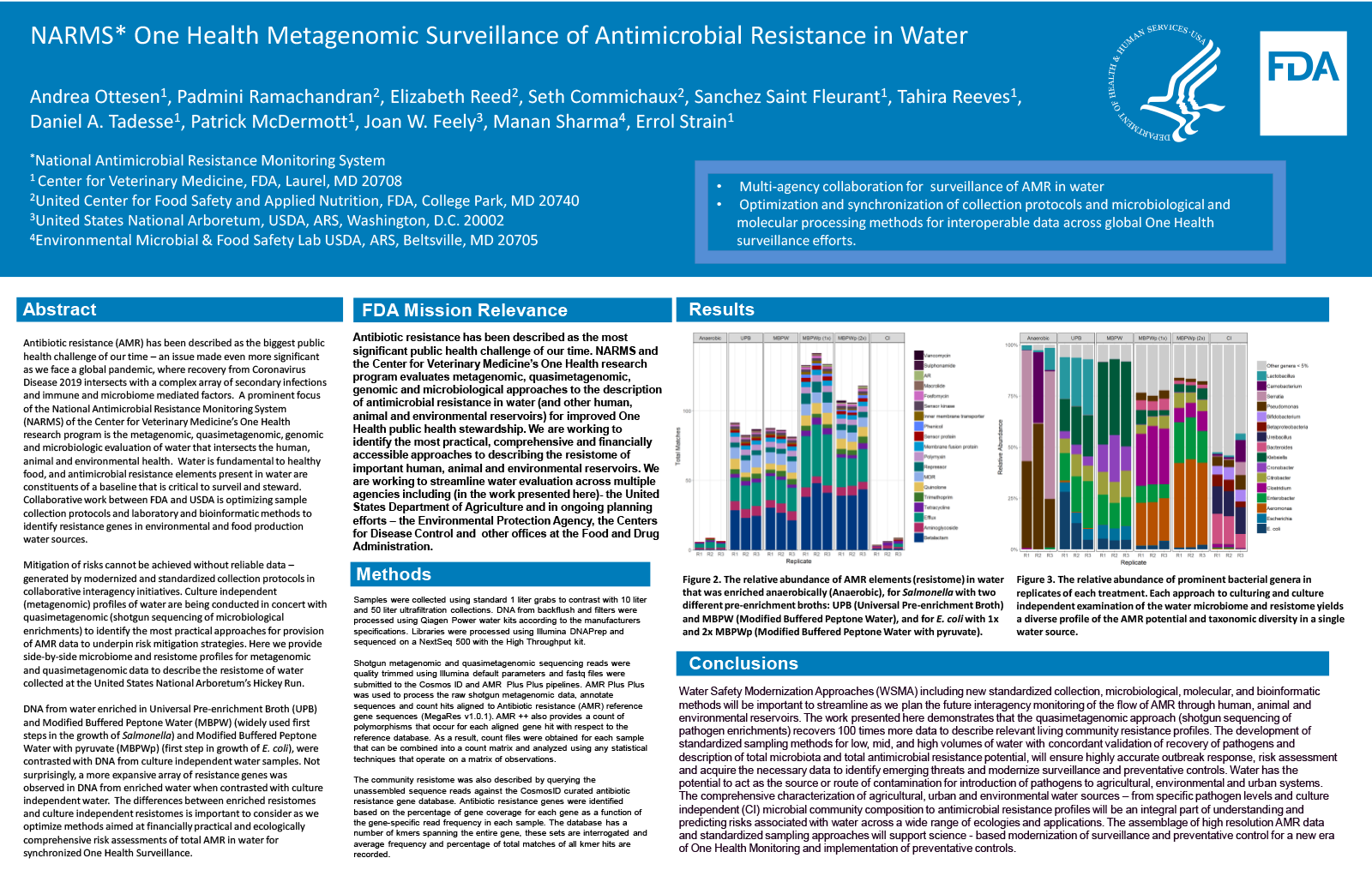
Mitigation of risks cannot be achieved without reliable data – generated by modernized and standardized collection protocols. Culture independent (metagenomic) profiles are being conducted in concert with quasimetagenomic (shotgun sequencing of microbiological enrichments) to identify the most practical approaches for provision of data to underpin risk mitigation strategies. Here we provide side-by-side microbiome and resistome profiles for metagenomic and quasimetagenomic data to describe the resistome of three water sources.
DNA from water enriched in Universal Pre-enrichment Broth (UPB) and Modified Buffered Peptone Water (MBPW) (widely used first steps in the growth of Salmonella) and Modified Buffered Peptone Water with pyruvate (MBPWp) (first step in growth of E. coli), were contrasted with DNA from culture independent water samples. Not surprisingly, a more expansive array of resistance genes was observed in DNA from enriched water when contrasted with culture independent water. The differences between enriched resistomes and culture independent resistomes is important to consider as we optimize methods aimed at financially practical and ecologically comprehensive risk assessments of total AMR in water for synchronized One Health Surveillance.