2021 FDA Science Forum
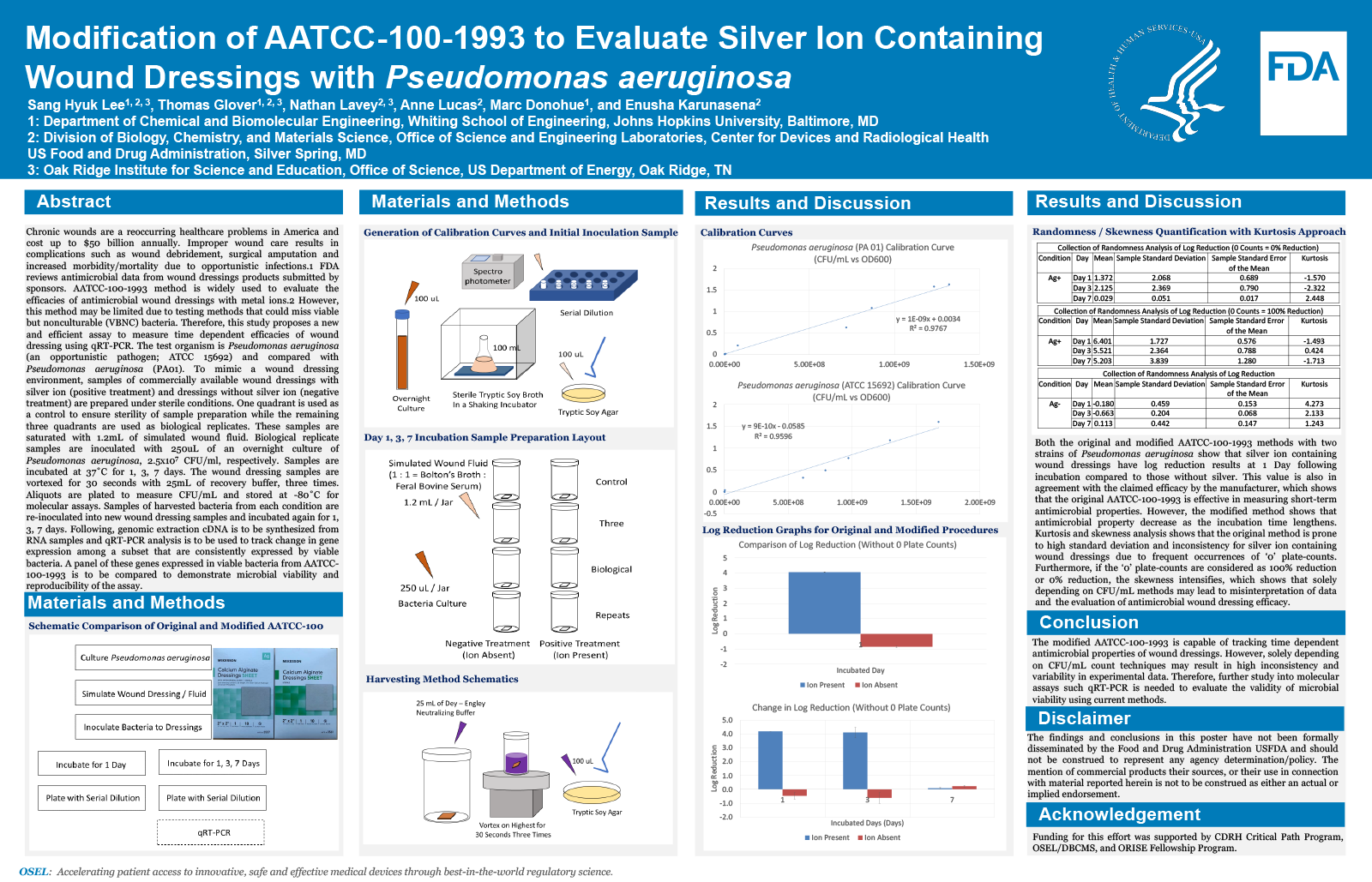
A Modified Procedure for AATCC-100-1993 to Account for Viable but Non-Culturable (VBNC) Bacteria and Evaluate Silver Ion Containing Wound Dressings with Pseudomonas Aeruginosa
- Authors:
- Center:
-
Contributing OfficeCenter for Devices and Radiological Health
Abstract
Chronic wounds are reoccurring healthcare problems in America, cost up to $50 billion annually. Improper wound care results in complications such as wound debridement, surgical amputation and increased morbidity/mortality due to opportunistic infections.1 USFDA reviews antimicrobial data from wound dressings products submitted by sponsors. AATCC-100-1993 method is widely used to evaluate the efficacies of antimicrobial wound dressings with metal ions.2 However, this method may be limited due to testing methods that could miss viable but nonculturable (VBNC) bacteria. Therefore, this study proposes a new and efficient assay to measure time dependent efficacies of wound dressing using qRT-PCR. The test organism is Pseudomonas aeruginosa (an opportunistic pathogen; ATCC 15692) and will be also be compared with Pseudomonas aeruginosa (PA01). To mimic a wound dressing environment, samples of commercially available wound dressings with silver ion (positive treatment) and dressings without silver ion (negative treatment) are prepared under sterile conditions. One quadrant is used as a control to ensure sterility of sample preparation while the remaining three quadrants are used as biological repeats. These samples are saturated with 1.2mL of simulated wound fluid. Biological replicate samples are inoculated with 250uL of an overnight culture of Pseudomonas aeruginosa, 2.5x10⁵ CFU/ml, respectively. Samples are incubated at 37˚C for 1, 3, 7 days. The wound dressing samples are vortexed for 30 seconds with 25mL of recovery buffer, three times. Aliquots are plated to measure CFU/mL and stored at -80˚C for molecular assays. Samples of harvested bacteria from each condition are re-inoculated into new wound dressing samples and incubated again for 1, 3, 7 days. Following, genomic extraction cDNA is synthesized from RNA samples and qRT-PCR analysis is used to track change in expression of specific genes such as lasI, fliG, fleN, fliN, fliC, fliF, flgK, flgG to identify a subset that are consistently expressed by viable bacteria. A panel of genes expressed in viable bacteria from AATCC-100-1993 is compared to demonstrate microbial viability and reproducibility of the new assay.