2023 FDA Science Forum
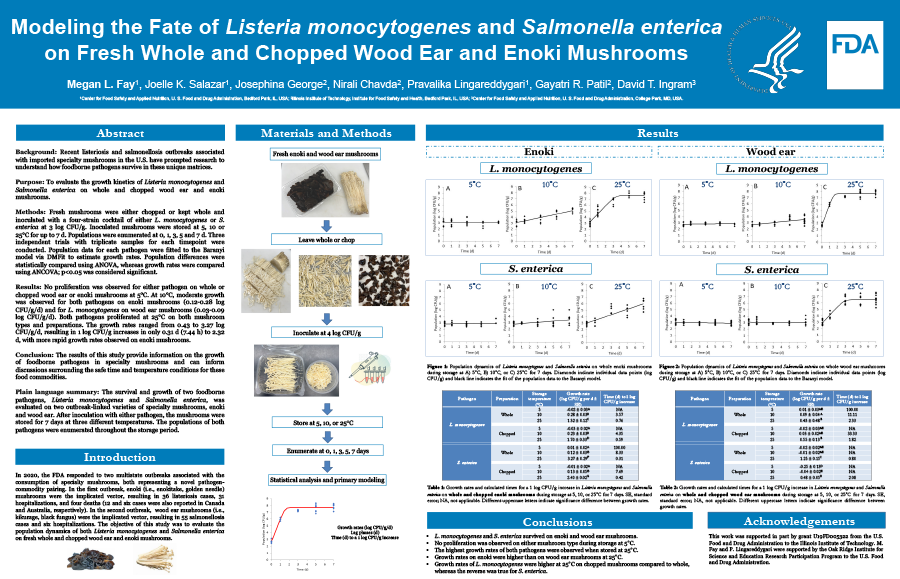
Modeling the Fate of Listeria monocytogenes and Salmonella enterica on Fresh Whole and Chopped Wood Ear and Enoki Mushrooms
- Authors:
- Center:
-
Contributing OfficeCenter for Food Safety and Applied Nutrition
Abstract
Background:
Recent listeriosis and salmonellosis outbreaks associated with imported specialty mushrooms in the U.S. have prompted research to understand how foodborne pathogens survive in these unique matrices. Purpose: To evaluate the growth kinetics of Listeria monocytogenes and Salmonella enterica on whole and chopped wood ear and enoki mushrooms. Methods: Fresh mushrooms were either chopped or kept whole and inoculated with a four-strain cocktail of either L. monocytogenes or S. enterica at 3 log CFU/g. Inoculated mushrooms were stored at 5, 10 or 25°C for up to 7 d. Populations were enumerated at 0, 1, 3, 5 and 7 d. Three independent trials with triplicate samples for each timepoint were conducted. Population data for each pathogen were fitted to the Baranyi model via DMFit to estimate growth rates. Population differences were statistically compared using ANOVA, whereas growth rates were compared using ANCOVA; p<0.05 was considered significant. Results: No proliferation was observed for either pathogen on whole or chopped wood ear or enoki mushrooms at 5°C. At 10°C, moderate growth was observed for both pathogens on enoki mushrooms (0.12-0.28 log CFU/g/d) and for L. monocytogenes on wood ear mushrooms (0.03-0.09 log CFU/g/d). Both pathogens proliferated at 25°C on both mushroom types and preparations. The growth rates ranged from 0.43 to 3.27 log CFU/g/d, resulting in 1 log CFU/g increases in only 0.31 d (7.44 h) to 2.32 d, with more rapid growth rates observed on enoki mushrooms. Conclusion: The results of this study provide information on the growth of foodborne pathogens in specialty mushrooms and can inform discussions surrounding the safe time and temperature conditions for these food commodities.