2023 FDA Science Forum
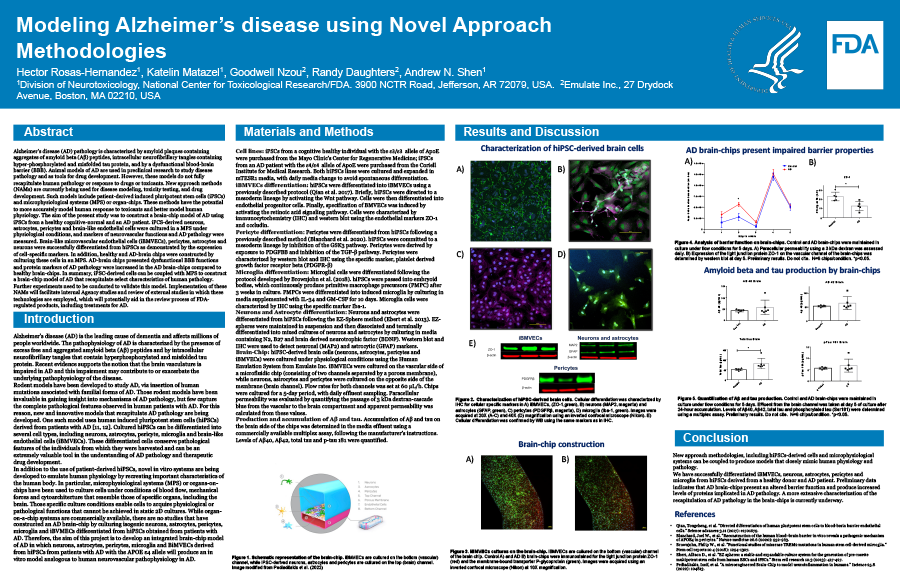
Modeling Alzheimer’s disease using Novel Approach Methodologies
- Authors:
- Center:
-
Contributing OfficeNational Center for Toxicological Research
Abstract
Alzheimer’s disease (AD) pathology is characterized by amyloid plaques containing aggregates of amyloid beta (Aβ) peptides, intracellular neurofibrillary tangles containing hyper-phosphorylated and misfolded tau protein, and by a dysfunctional blood-brain barrier (BBB). Animal models of AD are used in preclinical research to study disease pathology and as tools for drug development. However, these models do not fully recapitulate human pathology or response to drugs or toxicants. New approach methods (NAMs) are currently being used for disease modeling, toxicity testing, and drug development. Such models include patient-derived induced pluripotent stem cells (iPSCs) and microphysiological systems (MPS) or organ-chips. These methods have the potential to more accurately model human response to toxicants and better model human physiology. The aim of the present study was to construct a brain-chip model of AD using iPSCs from a healthy cognitive-normal and an AD patient. iPCS-derived neurons, astrocytes, pericytes and brain-like endothelial cells were cultured in a MPS under physiological conditions, and markers of neurovascular functions and AD pathology were measured. Brain-like microvascular endothelial cells, pericytes, astrocytes and neurons were successfully differentiated from hiPSCs as demonstrated by the expression of cell-specific markers. In addition, healthy and AD-brain chips were constructed by culturing these cells in an MPS. AD-brain chips presented dysfunctional BBB functions and protein markers of AD pathology were increased in the AD brain-chips compared to healthy brain-chips. In summary, iPSC-derived cells can be coupled with MPS to construct a brain-chip model of AD that recapitulate select characteristics of human pathology. Further experiments need to be conducted to validate this model. Implementation of these NAMs will facilitate internal Agency studies and review of external studies in which these technologies are employed, which will potentially aid in the review process of FDA-regulated products, including treatments for AD.