2023 FDA Science Forum
A microphysiological model of human lung airway for evaluating dissolution and permeability of inhaled drugs
- Authors:
- Center:
-
Contributing OfficeCenter for Drug Evaluation and Research
Abstract
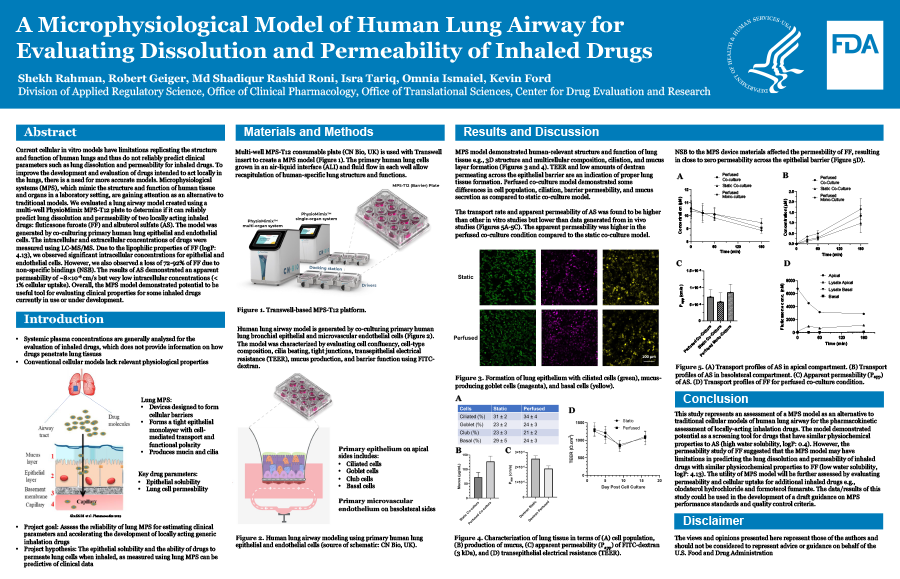
Current cellular in vitro models have limitations in replicating the structure and function of human lungs and thus do not reliably predict clinical parameters such as lung dissolution and permeability for inhaled drugs. Systemic plasma concentrations are generally analyzed for the evaluation of inhaled drugs, which does not provide information on how drugs penetrate lung tissues. To improve the development and evaluation of drugs intended to act locally in the lungs, there is a need for more accurate models. Microphysiological systems (MPS), which mimic the structure and function of human tissue and organs in a laboratory setting, are gaining attention as an alternative to traditional models. We evaluated a lung airway model created using CN Bio’s multi-well PhysioMimix MPS-T12 plate to determine if it can reliably predict lung dissolution and permeability of four locally acting inhaled drugs: fluticasone furoate (FF), albuterol sulfate (AS), olodaterol hydrocholoride (OH), and formoterol fumarate (FFU). The model was generated by co-culturing primary human lung epithelial and endothelial cells and characterized by evaluating cell confluency, cell-type composition, cilia beating, tight junctions, transepithelial electrical resistance, mucus production, and barrier permeability. The intracellular and extracellular concentrations of drugs were measured using LC-MS/MS. Due to the lipophilic properties of FF (logP: 4.13), we observed significant intracellular concentrations for epithelial and endothelial cells. However, we also observed a loss of 72-92% of FF due to non-specific bindings (NSB) to the MPS device materials, which affected the permeability of FF across the epithelial barrier. The results of FF suggest that the MPS model may have the limitations in accurately predicting the lung dissolution and permeability of inhaled drugs with similar physicochemical properties to FF. On the other hand, preliminary results of AS showed good permeability (2.86×10^-6 cm/s) but very low intracellular concentrations (< 1% cellular uptake). NSB was not observed for AS due to high water solubility and low lipophilicity (logP: 0.44). The results of AS were consistent with the drug's properties and previous research. Permeability results for OH and FFU will also be evaluated and presented. Overall, the MPS model demonstrated potential to be useful tool for evaluating clinical properties for some inhaled drugs currently in use or under development.