2023 FDA Science Forum
Methods to Decontaminate and Repurpose Laboratory Grade Pipette Tips
- Authors:
- Center:
-
Contributing OfficeCenter for Devices and Radiological Health
Abstract
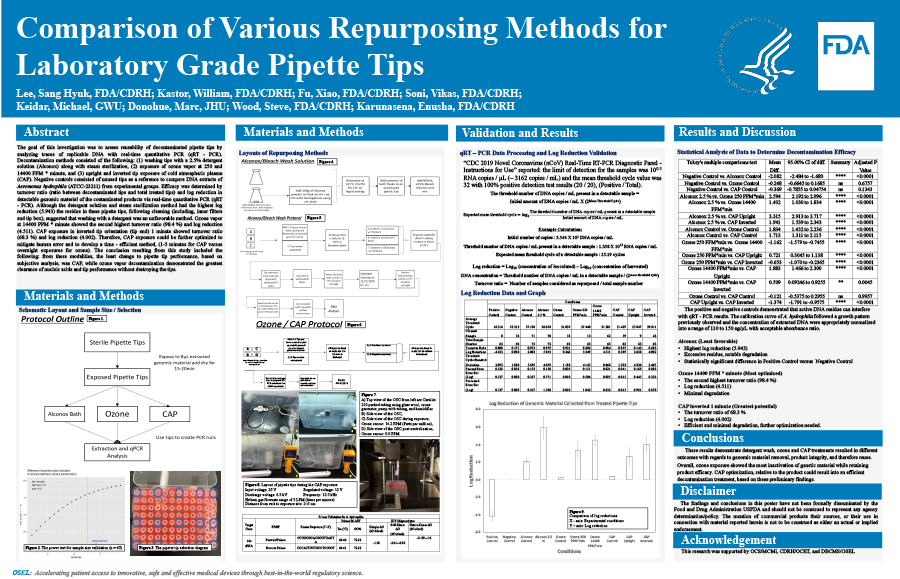
The goal of this investigation was to assess reusability of decontaminated pipette tips by analyzing traces of replicable DNA with real-time quantitative PCR (qRT - PCR). Decontamination methods consisted of the following: (1) washing tips with a 2.5% detergent solution (Alconox) along with steam sterilization, (2) exposure of ozone vapor at 250 and 14400 PPM * minute, and (3) upright and inverted tip exposure of cold atmospheric plasma (CAP). Negative controls consisted of unused tips as a reference to compare DNA extracts of Aeromonas hydrophila (ATCC-23211) from experimental groups. Efficacy was determined by turnover ratio (ratio between decontaminated tips and total treated tips) and log reduction in detectable genomic material of the contaminated products via real-time quantitative PCR (qRT - PCR).
Although the detergent solution and steam sterilization method had the highest log reduction (5.943) the residue in these pipette tips, following cleaning (including, inner filters and tip box), suggested that washing with a detergent was an unfavorable method. Ozone vapor at 14400 PPM * minute showed the second highest turnover ratio (98.4 %) and log reduction (4.511). CAP exposure in inverted tip orientation (tip end) 1 minute showed the third highest turnover ratio (68.3 %) and log reduction (4.002). Relatively, lower turnover ratio and log reduction of CAP could be attributed to absence of a streamlined procedure. Therefore, CAP exposure could be further optimized to mitigate human error and to develop a time - efficient method, (1-5 minutes for CAP versus overnight exposures for ozone).
The conclusion resulting from this study included the following: from these modalities, the least change to pipette tip performance, based on subjective analysis, was CAP, while ozone vapor decontamination demonstrated the greatest clearance of nucleic acids and tip performance without destroying the tips.