2021 FDA Science Forum
Method Optimization and Evaluation of Modified Moore Swabs for Recovery of Enteric Viruses in Agricultural Water
- Authors:
- Center:
-
Contributing OfficeCenter for Food Safety and Applied Nutrition
Abstract
Background:
Fresh produce is a major vehicle of foodborne illnesses attributed to human enteric viruses. Agricultural water plays a role in contamination of produce during irrigation, growing, and harvest of produce. To control contamination during pre-harvest production, surveillance of viruses in agricultural water is crucial.
Purpose:
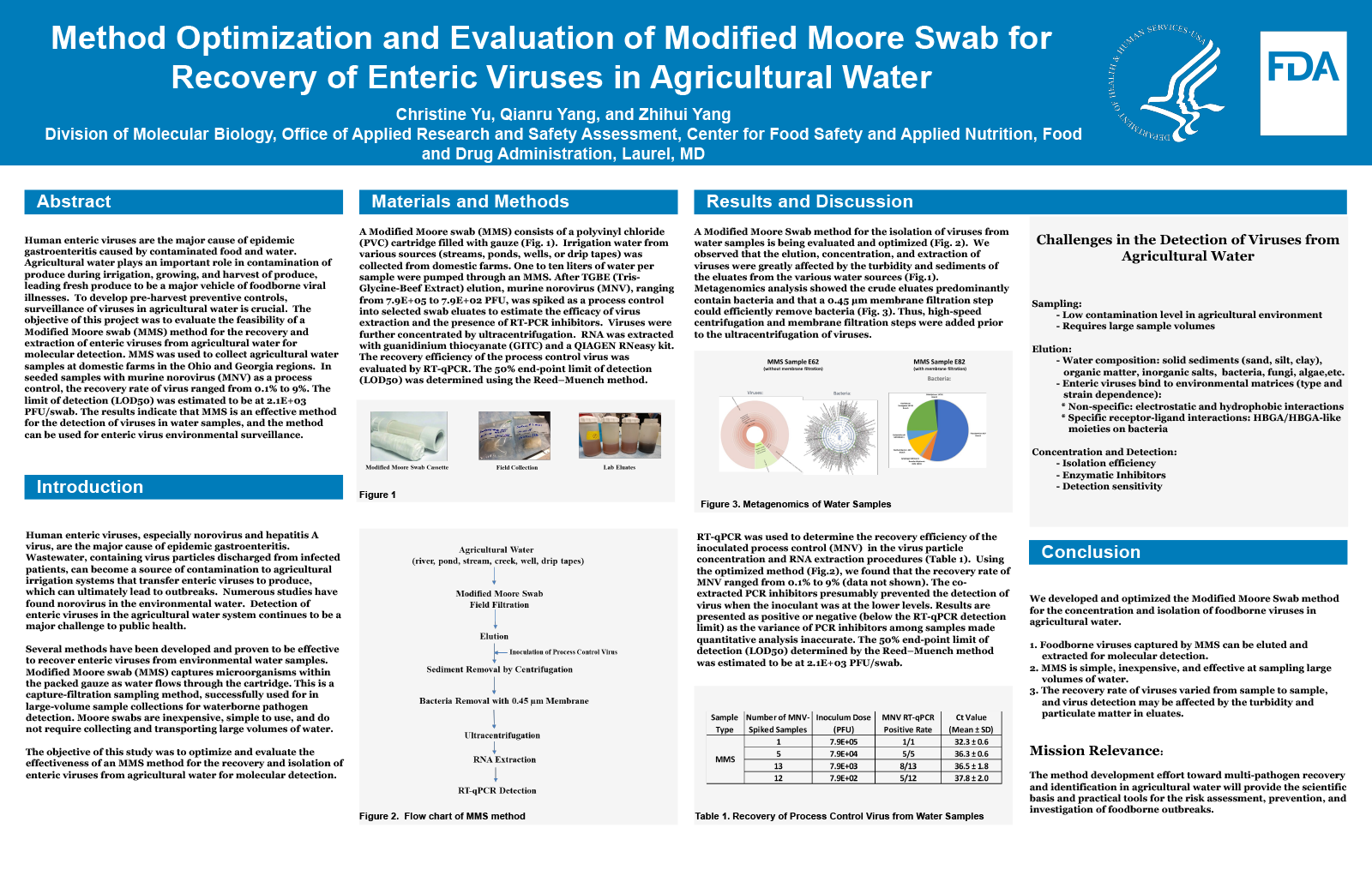
The objective of this project was to optimize and evaluate the modified Moore swabs (MMS) method for recovery and extraction of enteric viruses from agricultural water for molecular detection.
Method:
One to ten liters of water used in farm irrigation systems (streams, ponds, wells, or drip tapes) were collected by MMS, a capture-filtration sampling method. After elution, four serial dilutions of murine norovirus (MNV) ranging from 7.9E+05 to 7.9E+02 PFU were used for inoculation as a process control in 31 samples. Viruses were concentrated by ultracentrifugation. RNA was extracted with guanidinium thiocyanate (GITC) and QIAGEN RNeasy kit. The recovery efficiency of the process control virus was evaluated by RT-qPCR. The 50% end-point limit of detection (LOD50) was determined using the Reed–Muench method.
Results:
We observed that the elution, concentration, and extraction of viruses were greatly affected by the turbidity of the eluates from the various water sources. Metagenomics analysis showed the crude eluates predominantly contain bacteria. Low-speed centrifugation and 0.45 µm membrane filtration steps were added to the method to remove the sediments and bacteria prior to the ultracentrifugation of viruses. Using this method, RT-qPCR found the recovery rate of MNV was between 0.1% and 9%. The LOD50 was estimated to be at 2.1E+03 PFU/swab.
Conclusion:
Foodborne viruses captured by MMS from agricultural water can be eluted and extracted for molecular detection. The method development effort toward multi-pathogen identification in agricultural water will provide the scientific basis and practical tools for the risk assessment, prevention, and investigation of foodborne outbreaks.