2023 FDA Science Forum
Metagenomic Insights into Pet Food Microbiomes and Resistomes
- Authors:
- Center:
-
Contributing OfficeCenter for Veterinary Medicine
Abstract
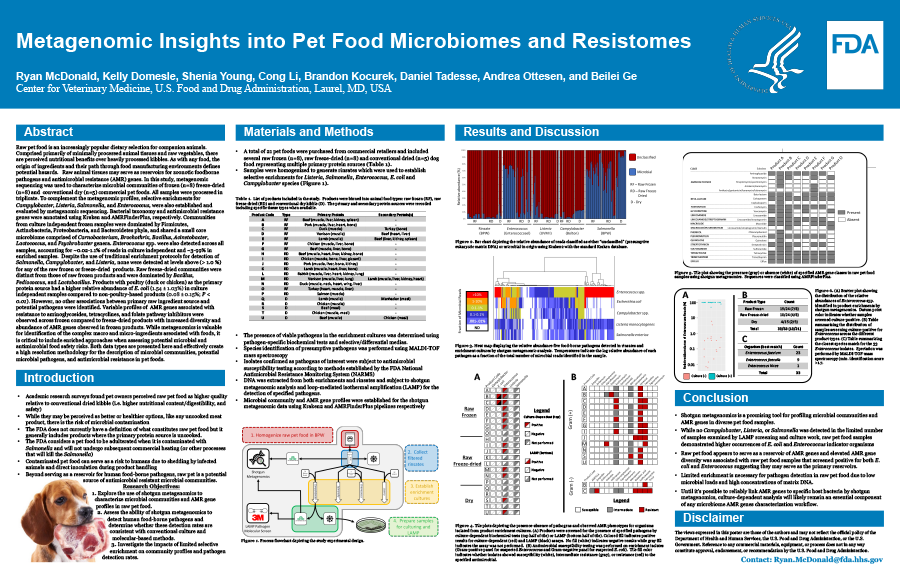
An increasing number of reports have indicated that “raw” pet food can serve as a reservoir for zoonotic foodborne pathogens and antimicrobial resistance genes, and dogs fed raw diets have higher rates of shedding of resistant bacteria in their feces. In this study, shotgun metagenomic sequencing was employed to characterize the microbial communities of frozen (n=7) and freeze-dried (n=7) commercial “raw” pet foods. All samples were processed in triplicate. To complement culture-independent metagenomic profiling, selective enrichments for Campylobacter, Listeria, Salmonella, and Enterococcus were evaluated using shotgun metagenomic sequencing. Bacterial taxonomic classifications and antimicrobial resistance genes were analyzed using Kraken and AMRFinderPlus, respectively.
Communities from culture-independent frozen samples were dominated by Firmicutes, Actinobacteria, Proteobacteria, and Bacteroidetes and shared a small core microbiome consisting of the genera Carnobacterium, Brochothrix, Bacillus, Acinetobacter, Lactococcus, and Psychrobacter. Enterococcus spp. were also detected from all frozen samples, with a relative abundance of ~0.02-1.1% and ~3-99% of in culture-independent and enriched samples respectively. Salmonella, Campylobacter, and Listeria were not detected at elevated levels (> 1.0%) in any of the frozen or freeze-dried products. Freeze-dried communities were distinct from those identified in frozen products and were dominated by the genera Bacillus, Pediococcus, and Lactobacillus. Products with poultry (duck or chicken) as the main protein source had a higher relative abundance of E. coli (1.54 ± 1.03%) in culture-independent samples than non-poultry-based products (0.08 ± 0.15%; P < 0.01).
No other associations between primary protein source and specific foodborne pathogens were detected. Antimicrobial resistance genes conferring resistance to aminoglycosides, beta-lactams, folate pathway inhibitors, glycopeptides, macrolides, phenicols, quinolones, and tetracyclines were detected with considerable variation in antimicrobial gene profiles observed between product types (frozen vs freeze-dried) where higher detection rates and diversity were found in frozen samples. While shotgun metagenomics is a powerful tool for characterizing the microbial communities of diverse environments, the complex nature of pet foods matrices makes the detection of low-abundance pathogens challenging. Continued characterization of foodborne pathogens and resistant bacteria is needed to better understand the risks of these types of pet foods to the health of pets and their owners.