2021 FDA Science Forum
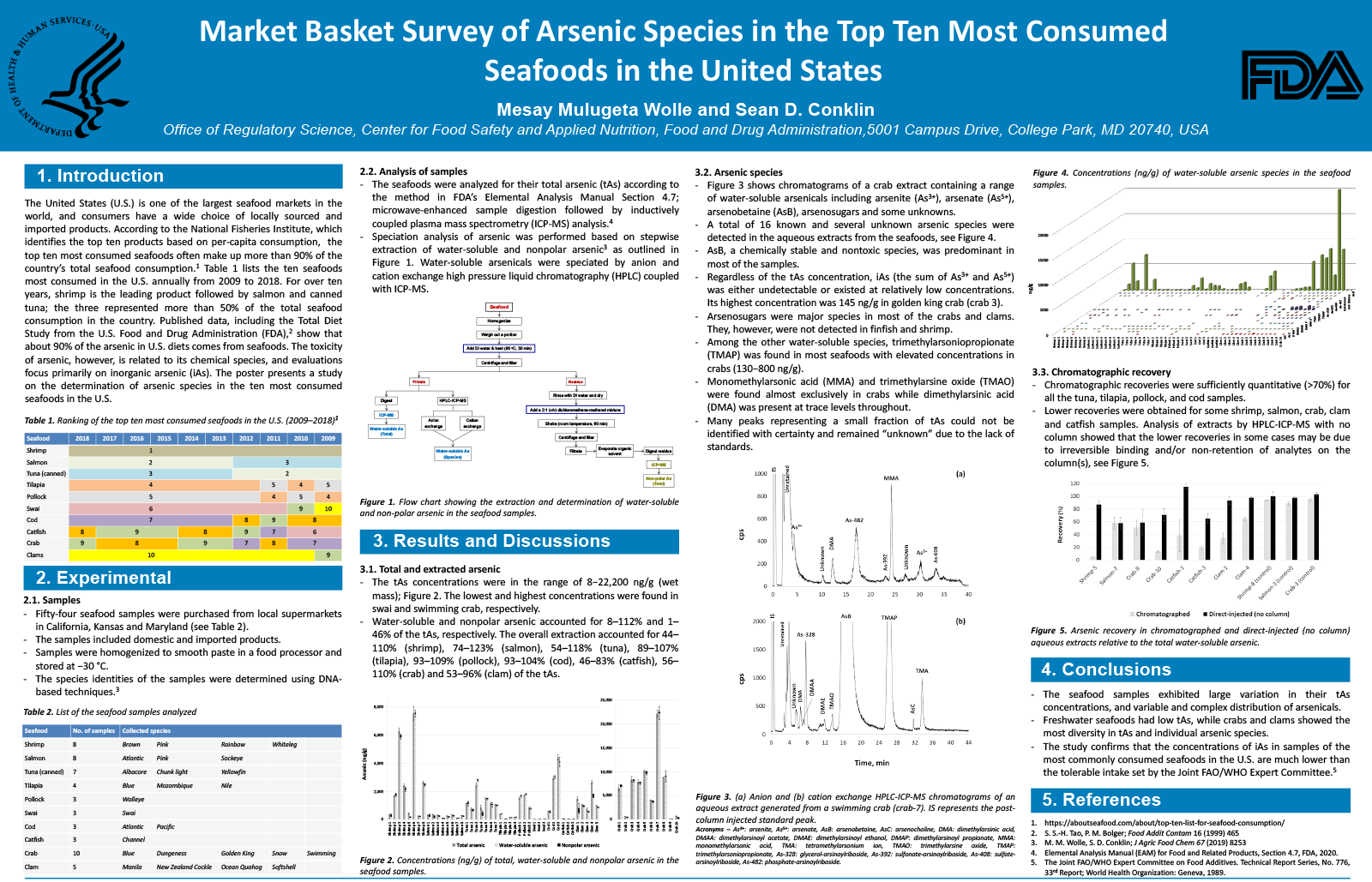
Market Basket Survey of Arsenic Species in the Top Ten Most Consumed Seafoods in the United States
- Authors:
- Center:
-
Contributing OfficeCenter for Food Safety and Applied Nutrition
Abstract
Seafoods, defined here as marine and freshwater fish and shellfish, are regarded as important parts of a healthy diet. The United States (U.S.) is one of the largest seafood markets in the world, and consumers have a wide choice of locally sourced and imported products. Seafoods, on the other hand, have long been known as major sources of human exposure to dietary arsenic. Published data, including the Total Diet Study from the U.S. Food and Drug Administration (FDA), shows that about 90% of the arsenic in U.S. diets comes from seafoods. Since the toxicity of arsenic is a function of its chemical species, most risk assessment practices focus on monitoring inorganic arsenic (iAs), which is a Class I carcinogen. Such an approach may be appropriate for products that accumulate arsenic in a few forms of known properties. The complex distribution of arsenic in seafoods suggests that risk assessment based only on iAs monitoring may not provide sufficient information as it leaves arsenicals of unknown or potential toxicity unidentified. The study reported here focused on the comprehensive speciation analysis of arsenic in the ten most consumed seafoods in the U.S. Fifty-four samples were collected from local supermarkets in three states (California, Kansas and Maryland) and analyzed using a method developed and validated by the FDA. Though not a statistically rigorous sampling, the study nevertheless represents the most comprehensive analysis of arsenic species from seafood in the American diet to date.