2021 FDA Science Forum
Mammographic Image Conversion Using a Conditional Generative Adversarial Network, cGAN
- Authors:
- Center:
-
Contributing OfficeCenter for Devices and Radiological Health
Abstract
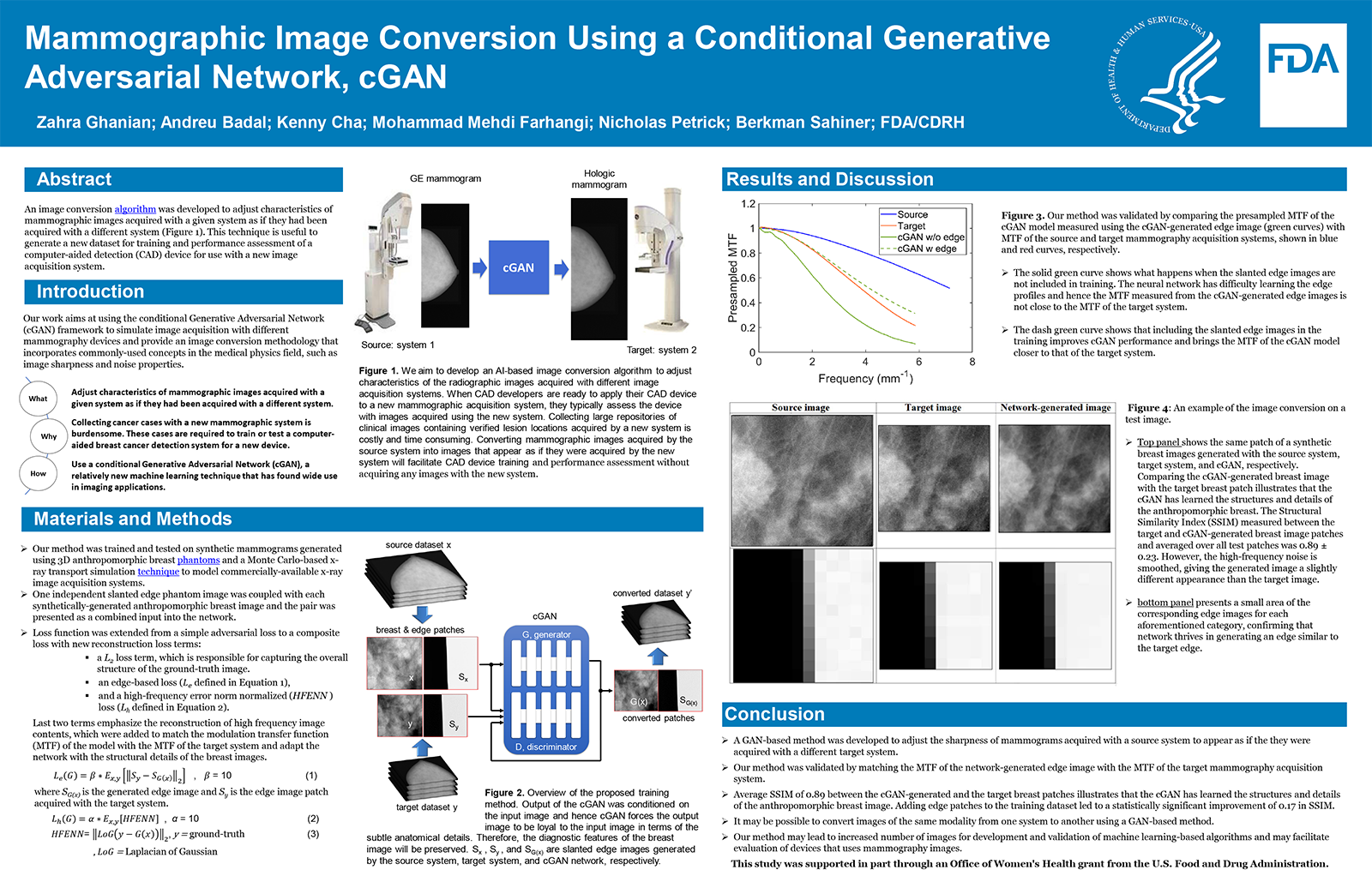
This study aims at developing a machine learning-based image conversion algorithm to adjust quantum noise, sharpness, scattering, and other characteristics of radiographic images acquired with a given imaging system as if they had been acquired with a different acquisition system. Purely physics-based methods which have previously been developed for image conversion rely on the measurement of the physical properties of the acquisition devices, which limit the range of their applicability. This work focused on the conversion of mammographic images from a source acquisition system into a target system using a conditional Generative Adversarial Network (cGAN). This network penalizes any possible structural differences between network-generated and target images. The optimization process was enhanced by designing new reconstruction loss terms which emphasized the quality of high frequency image contents. CGAN model was trained on a dataset of paired synthetic mammograms and slanted edge phantom images. One independent slanted edge phantom image was coupled with each anthropomorphic breast image and was presented the pair as a combined input into the network. To improve network performance at high frequencies, an edge-based loss function was incorporated into the reconstruction loss. Qualitative results demonstrated the feasibility of this method to adjust the sharpness of mammograms acquired with a source system to appear as if the they were acquired with a different target system. This method was validated by comparing the presampled modulation transfer function (MTF) of the network-generated edge image and the MTF of the source and target mammography acquisition systems at different spatial frequencies. This image conversion technique may help training of machine learning algorithms so that their applicability generalizes to a larger set of medical image acquisition devices. This work may also facilitate performance assessment of computer-aided detection systems.