2023 FDA Science Forum
Kratom Related Adverse Event Reports from the FDA CFSAN Adverse Event Reporting System (CAERS)
- Authors:
- Center:
-
Contributing OfficeCenter for Food Safety and Applied Nutrition
Abstract
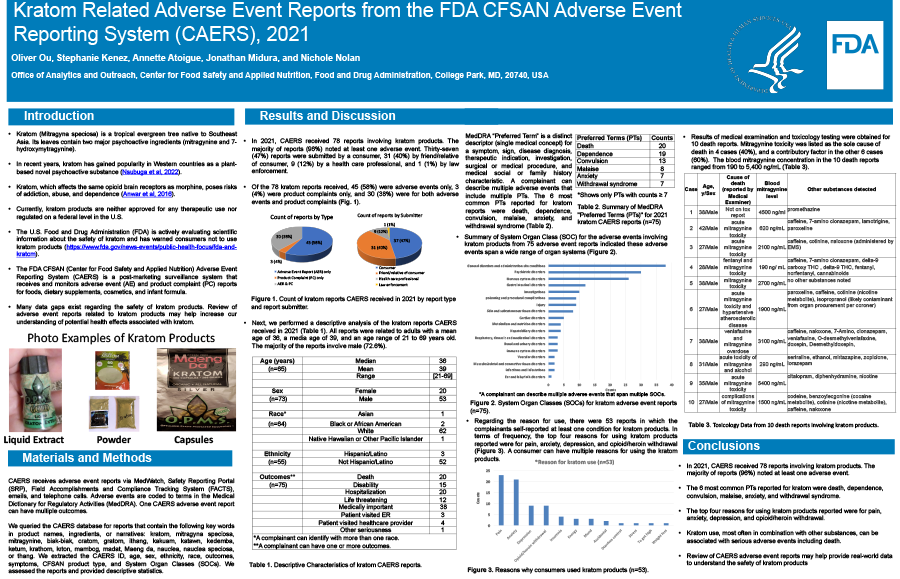
Kratom (Mitragyna speciosa), is a tropical evergreen tree native to Southeast Asia. Its leaves contain two major psychoactive ingredients (mitragynine and 7-hydroxymytragynine). Kratom use in the U.S. continues to rise1. The U.S. Food and Drug Administration is actively evaluating scientific information about the safety of Kratom and has warned consumers not to use Kratom products. The FDA CFSAN Adverse Event Reporting System (CAERS) is a post-marketing surveillance system that receives and monitors adverse event and product complaint reports for foods, dietary supplements, cosmetics, and infant formula. CAERS received 78 reports (75 adverse event reports and 3 product complaints) involving kratom products in 2021. Of these 75 adverse event reports, there were 20 deaths (27%) and 20 hospitalizations (27%). Results of medical examination and toxicology testing were obtained for 10 death reports. Mitragynine toxicity was listed as the sole cause of death in 4 cases (40%), and a contributory factor in the other 6 cases (60%). The blood mitragynine concentration in the 10 death reports ranged from 190 to 5,400 ng/mL. Our data demonstrate that kratom use, most often in combination with other substances, can be associated with serious adverse events including death. CAERS Data do have limitations. For examples, there is no certainty that a suspected product caused a reaction for any given report and the reports submitted to FDA vary in the quality and reliability of the information provided. Despite these limitations, review of adverse event reports may help provide needed real-world data to understand the use and safety of kratom products. 1. Schimmel J, Amioka E, Rockhill K, Haynes CM, Black JC, Dart RC, Iwanicki JL. Prevalence and description of kratom (Mitragyna speciosa) use in the United States: a cross-sectional study. Addiction. 2021 Jan;116(1):176-181. doi: 10.1111/add.15082. Epub 2020 Apr 28. PMID: 32285981.