2021 FDA Science Forum
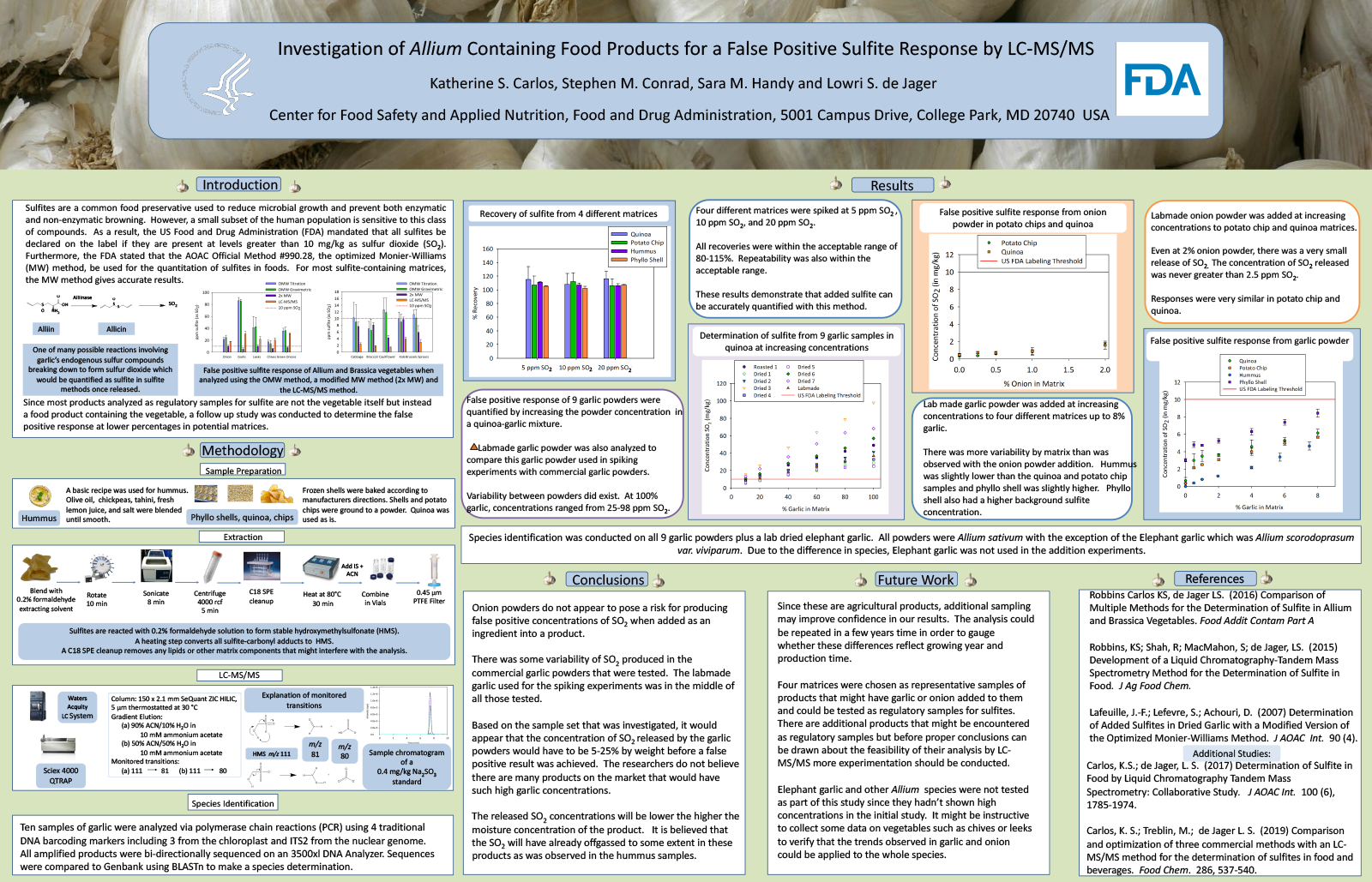
Investigation of Food Products Containing Garlic or Onion for a False Positive Sulfite Response by LC-MS/MS
- Authors:
- Center:
-
Contributing OfficeCenter for Food Safety and Applied Nutrition
Abstract
In the US, sulfites must be declared on the label if they are present in concentrations greater than 10 mg/kg (determined as) SO2 because an allergic-like response has been reported in a small subset of the population upon consumption of sulfite-containing products. The most widely used method for sulfite determination, the optimized Monier-Williams (OMW), produces false positive results with vegetables from the Allium (garlic) and Brassica (cabbage) genera due to extraction conditions that are thought to cause endogenous sulfur compounds to release SO2. Recently, an LC-MS/MS method was developed for sulfites but has only been tested with samples that are 100% Allium or Brassica. Since regulatory samples may contain these vegetables as ingredients, additional investigations were necessary to determine the potential extent of false positives. Four blank matrices, chips, hummus, and quinoa were spiked with various concentrations of onion and garlic powders. The sulfite concentrations were determined using an LC-MS/MS method. The matrix is extracted with a buffered formaldehyde solution, converting free and reversibly bound sulfite to the stable formaldehyde adduct, hydroxymethylsulfonate (HMS). It was determined that even at concentrations up to 8% garlic powder or 2% onion powder, the measured sulfite concentration was below the 10 mg/kg SO2 labeling threshold. Commercial dried garlic powders were evaluated to determine the variation in responses that might be encountered in future regulatory samples. Recovery studies were conducted to determine if these methods would detect added sulfite. The ability to eliminate false positives due to these ingredients will result in a greater reliability in the accurate determination of added sulfite to ensure compliance with labeling requirements.