2023 FDA Science Forum
Investigating the potential of a kidney microphysiological system (MPS) to assess toxicity associated with exposure to chemicals
- Authors:
- Center:
-
Contributing OfficeCenter for Food Safety and Applied Nutrition
Abstract
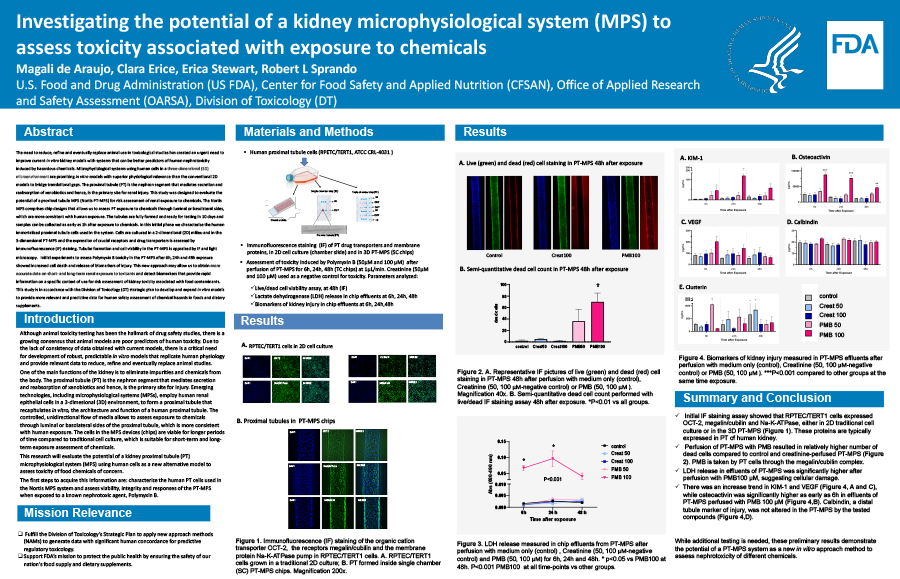
The need to reduce, refine and eventually replace animal use in toxicological studies has created an urgent need to improve current in vitro kidney models with systems that can be better predictors of human nephrotoxicity induced by hazardous chemicals. Microphysiological systems using human cells in a three-dimensional (3D) microenvironment are promising in vitro models with superior physiological relevance than the conventional 2D models to bridge translational gaps. The proximal tubule (PT) is the nephron segment that mediates secretion and reabsorption of xenobiotics and hence, is the primary site for renal injury. This study was designed to evaluate the potential of a proximal tubule MPS (Nortis PT-MPS) for risk assessment of renal exposure to chemicals. The Nortis MPS comprises chip designs that allows us to assess PT exposure to chemicals through luminal or basolateral sides, which are more consistent with human exposure. The tubules are fully formed and ready for testing in 10 days and samples can be collected as early as 1h after exposure to chemicals. In this initial phase we characterize the human immortalized proximal tubule cells used in the system. Cells are cultured in a 2-dimensional (2D) milieu and in the 3-dimensional PT-MPS and the expression of crucial receptors and drug transporters is assessed by immunofluorescence (IF) staining. Tubular formation and cell viability in the PT-MPS is appraised by IF and light microscopy. Initial experiments to assess Polymyxin B toxicity in the PT-MPS after 6h, 24h and 48h exposure showed increased cell death and release of biomarkers of injury. This new approach may allow us to obtain more accurate data on short- and long-term renal exposure to toxicants and detect biomarkers that provide rapid information on a specific context of use for risk assessment of kidney toxicity associated with food contaminants. This study is in accordance with the Division of Toxicology (DT) strategic plan to develop and expand in vitro models to provide more relevant and predictive data for human safety assessment of chemical hazards in foods and dietary supplements.